
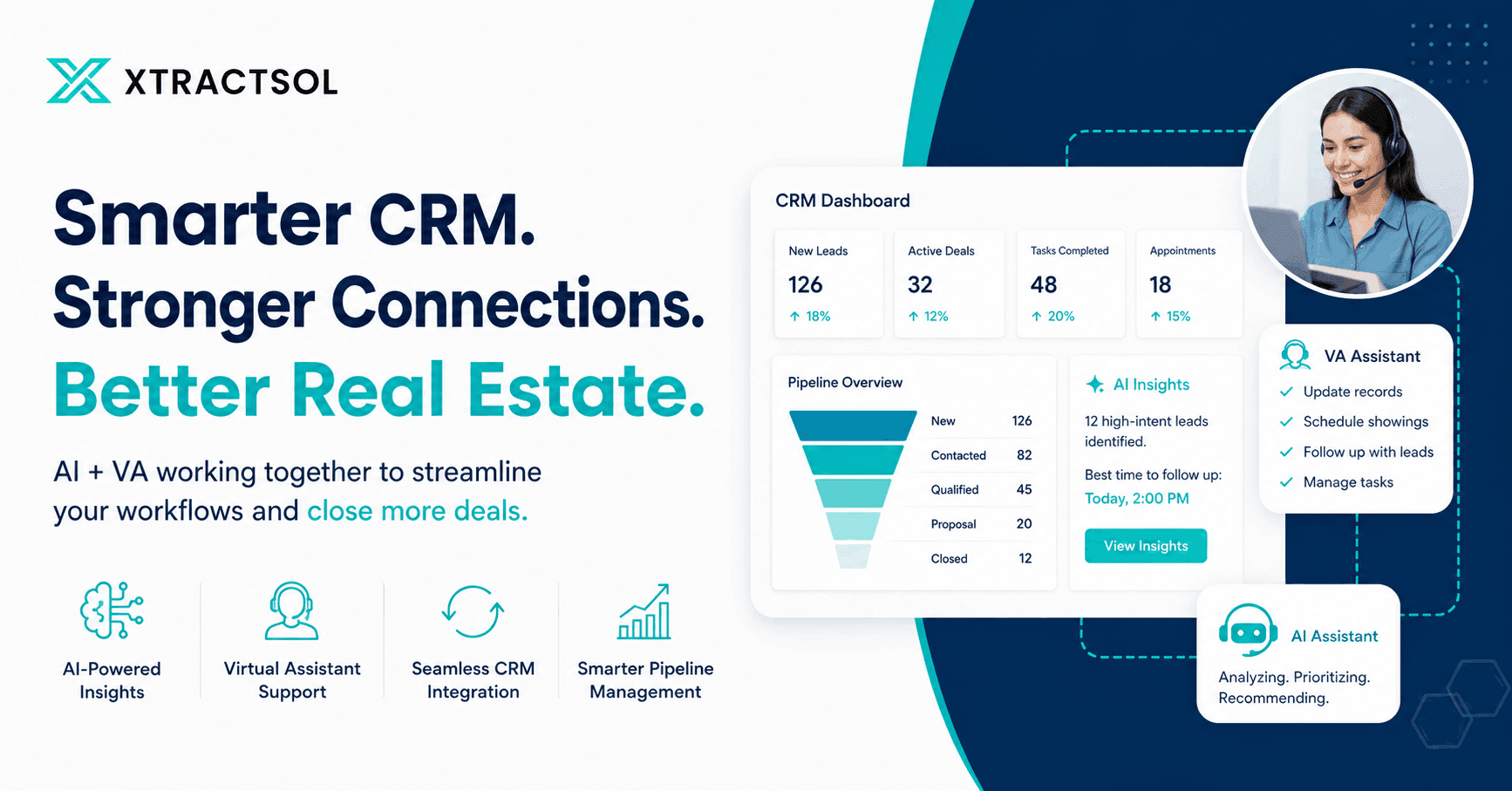
AI Real Estate Assistant: Enhancing CRM & VA Integration for Smarter Real Estate Operations
What is an AI Real Estate Assistant?
An AI real estate assistant is an intelligent software tool that integrates with your CRM (Customer Relationship Management) and Virtual Assistant (VA) systems to automate and optimize real estate operations. It helps manage lead generation, client communication, property searches, scheduling, and other repetitive tasks, allowing agents and operations teams to focus on building relationships and closing deals.
By integrating AI into your CRM and VA workflows, real estate businesses can improve efficiency, reduce manual work, increase data accuracy, and deliver a better client experience.
Understanding an AI Real Estate Assistant's Role in CRM & VA Integration
An AI real estate assistant acts as the connection between your CRM, which stores customer and transaction data, and your virtual assistants, who manage day-to-day communications and administrative tasks.
This integration keeps information synchronized across systems, automates workflows, and ensures timely responses to clients. Instead of manually updating records or tracking follow-ups, AI handles these routine processes while helping your team stay organized and productive.
Key Capabilities and Features
1. Lead Generation & Qualification
Real estate professionals often spend significant time identifying qualified leads. An AI assistant can analyze CRM data, customer behavior, budget, location preferences, and buying intent to identify prospects that are most likely to convert. By automatically prioritizing high-quality leads, your sales team can spend less time on manual screening and more time engaging with serious buyers.
2. Property Search & Recommendations
AI assistants simplify property searches by matching buyer preferences with available listings. Instead of manually reviewing hundreds of properties, agents receive personalized recommendations based on criteria such as:
- Location and neighborhood dynamics
- Price range and financial criteria
- Property type and architectural style
- Amenities and specific lifestyle requirements
This creates a faster and more personalized experience for both agents and clients.
3. Client Communication
Maintaining consistent communication is essential throughout the buying or selling journey. AI assistants can automate emails, text messages, reminders, and responses to common questions. Advanced conversational AI systems can also support voice interactions, helping businesses provide timely, context-aware conversations while reducing the workload on virtual assistants.
4. Scheduling & Follow-Ups
Scheduling property showings, meetings, and follow-up calls often requires multiple communications. AI assistants integrate with calendar and CRM platforms to automatically schedule appointments, send confirmations, and deliver reminders. This minimizes scheduling conflicts, reduces missed appointments, and ensures every lead receives timely follow-up.
5. Property Valuation & Market Analysis
AI-powered tools analyze historical sales data, comparable properties, public records, and market trends to generate property valuations and market insights. These data-driven recommendations help agents advise buyers and sellers with greater confidence.
6. Marketing Automation
AI can automate email campaigns, listing promotions, lead nurturing, and social media marketing based on customer behavior stored in the CRM. Automated marketing ensures consistent communication with prospects while reducing the manual workload for marketing teams.
7. Property Management
AI assistants also support property management by automating tenant communication, maintenance requests, lease reminders, and rent notifications. When integrated with a CRM, these activities provide property managers with a complete view of tenant interactions and property status.
8. Workflow Automation
One of the biggest advantages of AI is workflow automation. By connecting CRM systems, calendars, email platforms, and document management tools, AI streamlines processes from lead intake through closing. This reduces administrative work, minimizes delays, and helps transactions move more efficiently.
Benefits of CRM & VA Integration with an AI Real Estate Assistant
Integrating AI into your CRM and virtual assistant workflows offers several practical benefits:
- Saves Time: Automates repetitive administrative and data-entry tasks.
- Improves Conversion Rates: Swiftly identifies and prioritizes highly qualified prospects.
- Enhances Client Experience: Delivers faster, 24/7 personalized communication.
- Increases Data Accuracy: Minimizes human error and eliminates manual entry inconsistencies.
- Supports Business Scalability: Powers business growth without requiring immediate, significant staffing increases.
- Data-Driven Analytics: Provides valuable metrics and reporting for smarter operational decision-making.
These advantages help real estate businesses improve productivity, reduce operational costs, and create a smoother experience for both agents and clients.
The Future of AI in Real Estate
AI is becoming an increasingly valuable tool for the real estate industry. As technology continues to evolve, AI assistants will support more advanced capabilities such as compliance monitoring, contract review, predictive market analysis, and intelligent document processing.
Future AI solutions will combine voice, text, and document intelligence to provide more personalized recommendations, automate complex workflows, and help real estate professionals make faster, more informed decisions.
Frequently Asked Questions
How does an AI real estate assistant differ from a traditional virtual assistant?
A traditional virtual assistant typically performs predefined administrative tasks. An AI real estate assistant goes further by using machine learning and natural language processing to understand context, analyze data, automate backend workflows, and make intelligent recommendations based on history.
Can AI assistants integrate with existing CRM systems?
Yes. Most AI assistants are designed to integrate with existing CRM platforms through robust APIs, allowing data to flow seamlessly between systems without needing to replace your current software suite.
Will AI replace human agents or virtual assistants?
No. AI is designed to support—not replace—real estate professionals. It handles repetitive, data-heavy tasks so agents and virtual assistants can focus their energy on relationship building, negotiations, strategic problem-solving, and other activities that strictly require human empathy and expertise.
Which real estate businesses benefit the most from AI assistants?
Brokerages, property management companies, title companies, and real estate investment firms with high lead volumes or complex multi-step workflows can benefit significantly from AI-powered CRM and virtual assistant integration.
To learn more about AI-powered automation for the real estate industry, explore XtractSol's Real Estate Automation Solutions.
More posts
Product notes, how we build, and what we are learning.

Ready to get started?
Book a free discovery call and we will map how agentic AI can fit your workflows.