
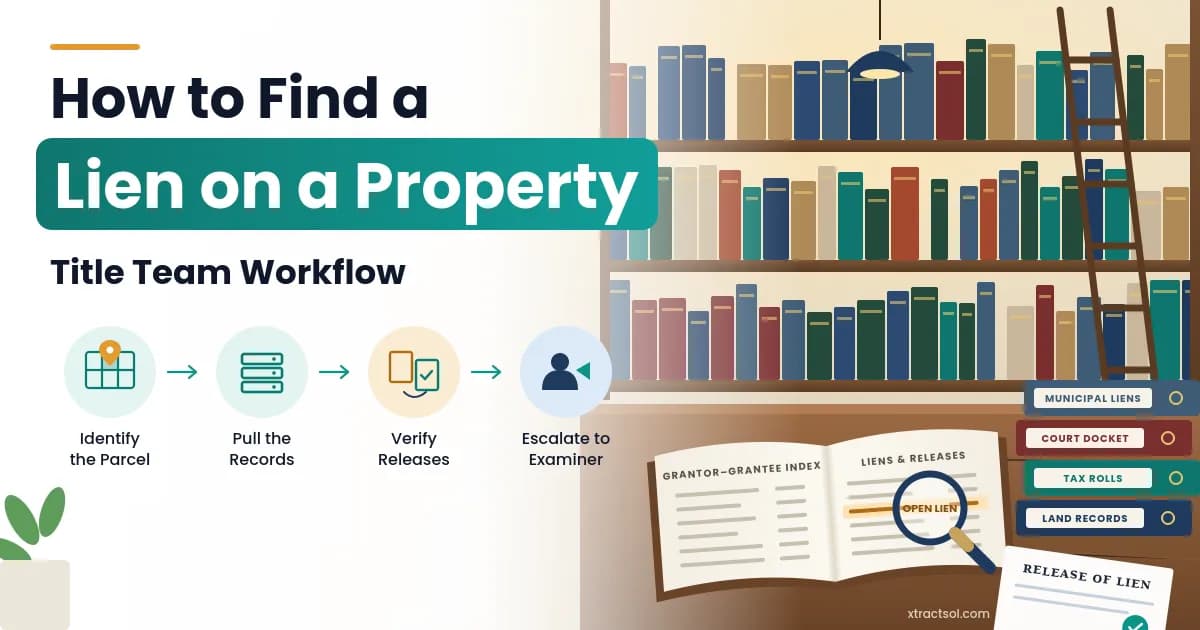
How to Find a Lien on a Property: Title Team Workflow
By Usama Muneer, Founder & CEO
• 7 min read • Updated
On This Page
Unresolved liens stall closings, and finding every lien on a property is core work for every title team. A single missed judgment, tax claim, or unreleased mortgage can send a file back to underwriting just days before the scheduled funding. XtractSol Agents help examiners search county land, tax, and court records in one pass, so the title review starts sooner. ALTA's explanation of title insurance facts describes why title searches follow party names through recorded indexes, and that trail is where most lien misses begin. A clean file starts with a complete paper record, not a lucky search.
Key Takeaways
- Liens are voluntary (mortgage) or involuntary (tax, judgment, mechanic's).
- County land records, tax rolls, court dockets, and municipal files hold different liens.
- General liens follow the debtor; specific liens attach to one parcel.
- Unreleased liens and name variations cause the costliest misses.
What Types of Property Liens Can Attach to Real Estate?
A property lien is a legal claim against real estate that secures a debt, and it stays on the record until the debt is paid and a release is recorded, or a court removes it.
Voluntary liens, like a mortgage, need the owner's consent. Involuntary liens, such as tax claims, judgment liens, and mechanic's liens, arise when a debt goes unpaid or a court orders payment.
Federal tax liens are general; county property tax liens are specific to a parcel. Judgment liens attach when a creditor records a judgment where the property sits. Mechanic's liens protect contractors who improved the parcel without payment.
In Torrens states, a court-issued certificate of title is conclusive proof of ownership, unlike title insurance, which covers title defects.
How Do You Find a Lien on a Property?
To find a lien on a property, search county land records, tax rolls, the judgment docket, and municipal lien files, then confirm each hit against the recorded document.
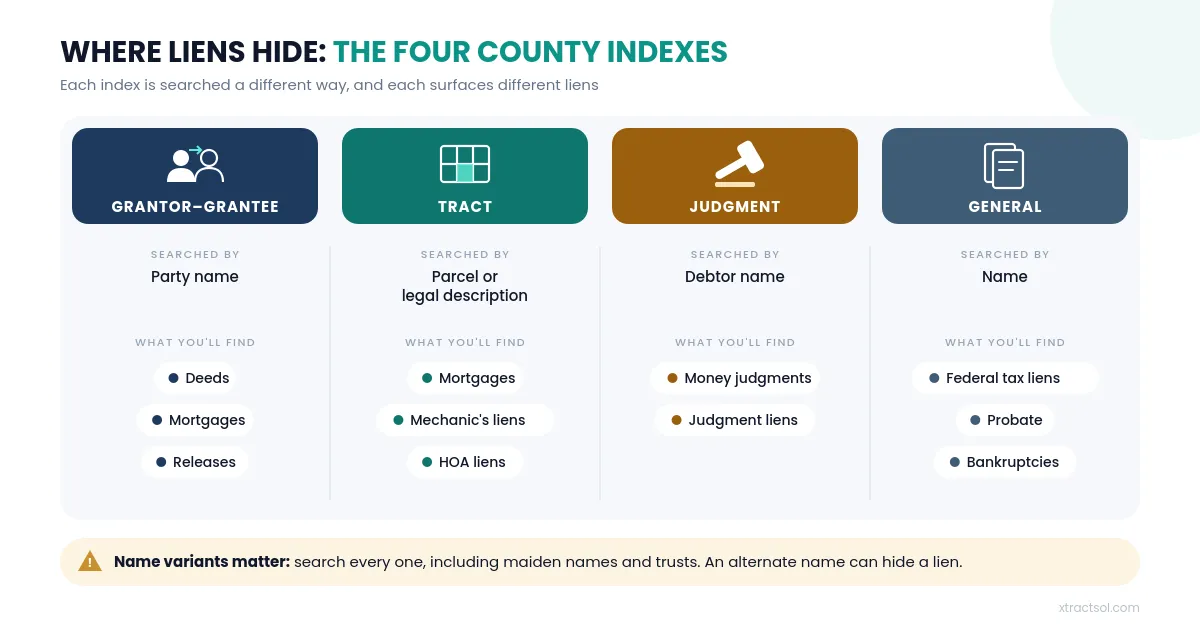
The county recorder holds deeds, mortgages, and releases. The tax collector tracks taxes and assessments. The court clerk keeps the judgment docket. City offices may hold code enforcement or utility liens missing from the land index.
- Grantor-grantee: deeds, mortgages, and releases by party name.
- Tract: instruments by parcel or legal description.
- Judgment: money judgments by debtor.
- General: probate, tax liens, and bankruptcies.
Search every name variant, including maiden names and trusts. An alternate name can hide a lien.
What Does a Professional Lien Search Workflow Look Like?
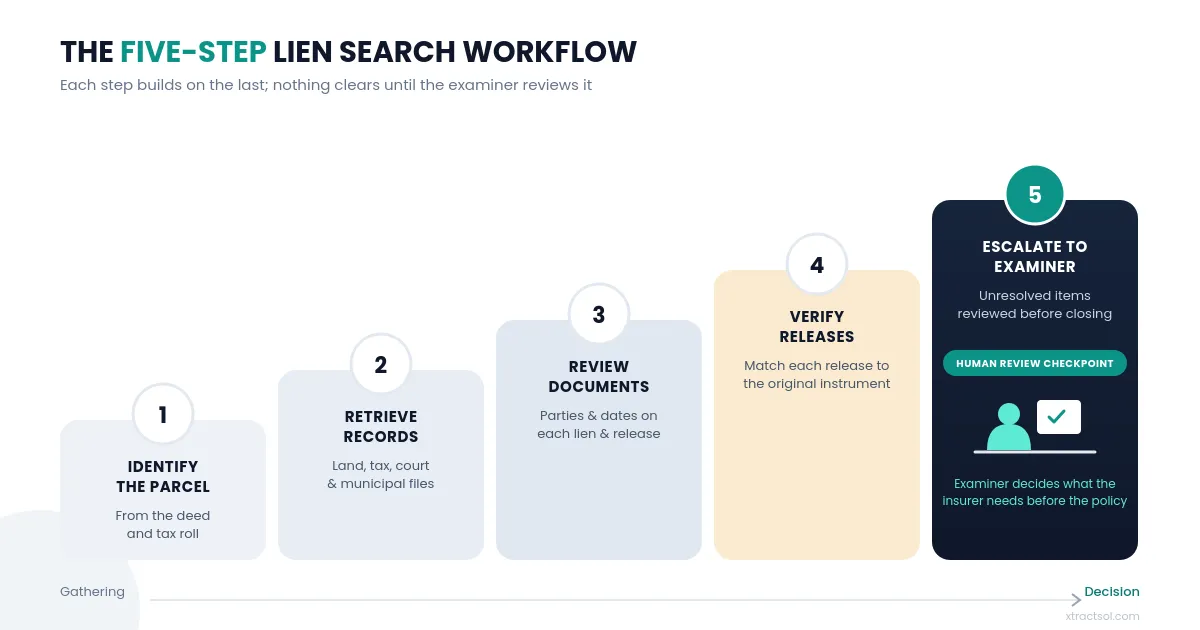
A professional lien search follows five steps: identify the parcel, retrieve records, review documents, verify releases, then escalate unresolved items to the examiner.
- Identify the current parcel from the deed and tax roll.
- Pull land, tax, court, and municipal records.
- Read each lien, judgment, and release for parties and dates.
- Match each release to the original recorded instrument.
- Route all unresolved items to the examiner before closing.
Escrow officers order payoff demands and coordinate closing. Examiners decide what the insurer needs before a title policy issues, and the team satisfies or removes those final requirements.
General Lien vs. Specific Lien: What's the Difference?
A general lien attaches to all property a debtor owns, while a specific lien attaches only to a named parcel.
Judgment liens and federal tax liens are general. Mortgages, property tax liens, HOA liens, and mechanic's liens are specific because they name the parcel.
A recorded judgment can cloud title to every property the debtor owns in that county. A specific lien affects only its parcel.
A bankruptcy discharge does not remove a lien. A judicial lien may be avoided under 11 U.S.C. § 522(f) only when it impairs an allowed exemption and a court orders it. Tax liens and mortgages generally survive unless separately resolved.
Why Do Unreleased Liens Create Title Risk?
An unreleased lien stays in the public record until a release, satisfaction, or court order is recorded, even after the debt is paid.
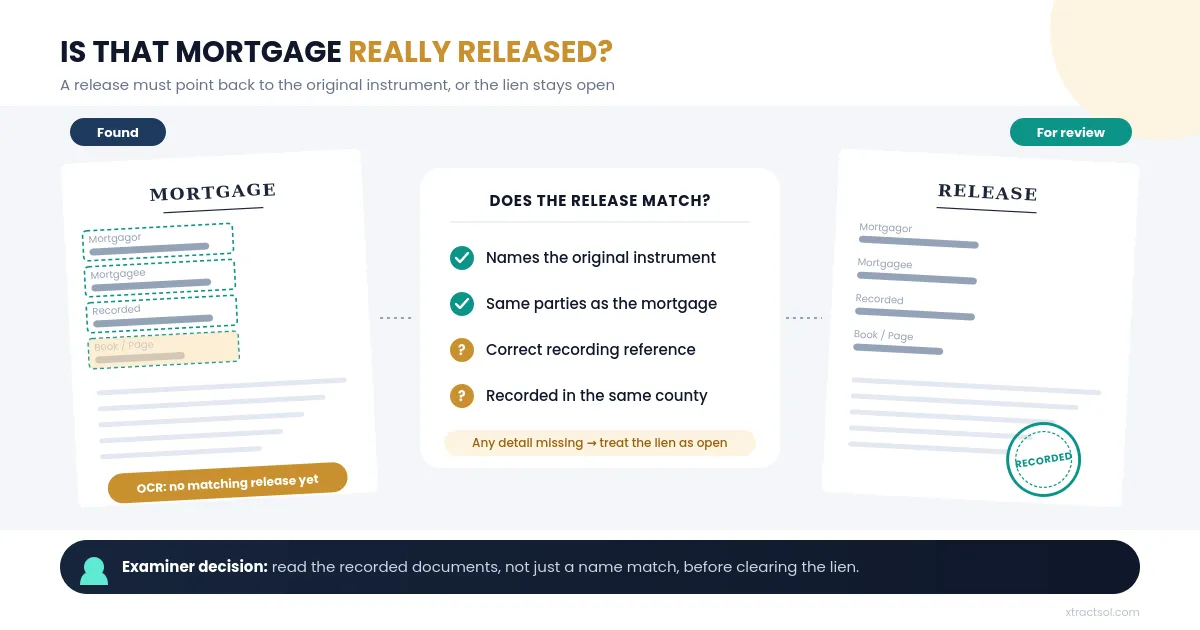
Old mortgages that were paid but never released stay open in the record until a release or satisfaction is recorded. They stay in the grantor-grantee index and can surface years later during a refinance.
A release might be indexed under another name, scanned poorly, or recorded in a different county. Title risk assessment depends on reading the recorded document, not a name match. A release should name the original instrument, parties, and recording reference. If any details are missing, the examiner treats the lien as open until corrected.
Implementation & Operational Considerations for Lien Research
Best Practices for Title Companies
A strong lien process uses a checklist, a second review, and an escalation path.
- Log each source, date, and name.
- Send open items to the examiner before promising a closing date.
The Agents search county land, tax, and court records in one pass. OCR flags unreadable pages, so the team reviews instead of gathers. Examiners still make title decisions.
County Coverage and Workflow Rollout
Some counties offer searchable indexes; others require portals, microfiche, or a visit.
Map the record types, counties, and handoff between search, title examination, and escrow. Add a QA step for the legal description and party. Keep evidence of each search, and use a documented automated title search process so review stays repeatable.
Conclusion
Finding a lien on a property is a records problem before it is a closing problem. The team has to know where each lien type is recorded, which index applies, and when a hit is fully resolved. Manual searches still depend on name accuracy, county coverage, and document review. The Agents reduce the gathering load while examiners keep the judgment call, so a team can handle more files without lowering the review standard.
See where AI fits in your title workflow.
Book a free 30-minute workflow review. Bring the counties you work in and the record types your team handles today. We will walk through the handoffs that slow the file down.
Book a Free 30-Minute Workflow Review
Frequently Asked Questions
Search county land records, tax rolls, the court docket, and municipal lien files. Confirm each hit against the recorded document, and check for a release before treating the debt as paid.
Most liens are recorded with the county recorder or clerk. Tax liens sit in county tax collector records, judgment liens in court dockets, and some claims in local city files.
Yes, a house can be sold with an active lien, but the lien must be paid or released before the lender's underwriting conditions are met and the title policy can issue.
About the Author
Usama Muneer is the Founder and CEO of XtractSol. XtractSol is the AI automation partner for title & escrow teams, from order intake to post-closing, built by engineers who've automated title work since 2024.
See where AI fits in your title workflow.
Stay Updated
Get the latest insights on AI and automation delivered to your inbox.
On This Page
See where AI fits in your title workflow.
Stay Updated
Get the latest insights on AI and automation delivered to your inbox.
More posts
Product notes, how we build, and what we are learning.

Title Search
What is a judgement lien? A 2026 Guide for Title Teams
What is a judgement lien, and how does it block a closing? Learn how liens attach, how long they last, and how title teams clear them before closing.
Read more
Title Search
Assignment of Mortgage: What Title Teams Need to Know
What is an assignment of mortgage? Learn what it transfers, how MERS and county recording affect the chain of assignments, and how title teams cure gaps.
Read more
Title Search
Why Is It Important to Publicly Record a Deed? Risks & Process
Why record a deed? Recording gives public notice, protects priority against later buyers, and keeps the chain of title traceable. See how the process works.
Read more
Ready to get started?
30 minutes. We walk one of your files from order to closing and send a one-page note on the 2-3 steps worth automating first.