
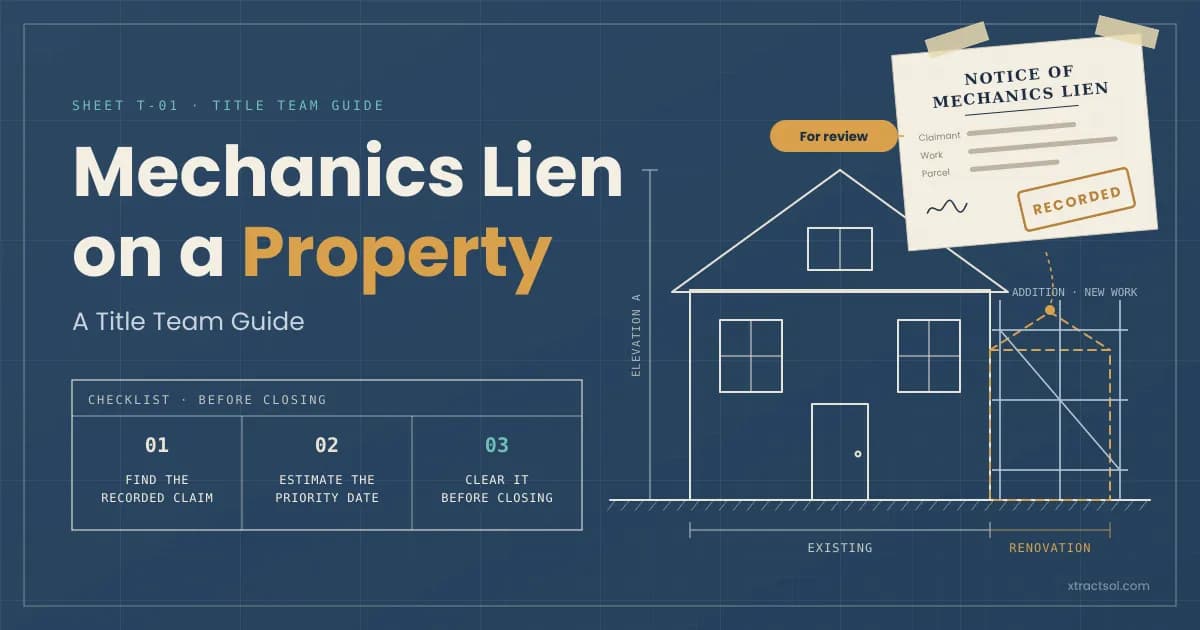
Mechanics Lien on a Property: A Title Team Guide
By Usama Muneer, Founder & CEO
• 6 min read
A mechanics lien on a property can appear weeks before closing, even when the seller believes every contractor was paid in full. Title teams see the pattern often. A finished renovation, a subcontractor who never received the final draw, and a recorded claim can quietly stall the lender's title condition. XtractSol Agents search county land, tax, and court records in one pass so examiners can review construction claims sooner. A January 2026 ALTA Insights webinar on commercial deals covers the risk, documentation and title insurance coverage for mechanic's liens. The claim cannot quietly wait until closing or the wire moves.
Key Takeaways
- A construction lien is a statutory claim for unpaid work on an improved parcel.
- Priority can relate back to the first work date, not the filing date.
- Title teams resolve claims with a release, payoff, bond, or escrow holdback.
What Is a Mechanics Lien on a Property?
A mechanics lien is a statutory claim recorded against a property by a contractor, subcontractor, or supplier who was not paid for labor, materials, or services that improved the parcel.
The lien, also called a construction lien or contractor lien, arises by law, not contract, and runs with the land. The claimant records it with the county recorder, creating a cloud on title. In Torrens states, the claim is handled against the registered title.
Who Can File a Mechanics Lien Against a Property?
A general contractor, subcontractor, material supplier, or laborer can file if state law gives that party lien rights and the required notices were served.
Most states require a preliminary notice. A missed notice can end the claim. Public projects use a bond claim.
How Does Mechanics Lien Priority Work?
In most states, a mechanics lien's priority relates back to the first visible work or first delivery on the project, not the date the lien is recorded.
A construction lien recorded late can sit ahead of a mortgage recorded after work began, depending on state law. A mortgage recorded before work began usually keeps its place.
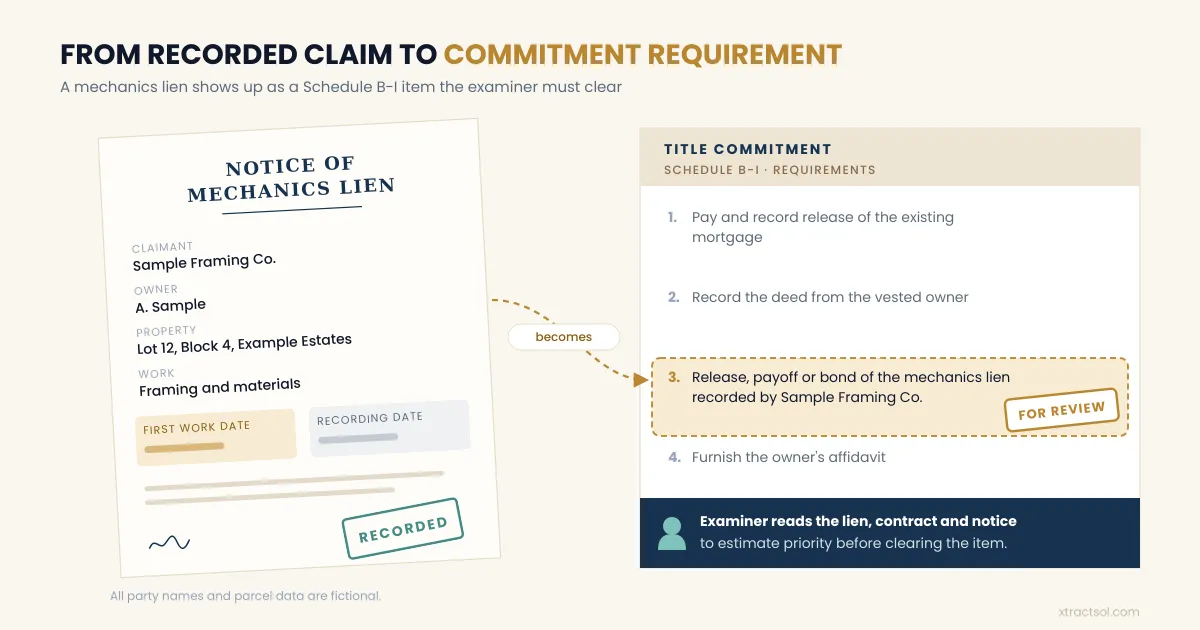
The risk is a silent priority date. A title search shows the recording date, not when work began. The examiner reads the lien, contract, and any notice of commencement to estimate priority.
How Do Mechanics Liens Affect a Home Sale and Closing?
A recorded construction lien clouds title, so the seller must pay, release, bond, or otherwise resolve it before the buyer's lender will fund and the policy can issue.
The claim often gets paid from proceeds, or the closing date moves while the claimant provides a release. Clear title has no open claims, marketable title is free of reasonable doubt, and insurable title is what an underwriter will accept with exceptions.
What Title Companies Review at Closing
The title company searches the indexes, lists the claim in the title commitment, and collects documents to satisfy or remove the requirement.
Schedule A identifies the proposed insured, the vested owner, the policy amount and the legal description; Schedule B-I lists requirements, and Schedule B-II lists exceptions. The escrow officer coordinates payoff; the examiner decides what evidence the insurer needs.
Mechanics Lien vs. Judgment Lien: What's the Difference?
A construction lien is a statutory claim tied to one improved parcel, while a judgment lien is a general lien created by recording a court judgment against a debtor.
A construction lien starts with unpaid work. A judgment lien often starts when a creditor records an abstract of judgment, reaching every parcel the debtor owns there.
A judgment lien dates from recording; a construction lien may relate back to work start. A bankruptcy discharge does not remove a lien. A court may avoid a judicial lien under 11 U.S.C. § 522(f) only when it impairs an allowed exemption, not a statutory construction lien.
How Is a Mechanics Lien Removed?
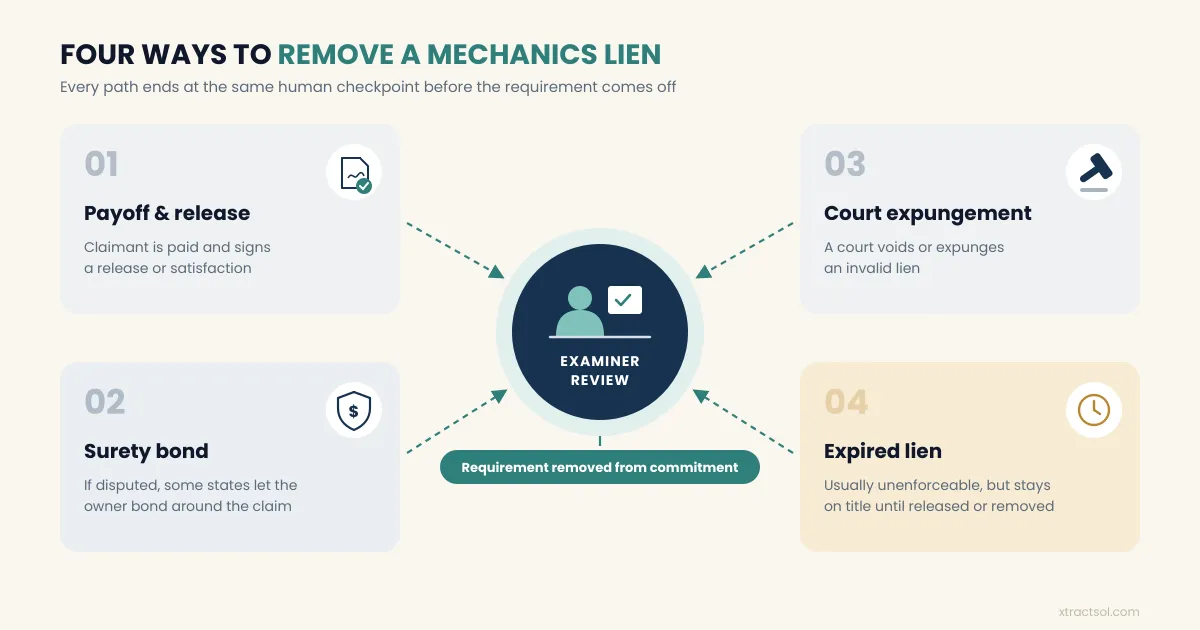
A mechanics lien is removed by recording a release after payment, bonding around the claim, or obtaining a court order that voids or expunges it.
Payment is the simplest path. The claimant signs a release or satisfaction. A conditional waiver releases rights when payment clears; an unconditional one releases them on signature.
If the claim is disputed, some states let the owner record a surety bond to release the land. If the lien is invalid or expired, a court can expunge it.
Implementation & Operational Considerations
A construction lien check starts before escrow, not at the closing table.
Order a municipal and builder lien search when the file opens. Grantor-grantee searches run by party name, tract searches by legal description, judgment indexes hold money judgments, and general indexes hold probate, tax, and bankruptcy matters.
Ask the seller for a payment history and final waivers from the general contractor and subcontractors.
Check contractor licensing in state databases. The Agents search county land, tax, and court records in one pass, and OCR flags unreadable pages.
Conclusion
A mechanics lien on a property is a records problem, a priority problem, and a closing problem. The team has to find the recorded claim, estimate the priority date, and confirm that the release, payoff, bond, or court order removes the requirement. Manual searches depend on name accuracy, county coverage, and careful document review. The Agents reduce the gathering load while examiners keep the judgment call, so the team can handle files without lowering standards.
See where AI fits in your title workflow.
Book a free 30-minute workflow review. Bring the counties you work in and the claims your team handles. We will walk through the handoffs that slow the file down.
Book a Free 30-Minute Workflow Review
Frequently Asked Questions
A recorded construction lien blocks the lender's title condition until the seller pays, releases, bonds, or otherwise resolves the claim. The payoff often comes from the sale proceeds at closing.
General contractors, subcontractors, suppliers, and laborers can file when state law grants lien rights and they meet all the project notice and deadline rules. Some states also include design professionals.
State mechanics lien laws set a recording deadline after the last work and a separate deadline to file a foreclosure lawsuit. Missing the enforcement deadline usually makes the lien unenforceable.
About the Author
By Usama Muneer, Founder & CEO
Usama writes about title search operations and practical automation for title and escrow teams.
XtractSol Agents prepare the search package from public records; examiners make every title decision.
See where AI fits in your title workflow.
Stay Updated
Get the latest insights on AI and automation delivered to your inbox.
See where AI fits in your title workflow.
Stay Updated
Get the latest insights on AI and automation delivered to your inbox.
More posts
Product notes, how we build, and what we are learning.

Title Search
Satisfaction of Mortgage: Resolving Unreleased Liens
A satisfaction of mortgage releases a paid-off lien, but only when it is recorded. See how title teams verify releases and resolve unreleased mortgage issues.
Read more
Title Search
What is a judgement lien? A 2026 Guide for Title Teams
What is a judgement lien, and how does it block a closing? Learn how liens attach, how long they last, and how title teams clear them before closing.
Read more
Title Search
Assignment of Mortgage: What Title Teams Need to Know
What is an assignment of mortgage? Learn what it transfers, how MERS and county recording affect the chain of assignments, and how title teams cure gaps.
Read more
Ready to get started?
30 minutes. We walk one of your files from order to closing and send a one-page note on the 2-3 steps worth automating first.