

Manual vs Automated Title Search: What’s the Difference?
By XtractSol Team
• 6 min read • Updated
A closing file lands at 4:15 on a Friday, and the search is still manual: deeds pulled county by county, liens checked in three separate indexes, and a 1978 deed naming a grantor whose name changed spelling on a later mortgage. That is where title teams lose the week. Manual vs automated title search comes down to one trade: hand searching buys accuracy with labor, while automation retrieves records fast and leaves judgment to your examiners.
Key Takeaways
- Manual title search has an examiner rebuild the chain of title by hand.
- Automated title search software uses OCR and language models to extract records.
- Automation shortens retrieval, not the examiner's risk decisions.
- High-volume, multi-county files gain the most.
What Is the Difference Between Manual and Automated Title Search?
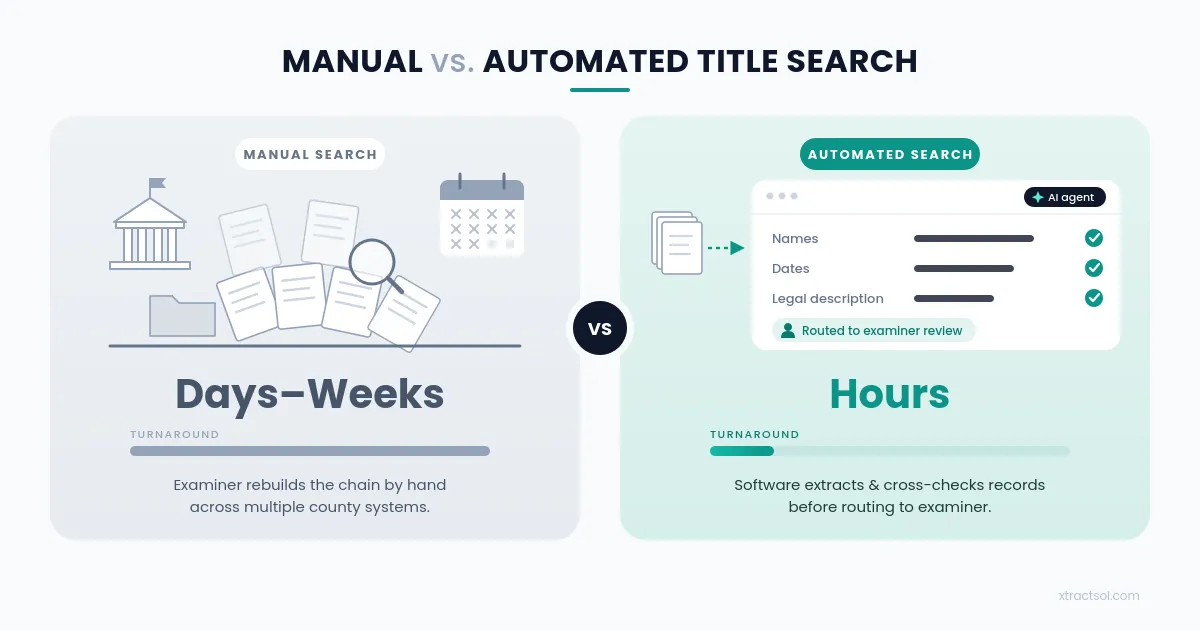
Manual title search is the traditional process in which a title examiner or abstractor reads county records by hand to rebuild the chain of title, while automated title search uses software to extract, index, and cross-check those same records. Both answer the same question: who owns the property and what claims sit against it.
| Step | Manual title search | Automated title search |
|---|---|---|
| Record retrieval | Abstractor requests documents county by county | Software pulls records from connected county sources |
| Data extraction | A person types names, dates, and legal descriptions | OCR and language models read the document text |
| Chain of title | Rebuilt by hand from the oldest deed forward | Rebuilt and cross-checked against prior records |
| Issue review | Examiner reads every lien, judgment, and easement | Examiner starts with the flagged items; every finding links to its recorded document |
| Turnaround | Days to weeks on a complex file | Hours for retrieval, with examiner review after |
Why Does Manual Title Search Slow Down Closings?
A manual search slows a closing because one person must find, read, and reconcile records spread across dozens of county systems.
County recorder offices do not share a format. Some publish searchable indexes, while others still scan microfilm or require a courthouse terminal visit.
Older records add friction. A 1954 deed may name J. A. Whitfield, while the 1972 mortgage releasing it says James Albert Whitfield. A person can tell; a keyword search cannot.
In ALTA's 2026 study, 21% of purchase files needed review of more than 50 documents (ALTA summary). Miss one judgment or unreleased mortgage, and the defect moves into the commitment.
How Does Automated Title Search Software Handle Older County Records?
Automated title search software reads older records by converting scanned images into text, then extracting names, dates, and legal descriptions. Our guide to automated title search covers the full pipeline.
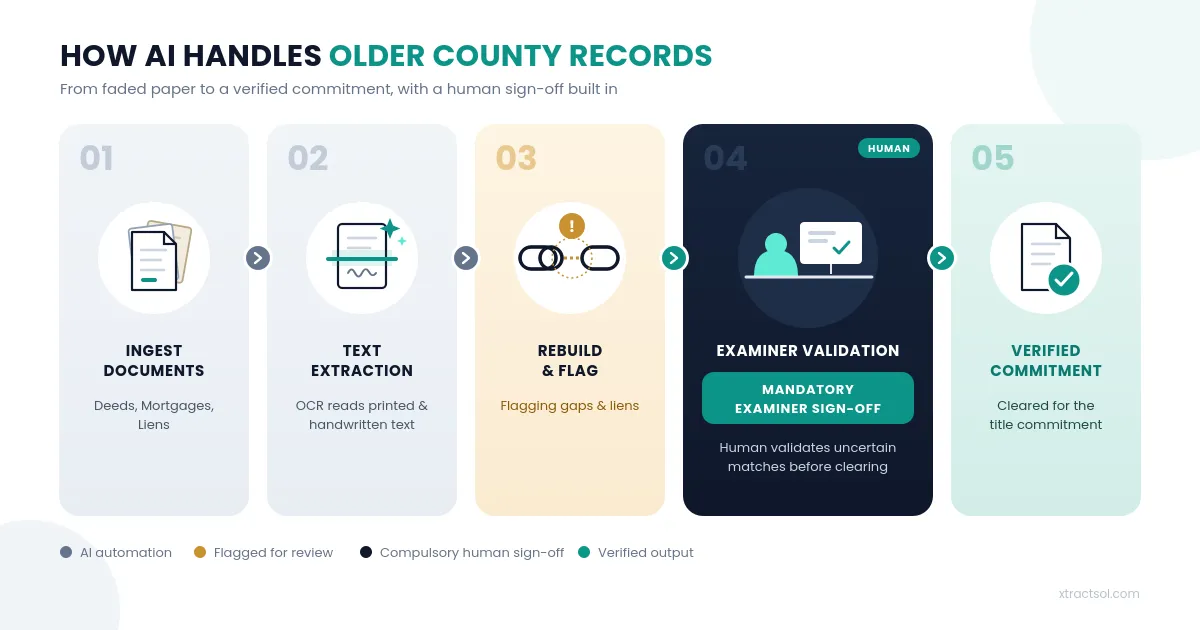
- Ingest and classify records. The platform pulls deeds, mortgages, liens, judgments, and tax records.
- Extract text with OCR and NLP. OCR reads the page, and language processing finds the grantor, grantee, and recording date.
- Rebuild the chain of title. The system links transfers in date order and flags gaps, like a deed with no matching prior owner.
- Flag liens and encumbrances. Rules and models surface claims on the property, such as a mechanic's lien or an old encumbrance.
- Route low-confidence items to a person. Poor scans or uncertain matches go to an examiner for human-in-the-loop validation.
What Changes for Title Teams After Automation?
The clearest change is title search turnaround time. Retrieval and indexing move from days to hours, so examiners start with an organized file.
Cost changes shape rather than disappearing. A manual search costs labor hours that grow with volume and rework. Automation adds a platform cost and trims those hours, so the math favors teams running steady multi-county volume.
Compliance sits on two tracks. State insurance departments and underwriters set what a search must cover. The federal TRID disclosure timeline, run by the Consumer Financial Protection Bureau (CFPB), puts its own clock on the loan file. Automation helps by keeping an audit trail: every extracted field can point back to its source page.
Implementation and Pricing
The main cost drivers are search volume, county and state coverage, integration depth, and how much human review stays in the workflow.
Integration is the part teams underestimate. The platform must talk to your existing title production software, document storage, and often your underwriter's systems. Clean API access makes that manageable. Systems with no API may need a file-based handoff.
A practical rollout starts with your highest-volume counties, runs automated output beside the manual process for a set period, and compares exception quality before you commit the full book. XtractSol scopes pricing per operation because coverage and integration effort vary.
Conclusion
Manual title search works, but it is expensive at scale every day, and its cost lands on the examiners whose judgment you need most. Every hour an abstractor spends clicking county sites is an hour not spent on liens, encumbrances, and file quality.
Automated title search moves retrieval and indexing to software and keeps the examiner in charge of the risk decisions. The question is which parts of your search a machine should handle and which should stay with a person. That split keeps turn times predictable without giving up examiner judgment. XtractSol builds it into a working title workflow.
Ready to Automate Your Title Searches?
See where automation fits. Our title search automation services connect record retrieval, extraction, and examiner review in one workflow, so your team spends its hours on risk.
Frequently Asked Questions
It depends on the record. Automation is more consistent at extraction and indexing, but it still flags uncertain matches for a reviewer, so accuracy comes from the human check.
No. Automated title search software handles retrieval and data extraction. Title examiners still decide ownership, insurability, and whether a defect needs curing, which a platform cannot.
Often, yes. OCR and language models can read most scanned documents; handwriting and poor scans go to a person., though poor scans or missing pages may need manual handling. Test your busiest jurisdictions first.
About the Author
XtractSol is the AI automation partner for title & escrow teams, from order intake to post-closing. Built by engineers who've automated title work since 2024.
See where AI fits in your title workflow.
Stay Updated
Get the latest insights on AI and automation delivered to your inbox.
See where AI fits in your title workflow.
Stay Updated
Get the latest insights on AI and automation delivered to your inbox.
More posts
Product notes, how we build, and what we are learning.
Title Search
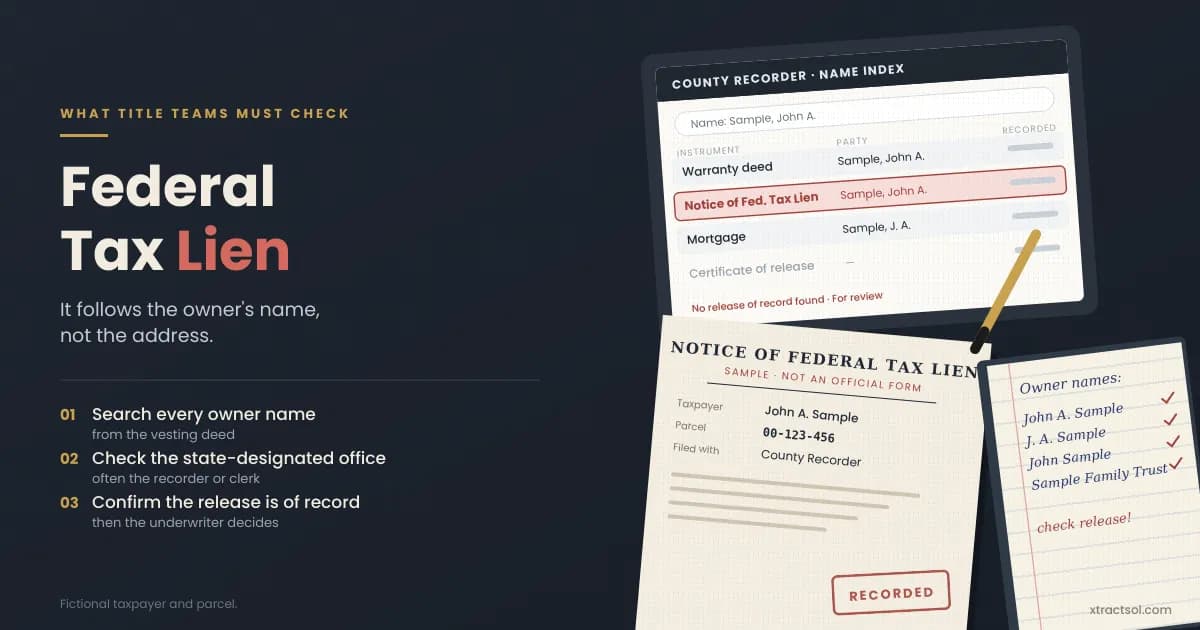
Federal Tax Lien: What Title Teams Must Check
Learn how a federal tax lien attaches, where the notice is filed, how it differs from a judgment lien, and what a title team checks before closing.
Read more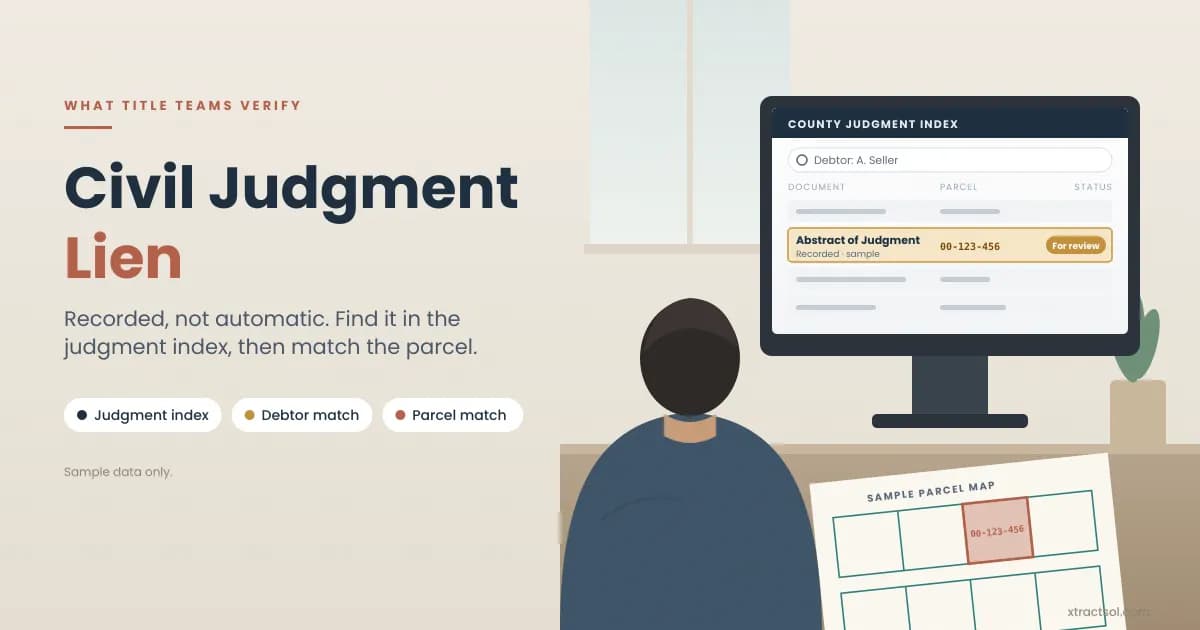
Title Search
Civil Judgment Lien: What Title Teams Verify
A civil judgment lien attaches to real estate only after the creditor records the judgment. See how title teams find, renew, and release one before closing.
Read more
General
Judgment Lien on Real Property: A Title Team Guide
Learn how a judgment lien attaches to real property, how state recording rules and duration work, and how title teams find and resolve liens before closing.
Read more
Ready to get started?
30 minutes. You walk us through how one file moves from order to closing, and we send a one-page note on the 2-3 steps worth automating first. Nothing to send us.