
Judgment Lien: What Title Teams Must Verify
By XtractSol Team
• 8 min read
A judgment lien is a court-created claim on a debtor's real property that attaches only after the creditor records or dockets the judgment in the county where the property sits, following that state's statute.
A judgment lien can sit on a property for years before anyone notices it. The creditor must record or docket the judgment in the county where the property sits, and the office and document vary by state and county. A search that stops at the deed index can miss the lien and delay closing. XtractSol Agents prepare the title search package, every finding linked to the recorded document, so the examiner can review the lien against the record. The American Land Title Association (ALTA) notes that title professionals review public records to identify unpaid liens and recording issues before closing.
Key Takeaways
- A judgment lien attaches only after the creditor records or dockets the judgment under state law.
- The office, document, and index vary by state and county.
- Texas, for example, records an abstract of judgment with the county clerk.
- Search beyond the deed index and confirm every hit against the commitment.
What Is a Judgment Lien on Real Property?
A judgment lien starts with a money judgment. The judgment creditor holds the claim, and the judgment debtor owes the money. It is created by a court judgment without the owner’s consent and does not transfer ownership, as Cornell Law School explains. In practice, it usually shows up as a requirement to pay or release at sale or refinance.
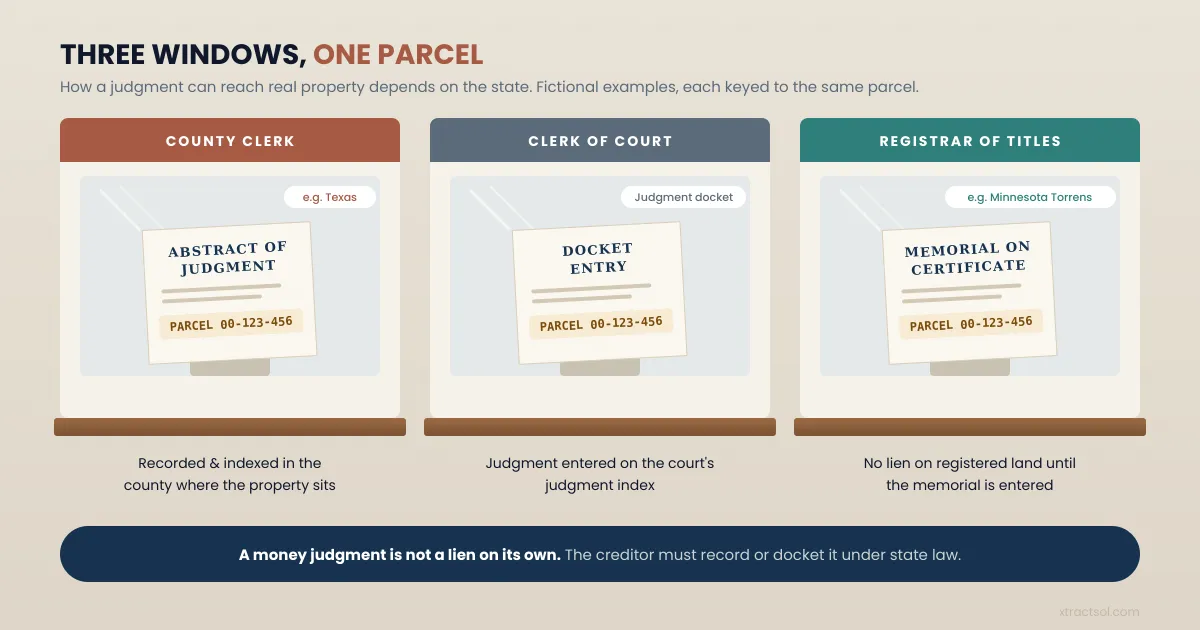
The office and document vary by state and county. In Texas, a first or subsequent abstract of judgment, recorded and indexed in the county where the property sits, creates a lien on the debtor's non-exempt real property in that county, including property acquired later (Texas Property Code § 52.001). The county clerk records and indexes the abstract (§ 52.004). Other states use a different act or office, so confirm the local rule.
For judgments in favor of the United States, 28 U.S.C. § 3201 creates a lien on all real property of the debtor when a certified copy of the abstract is filed in the manner a tax lien notice is filed. The lien lasts 20 years and may be renewed once for another 20 years with timely filing and court approval. A satisfaction or release ends it.
| Feature | judgment lien | Mortgage |
|---|---|---|
| Consent | Involuntary | Consensual |
| Source of claim | Court judgment | Loan agreement |
A judgment lien depends on the state's recording or docketing rule. Priority follows the state's recording statute. Cornell Law School explains that a judgment lien is senior to later liens and junior to earlier ones.
In Minnesota’s registered-land (Torrens) system, a money judgment is not a lien on registered land until the creditor files a certified copy with the registrar and the registrar enters a memorial on the certificate of title Minn. Stat. § 508.63.
Why Are Judgment Liens Easy to Miss in a Title Search?
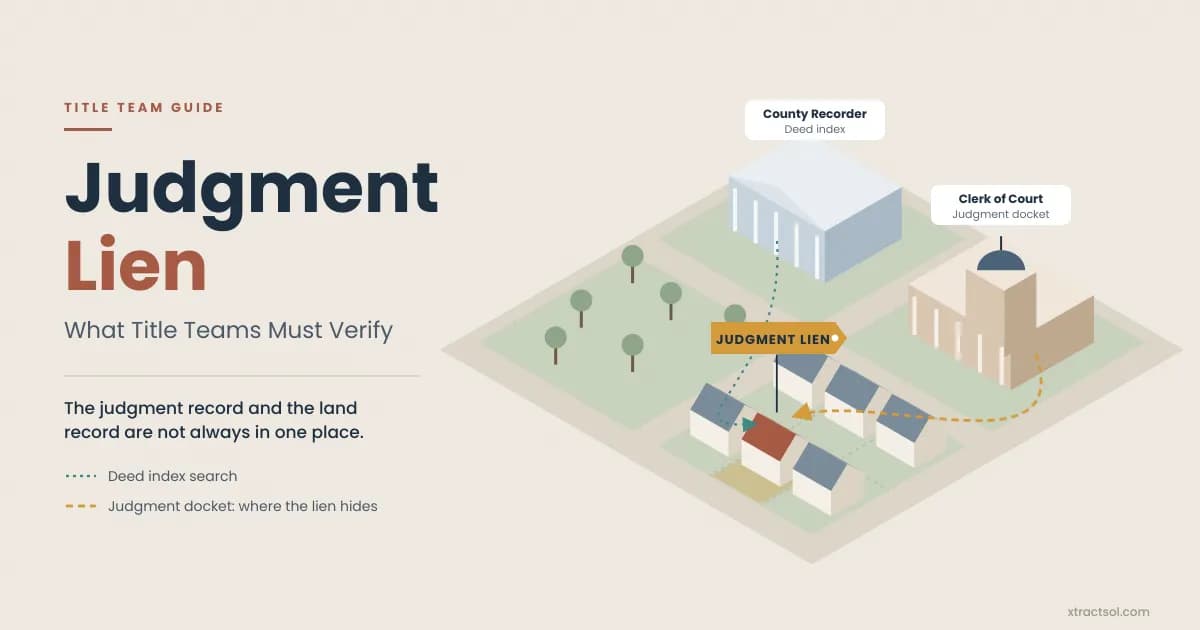
A judgment lien can hide because the judgment record and the land record are not always in the same place. Index names and locations vary by state and county. Some counties keep a judgment index or docket at the clerk of court; others keep a general or miscellaneous index at the recorder. Probate records are held by the probate court.
Deeds and mortgages sit in the grantor-grantee or tract index; the lien is a separate record. Check the county's index list before you search.
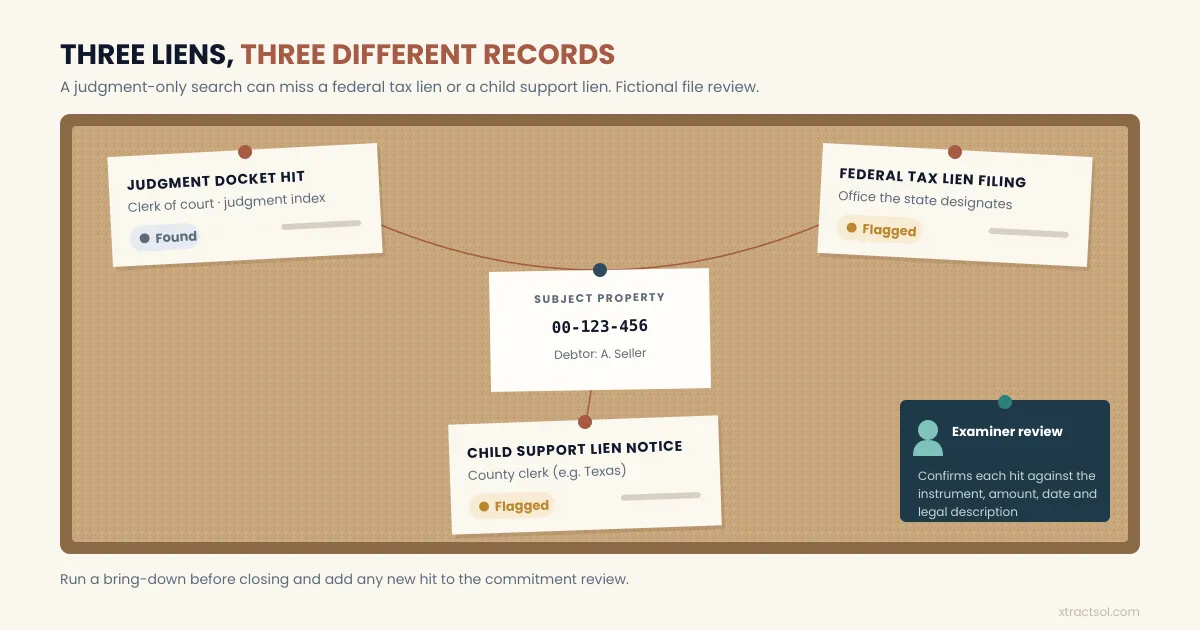
Federal tax lien notices are filed in the office each state designates for real property under 26 U.S.C. § 6323(f). Confirm the filing office for the county; it may be the recorder, the clerk, or another state office. A federal tax lien is not a judgment lien, so a judgment-only search can miss it.
Child support liens add another record type. In Texas, a child support lien arises by operation of law against real and personal property, and the claimant files a lien notice or abstract of judgment with the county clerk where the property is located (Texas Family Code § 157.312, § 157.317). The lien attaches to nonhomestead real property, so a homestead exemption can limit what it reaches. The rule varies by state; confirm the statute.
A lien recorded after the search but before closing can sit between the search date and closing. Run a bring-down and compare every new hit to the commitment.
Bankruptcy does not automatically remove a judgment lien. Under 11 U.S.C. § 522(f), a debtor may avoid a judicial lien only to the extent it impairs an exemption, and the section excludes liens securing domestic support obligations. Avoidance is not automatic. The debtor must act in the bankruptcy case, so look for a recorded release or a court order.
How Should a Title Team Search for and Resolve a judgment Lien?
Start with the debtor's name and the parcel, then search every index the county uses.
- Collect name variations, former names, and entity names for the judgment debtor.
- Search the judgment index or docket and the general or miscellaneous index, if the county keeps one.
- Search the recorder's records for the abstract, judgment, federal tax lien, and child support lien.
- Confirm each hit against the instrument, amount, recording date, and legal description.
- Run a bring-down before closing and add any new hit to the commitment review.
- Send open items to the examiner. The parties satisfy or remove the requirement, or the commitment lists it as an exception.
The examiner decides what the commitment requires. Escrow officers handle payoffs and prorations. A title underwriter or insurer makes the underwriting decision, not the examiner.
How Do XtractSol Agents Support Judgment Lien Review?
judgment lien review is a gathering problem first and a judgment call second. XtractSol Agents prepare the title search package, every finding linked to the recorded document. County coverage varies, so the examiner confirms the right documents came back. XtractSol Agents do not confirm ownership, cure title defects, or decide insurability.
Our title search automation work and our smart title commitment intelligence case study show how search findings move into the commitment for review.
Implementation & Operational Considerations
The handoff varies by state, county, and the title agent's workflow. Some counties publish digital indexes and document images. Older records, microfiche, or restricted access may still require a courthouse visit.
A judgment lien can become a curative item. The parties may need a satisfaction, a release, or a court order before the requirement is removed. The title curative guide covers that next step. Escrow officers handle payoffs and prorations. The examiner makes the title decision, and the title insurer sets the policy requirements.
Conclusion
A judgment lien is easy to miss because it starts as a court record, not a deed. The creditor must record or docket it in the right county, and the lien follows a priority and duration path set by state law. A search that stops at the deed index can miss it.
Checking the judgment index, the recorder's records, the federal tax lien filing office, and the child support lien records together catches the lien before closing. XtractSol Agents prepare the search package while examiners keep the title decision.
See where AI fits in your title workflow.
Book a free 30-minute workflow review.
Book a Free 30-Minute Workflow Review
Frequently Asked Questions
No. A money judgment does not attach to real property on its own. The creditor must record or docket it under the state statute, and the office varies by state and county.
It depends on state law. Texas sets a 10-year term and ends the lien if the judgment becomes dormant. Liens on judgments in favor of the United States run 20 years and can be renewed once with court approval.
Search the judgment index or docket, the recorder's records, and the county's other indexes. Check federal tax lien filings and child support liens, then compare every hit to the commitment.
About the Author
Usama Muneer, Founder & CEO, XtractSol. Usama writes about title search operations, public records, and practical automation for title and escrow teams.
XtractSol Agents prepare the search package from public records; examiners make every title decision.
See where AI fits in your title workflow.
Stay Updated
Get the latest insights on AI and automation delivered to your inbox.
See where AI fits in your title workflow.
Stay Updated
Get the latest insights on AI and automation delivered to your inbox.
More posts
Product notes, how we build, and what we are learning.
Title Search
What Is an Auditor? A Guide for Title and Escrow Teams
Learn what an auditor is in real estate, how county auditor and recorder duties vary by state and county, and which records a deed needs before recording.
Read more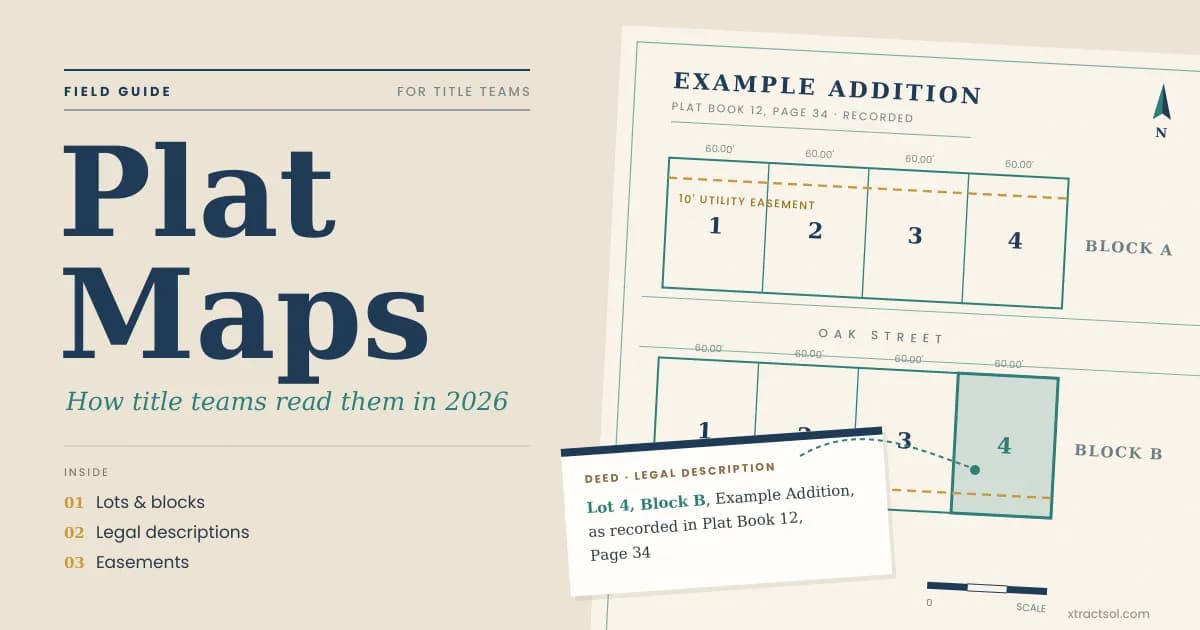
Title Search
Plat Maps Explained: A Guide for Title Teams (2026)
Learn how plat maps define lots, blocks, and easements, and how title teams use recorded plats to support more accurate property searches and commitments.
Read more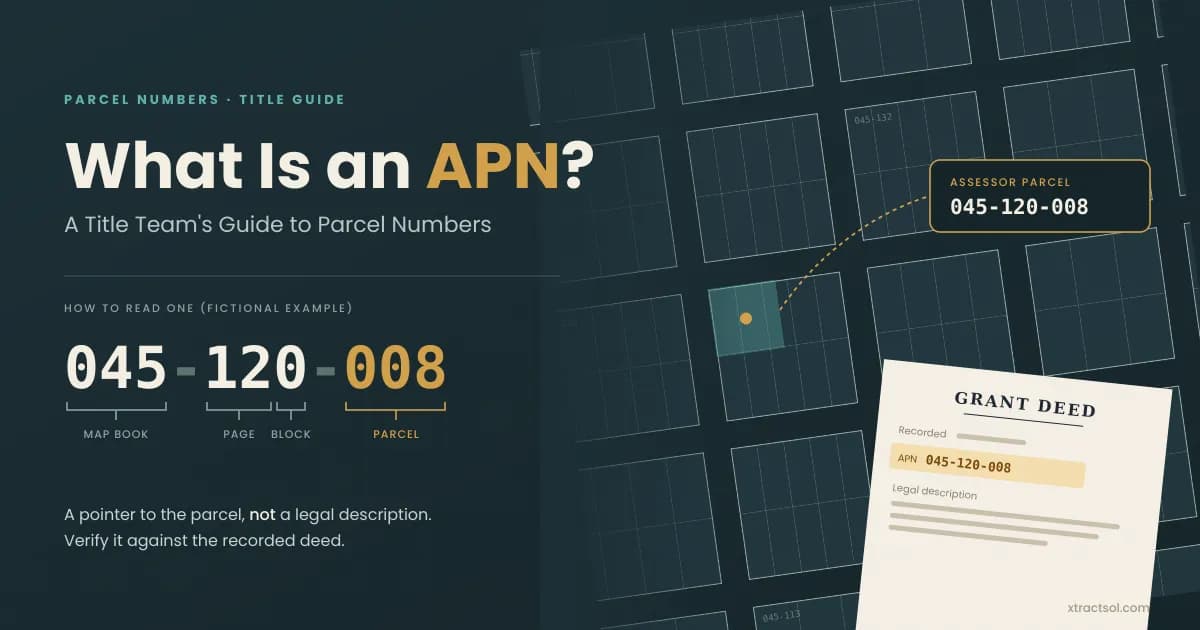
Title Search
What Is an APN? A Guide to Assessor Parcel Numbers
Learn what is an APN is, how title teams find an assessor parcel number by address, and why splits, mergers, and county formats can change a property search.
Read more
Ready to get started?
30 minutes. You walk us through how one file moves from order to closing, and we send a one-page note on the 2-3 steps worth automating first. Nothing to send us.