
What Is an APN? A Title Team's Guide to Parcel Numbers
By Usama Muneer, Founder & CEO
• 6 min read
An Assessor's Parcel Number (APN) is the label a county uses to track a parcel. Title teams use it to pull tax certificates, match deeds to lots, and check splits. Lookups stall when a portal disagrees with deeds. XtractSol Agents search county land, tax, and court records in one pass; examiners focus on review. In a 2021 article on ALTA's site, Brent Jones of Esri and David Rooney of Orange County, Fla., note that parcels are 'the most requested data layer' and that linking deeds to parcels 'helps clarify whether there is current recorded property ownership.'
Key Takeaways
- An APN is a county parcel identifier, not a legal description or address.
- It follows the land; splits and mergers retire old numbers.
- Reconcile it with the deed and county tax record first.
- XtractSol Agents gather county records; examiners review.
What Is an APN?
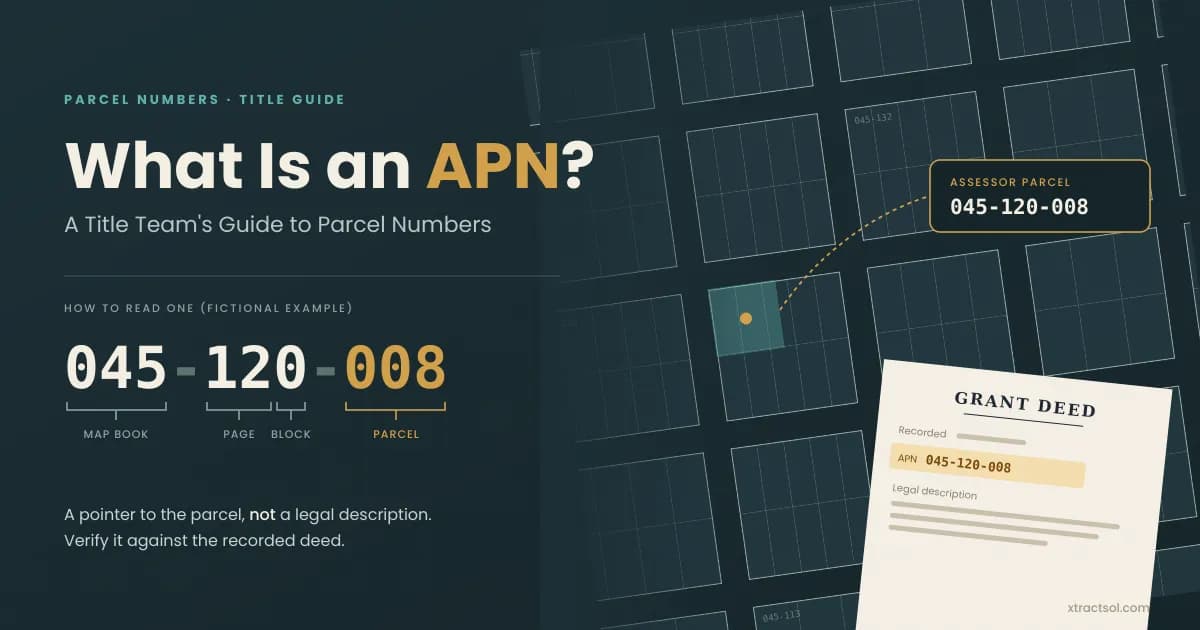
An Assessor's Parcel Number (APN) is the unique identifier a county assessor assigns to a parcel of land for property tax and assessment records. It is an administrative label, not a boundary. Many counties, including California's, build it from a map book, page, block, and parcel.
A fictional parcel might read 045-120-008: map book 045, page 12, block 0, parcel 008. After a split, the county retires 045-120-008 and issues 045-120-009 and 045-120-010.
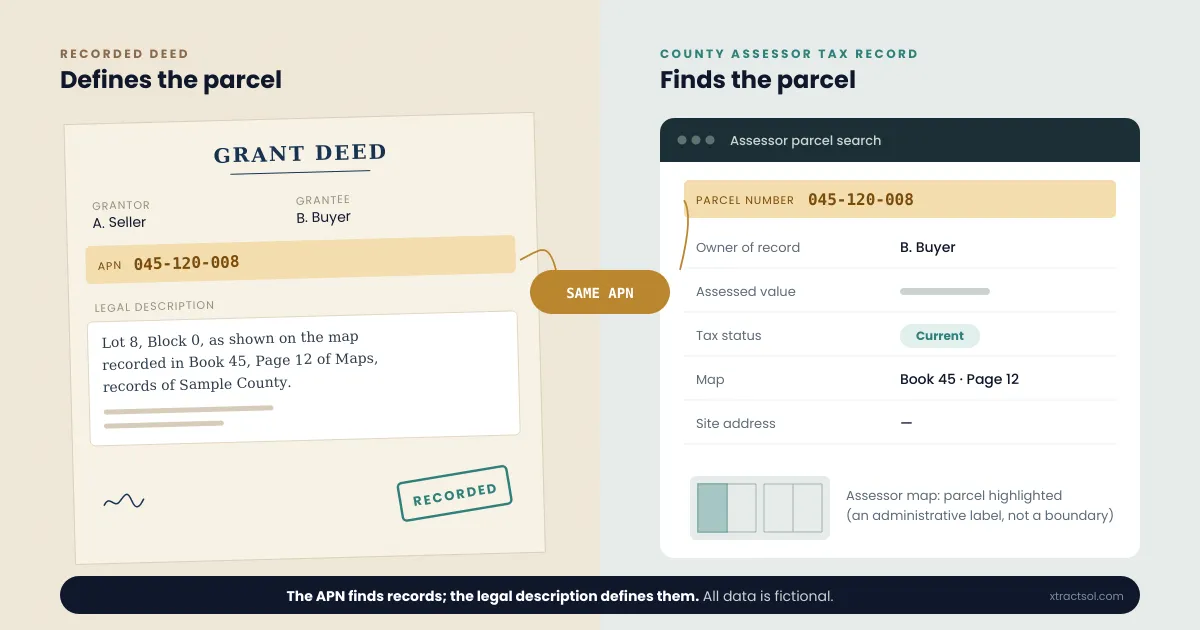
An APN is not a street address. An address can change and may not exist for vacant land. An APN is also not a legal description. A legal description uses lots, blocks, metes and bounds to define the property boundaries and lot lines (Cornell Law). The APN finds records; the legal description defines them.
A single APN can cover more than one lot, so examiners check the deed.
Why APNs Matter in a Title Search
The assessor values each parcel, and the treasurer or tax collector bills and tracks taxes by parcel. An examiner pulls those records to confirm the parcel's tax status.
The APN also supports title and deed records research. Deeds, mortgages, and releases are searched in the grantor-grantee index or, in some counties, the tract index. Judgments and court decrees sit in the judgment index. Powers of attorney, probate matters, and federal tax liens sit in the general index. The APN connects the tax file, assessor map, and recorded deed, but does not replace those indexes.
A clean tax record does not establish marketable title. The examiner still traces the chain of title and reviews recorded defects. Marketable title turns on litigation risk, not perfection.
How to Find the APN for a Property
Use the fastest source you trust, then verify against a second record.
- Check the property tax bill or assessment notice. The APN sits near the top under "Parcel Number," "APN," "Tax ID," or "Folio."
- Search the county assessor parcel search by address or owner name. An APN lookup by address returns assessed value and ownership.
- Open the county assessor parcel map or Geographic Information System (GIS) viewer without an address. Search by map book, page, and block, or click the parcel.
- Match the APN to the recorded deed. Confirm the legal description covers the same parcel.
- Search the recorder's index by owner name, or by APN where the county indexes by parcel, then compare tax status and recorded interests.
A structured public record research workflow keeps these checks in one file, which matters when a portal returns older numbers. Reconcile any disagreement before reporting.
How XtractSol Agents Fit Into APN Research
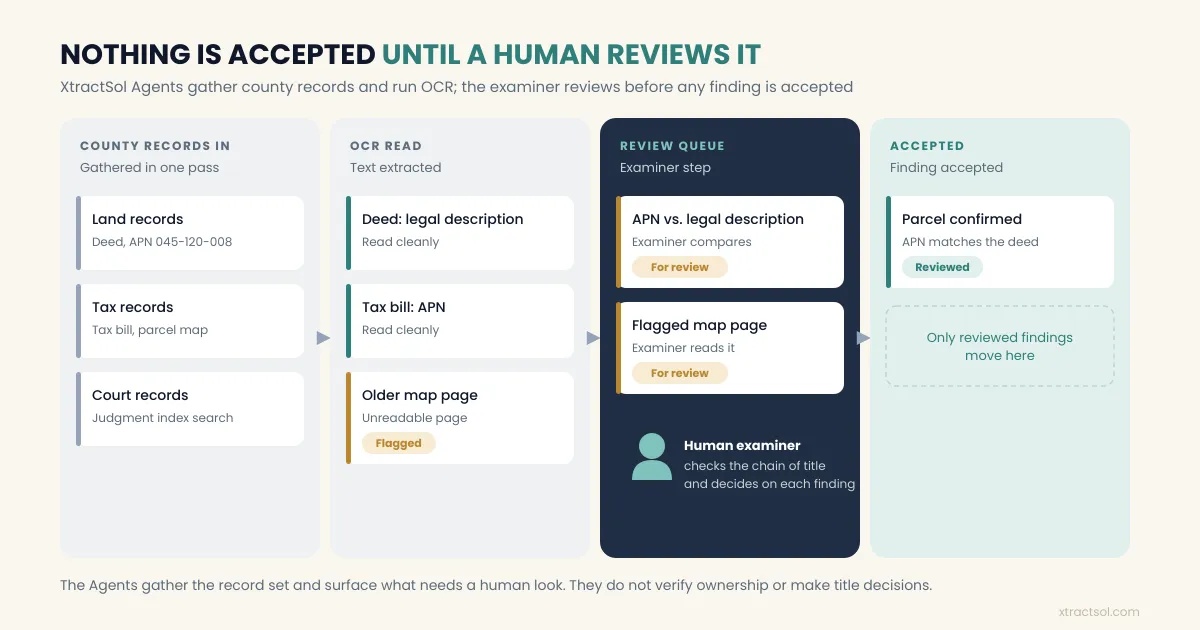
XtractSol Agents search county land, tax, and court records in one pass. OCR reads the recorded documents, and pages it cannot read cleanly are flagged for the examiner. Examiners spend their time on review instead of gathering.
The Agents do not verify ownership or make title decisions. They gather the record set and surface what needs a human look. An examiner still compares the APN to the legal description, checks the chain of title, and decides how to treat a lien or exception.
The Agents return the search in hours, not days; work that needs a trained eye stays with the examiner. Our property tax payment status extraction work is one example of the record types the Agents handle.
Implementation & Operational Considerations
APNs break in predictable places.
Splits, mergers, and retired numbers
Sales do not change an APN; boundary changes do. A subdivision, split, or merger retires the old number and issues new ones. Sacramento County does not create new assessor parcels in May and June during tax roll work, so a split can wait for a usable number (Sacramento County). Retired numbers break historical comparisons, so carry predecessor and successor numbers.
Unaddressed land and right-of-way parcels
Vacant, rural, and off-grid land often has no address. Search by owner name, map book and page, or the GIS boundary. Streets, alleys, and rights-of-way may appear as parcel records with placeholder numbers, not the fee parcel.
State terminology and property identification numbers
The same identifier appears as a parcel identification number (PIN), a folio number in parts of Florida, or an SBL reference in New York. Confirm the format; punctuation and leading zeros differ between the bill and the GIS layer.
Conclusion
An APN is a county's filing key for a parcel, and title teams use it to connect tax records, assessor maps, and recorded deeds. It is reliable within its county, but it is not a legal description and it changes with boundaries. Treat it as a pointer, verify it against the deed, and keep the examiner in charge of title. XtractSol Agents gather the records so examiners can focus on review.
See where AI fits in your title workflow.
Book a free 30-minute workflow review.
Book a Free 30-Minute Workflow Review
Frequently Asked Questions
An APN, or Assessor's Parcel Number, is the identifier a county assessor assigns to a parcel for tax purposes. It links the parcel to tax records, but it is not a legal description.
No. An APN is an administrative identifier for assessment and tax records. A legal description defines the property boundary in a deed using lots, blocks, metes and bounds, or another recorded method.
Search the county assessor's parcel portal by street address, then confirm the result against the property tax bill or recorded deed. For vacant land, use the GIS map or search by owner name.
About the Author
Usama Muneer, Founder & CEO. Usama leads XtractSol's work on AI agents for title search and settlement teams.
XtractSol Agents prepare the search package from public records; examiners make every title decision.
See where AI fits in your title workflow.
Stay Updated
Get the latest insights on AI and automation delivered to your inbox.
See where AI fits in your title workflow.
Stay Updated
Get the latest insights on AI and automation delivered to your inbox.
More posts
Product notes, how we build, and what we are learning.
Title Search
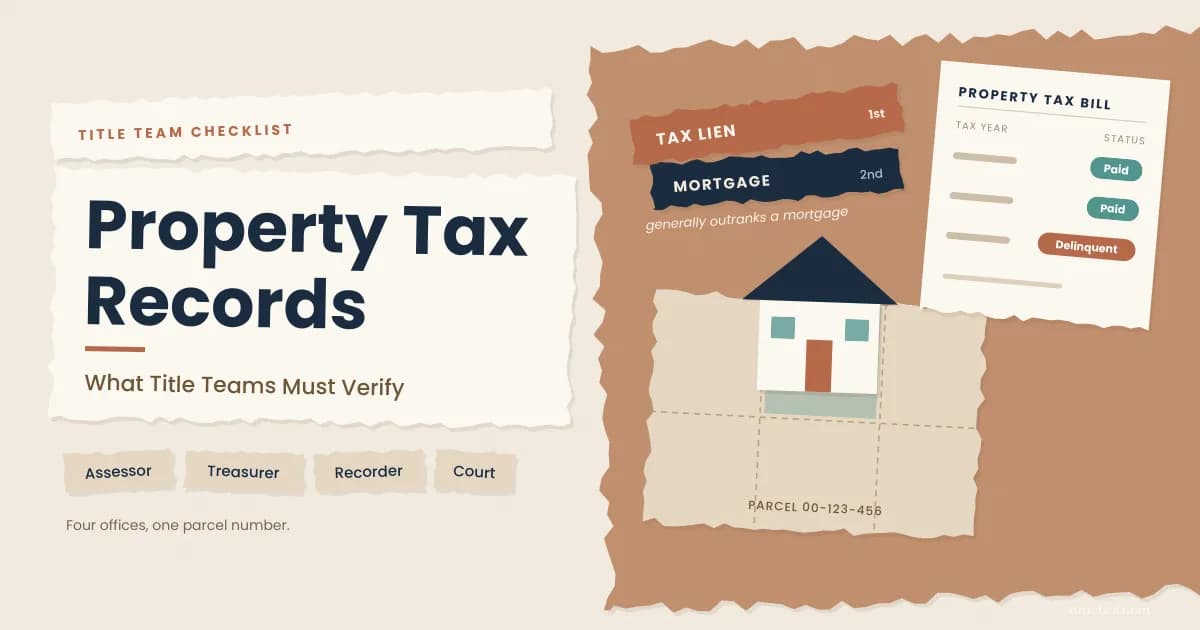
Property Tax Records: What Title Teams Must Verify
Learn how property tax records work for title teams, from assessor and treasurer searches to delinquent tax liens, assessed value, and closing prorations.
Read more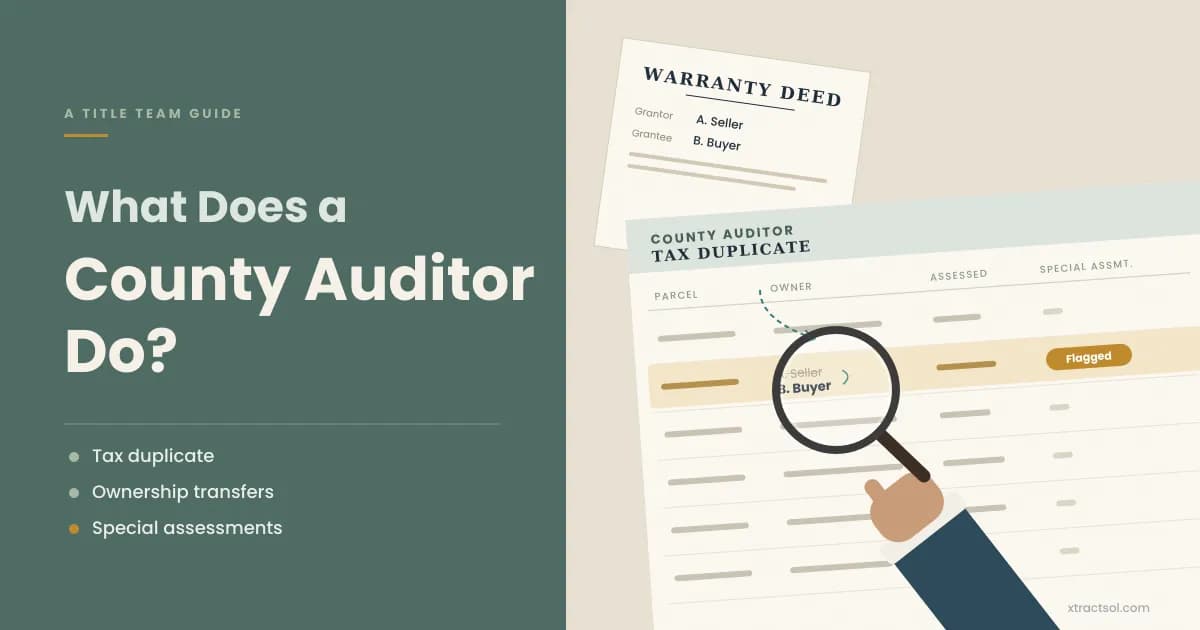
Title Search
What Does a County Auditor Do? A Guide for Title Teams
What does a county auditor do in real estate? Learn how auditor and assessor duties differ, and how title teams verify transfers, prorations, and assessments.
Read more
Title Search
Release of Lien: How Title Teams Verify Removal
Discover how title teams verify a release of lien to clear phantom liens and prevent closing delays. See how a lien waiver differs from a recorded release.
Read more
Ready to get started?
30 minutes. We walk one of your files from order to closing and send a one-page note on the 2-3 steps worth automating first.