
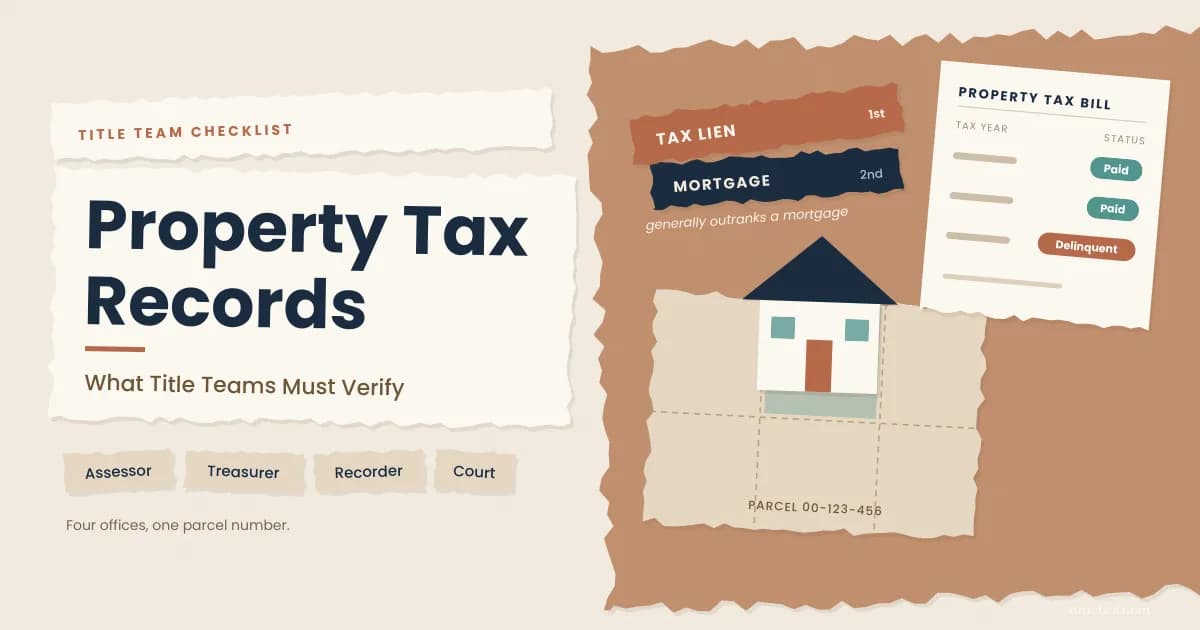
Property Tax Records: What Title Teams Must Verify
By Usama Muneer, Founder & CEO
• 7 min read
Property tax records show what a county assesses, bills, and collects on a parcel, and they anchor every title search. A missed delinquent balance or tax lien can delay closing or push a lender's mortgage into a junior position. The work is repetitive, and one miss reopens files. XtractSol Agents gather county land, tax, and court records in one pass so examiners can review the tax picture sooner. The EY report for ALTA (January 2024, 2022 data) notes that title and settlement companies identify and collect $3 billion in back federal income taxes, property taxes, and child support each year.
Key Takeaways
- Tax data sits with the assessor and treasurer, not the deed index.
- A delinquent balance can become a lien that outranks mortgages.
- Assessed value is a tax base, not market value.
- Verify payment status, special assessments, and certificates before closing.
What Do Property Tax Records Show?
Property tax records are county files that show a parcel's assessed value, tax rate, annual charges, payment status, and any delinquent balance or recorded lien.
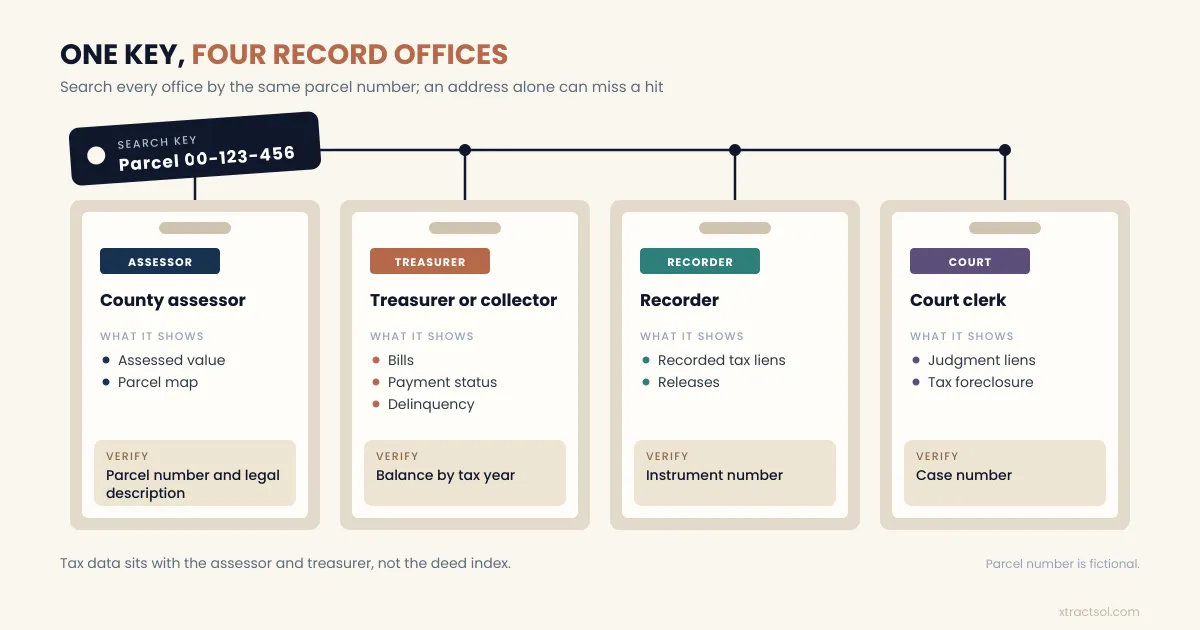
The assessor sets value and keeps the parcel map. The treasurer bills and tracks delinquency. The recorder holds liens and releases; the court clerk keeps judgment records.
Records are organized by parcel number; a tax card ties the legal description and history.
Assessed Value vs. Market Value
Cornell Law School explains that property taxes are ad valorem, based on a proportion of value. Market value moves with sales, while assessed value updates on a slower cycle, so the tax card is not an appraisal.
Where Can You Find Public Property Tax Records Online?
Start with the county assessor's parcel search and the treasurer or tax collector's payment portal, using the parcel number or street address.
Many county property tax records are online. Assessor sites include GIS maps and property tax assessment records; treasurer sites show payment status and balance lookup by year. Older records may need a counter request.
| Record source | What it shows | What to verify |
|---|---|---|
| County assessor | Assessed value, parcel map | Parcel number and legal description |
| Treasurer or collector | Bills, payment status, delinquency | Balance by tax year |
| Recorder | Recorded tax liens and releases | Instrument number |
| Court clerk | Judgment liens, tax foreclosure | Case number |
How Do Past Unpaid Property Taxes Affect a Title Search?
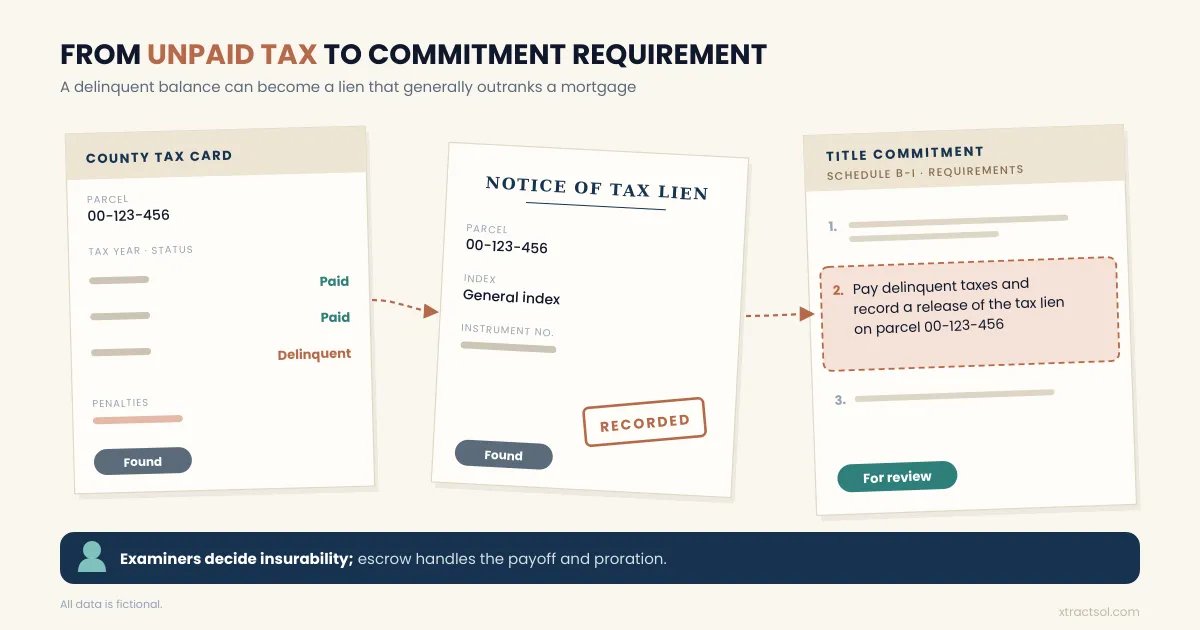
Past unpaid property taxes can become a lien that generally takes priority over a mortgage, so a title search must confirm the balance and any recorded tax lien before closing.
Cornell Law School's definition explains that a tax lien gives the government a security interest and takes precedence over a mortgage.
The tax roll shows property tax delinquency and penalties. Delinquent tax records may appear in the general or judgment index, while deeds and mortgages sit in the grantor-grantee or tract index. A grantor-grantee search misses the tax item.
Tax liens on real estate can outlast several owners. The commitment lists the tax item as a requirement or exception; the parties satisfy or remove it before the policy issues.
How Do You Check for Delinquent Tax Liens and Payment Status?
Check the county tax portal for current payment status, then confirm any recorded lien in the general or judgment index and compare both to the title commitment.
Search by address if you must, but confirm on the parcel number.
- Pull the parcel number and legal description.
- Review payment status for each tax year, including penalties.
- Search the recorder and general index for tax liens, federal liens, and releases.
- Check the court clerk for tax foreclosure, tax sale, or judgment records.
- Compare every hit to the commitment and send open items to the examiner.
Escrow officers handle payoffs and adjustments; examiners and underwriters decide insurability.
How Do XtractSol Agents Support Property Tax Record Research?
Tax research is a gathering problem before judgment.
Collecting Land, Tax, and Court Records
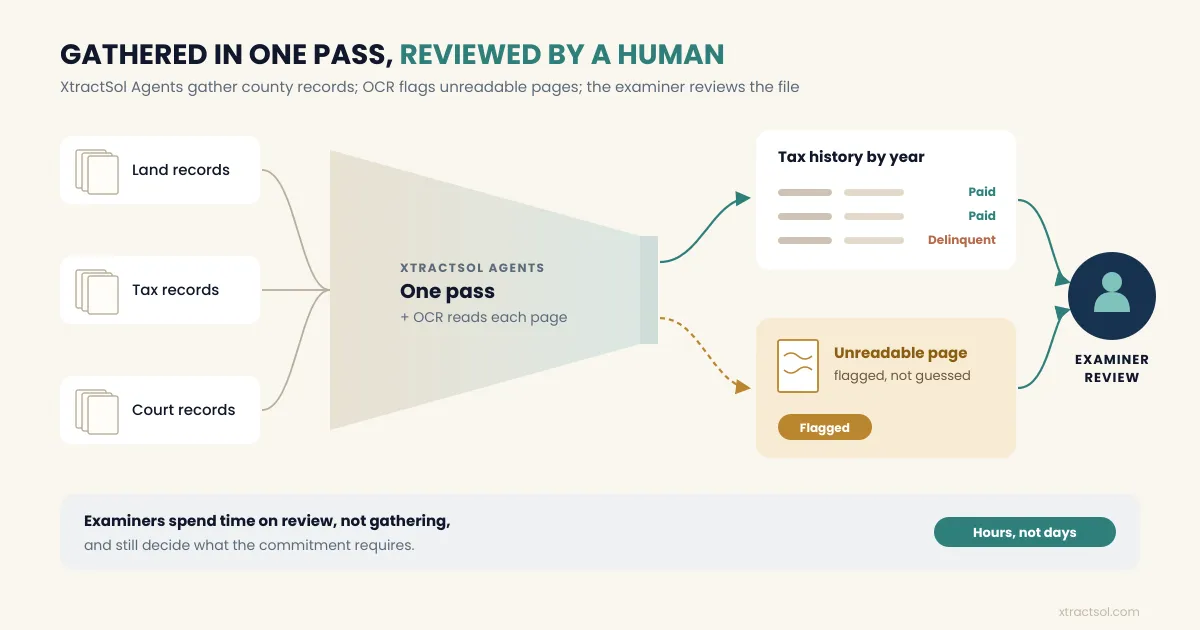
The Agents search county land, tax, and court records in one pass.
Handling Unreadable Pages
OCR reads the recorded documents and flags pages it can't read cleanly for the examiner.
Organizing Property Tax History by Year
XtractSol's property tax payment status extraction case study describes a workflow that organizes treasurer and auditor records by tax year, payment status, penalties, and assessments.
Keeping the Examiner in Charge
Examiners spend time on review, not gathering, and still decide what the commitment requires. See our public record research service for how this works.
Implementation & Operational Considerations
Property tax records do not end at the current bill.
Special Assessments and Improvement Districts
Local improvement districts can add charges outside the general tax line. Check the tax bill, the assessment roll, and recorded assessments.
Tax Sales, Certificates, and Redemption
Some states sell tax lien certificates, others deeds. Redemption periods vary, so confirm the status with the county and read the instrument.
Escrow Prorations and Handoffs
Escrow officers calculate the proration and need the latest tax status from the examiner. The title curative guide covers the next step when a tax item becomes a curative requirement.
Conclusion
Property tax records are easy to pull and easy to misread. The tax roll, assessor card, lien, and court record tell part of the story, and a stale balance can change the closing plan or the lender's priority. Checking all four catches delinquency before it reaches the closing table. That review protects the closing date and the entire file. The Agents return the search in hours, not days, while examiners keep the final judgment call.
See where AI fits in your title workflow.
Book a free 30-minute workflow review. Bring your counties and the records you handle. We will walk the handoffs that slow files.
Book a Free 30-Minute Workflow Review
Frequently Asked Questions
Start with the county assessor and treasurer websites using the parcel number. Many counties publish tax cards, payment status, and GIS maps, but older records may need a counter request.
Unpaid taxes can become a lien that generally outranks a mortgage. The title search must show the balance, any recorded liens, and any tax sale before the commitment addresses it.
Check the treasurer's payment portal by tax year, then search the recorder and general index for recorded tax liens on the parcel. Confirm each hit against the commitment before closing.
About the Author
By Usama Muneer, Founder & CEO
Usama writes about title search operations and practical automation for title and escrow teams.
XtractSol Agents prepare the search package from public records; examiners make every title decision.
See where AI fits in your title workflow.
Stay Updated
Get the latest insights on AI and automation delivered to your inbox.
See where AI fits in your title workflow.
Stay Updated
Get the latest insights on AI and automation delivered to your inbox.
More posts
Product notes, how we build, and what we are learning.
Title Search
What Does a County Auditor Do? A Guide for Title Teams
What does a county auditor do in real estate? Learn how auditor and assessor duties differ, and how title teams verify transfers, prorations, and assessments.
Read more
Title Search
Release of Lien: How Title Teams Verify Removal
Discover how title teams verify a release of lien to clear phantom liens and prevent closing delays. See how a lien waiver differs from a recorded release.
Read more
Title Search
Mechanics Lien on a Property: A 2026 Title Team Guide
Learn how a mechanics lien affects a property sale, how lien priority and release work, and how title teams resolve construction liens before closing.
Read more
Ready to get started?
30 minutes. We walk one of your files from order to closing and send a one-page note on the 2-3 steps worth automating first.