
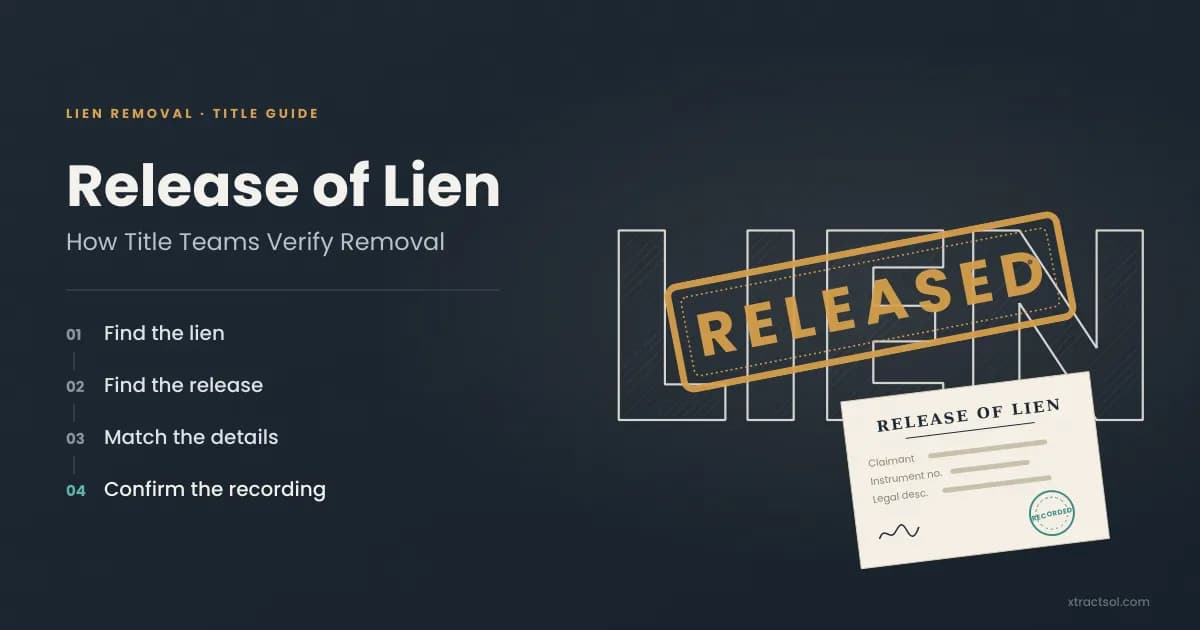
Release of Lien: How Title Teams Verify Removal
By Usama Muneer, Founder and CEO
• 6 min read
A release of lien is the recorded instrument that cancels a filed lien and removes its cloud on title. When a creditor records a lien and never records the release, the public record still shows an open claim, and title teams must resolve it before a title policy can issue. XtractSol Agents search county land, tax, and court records in one pass, so examiners catch missing releases earlier. As ALTA's construction lien chapter explains, these liens have historically been one of the greatest sources of loss to the land title industry, partly because of their secret nature in many states.
Key Takeaways
- A release of lien must be recorded; a waiver alone does not cancel a lien.
- The examiner ties each release to the original lien in the correct county index.
- Unreleased claims become phantom liens that stall closings.
What Is a Release of Lien?
A release of lien is a signed and recorded document from the lien claimant that cancels a specific filed lien, in whole or in part, in the official county record.
The release is the last step in a chain that starts with the lien. A lien is a claim against the property, not the deed. The deed transfers ownership, and the chain of title records every instrument that touched the property. A release adds an instrument that closes the claim.
Most counties rely on recorded instruments and public indexes; a few still use Torrens registration, where a registrar's certificate proves title.
Why Do Unreleased Liens Hold Up Closings?
Unreleased liens are costly because they are easy to miss until the closing. The lender needs a clean payoff, and the title file needs a recorded release before a policy can issue. A paid lien that was never released is a phantom lien: the creditor has the money, but the index shows an open claim.
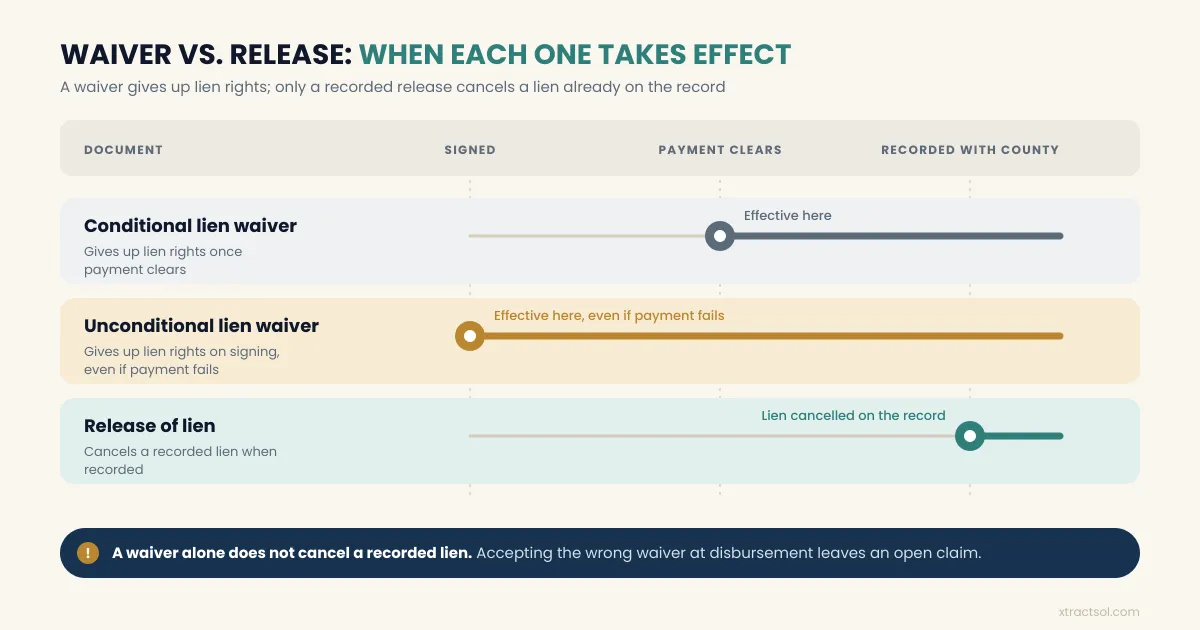
An unconditional lien waiver is effective when signed, even if payment fails; a conditional lien waiver takes effect only when payment is received. Accepting the wrong one at disbursement leaves the team defending a closed claim. A late release can also push the closing date.
How Does Lien Removal Verification Work?
Lien removal follows a short sequence.
| Document | Effect and timing |
|---|---|
| Conditional lien waiver | Gives up lien rights once payment clears |
| Unconditional lien waiver | Gives up lien rights on signing, even if payment fails |
| Release of lien | Cancels a recorded lien when recorded |
Confirm the debt is satisfied through a payoff demand. The claimant signs the release, and the signer's authority must match the original lien. Record it in the right index: deeds, mortgages, and releases in the grantor-grantee or tract index; judgments in the judgment index; tax liens in the general index.
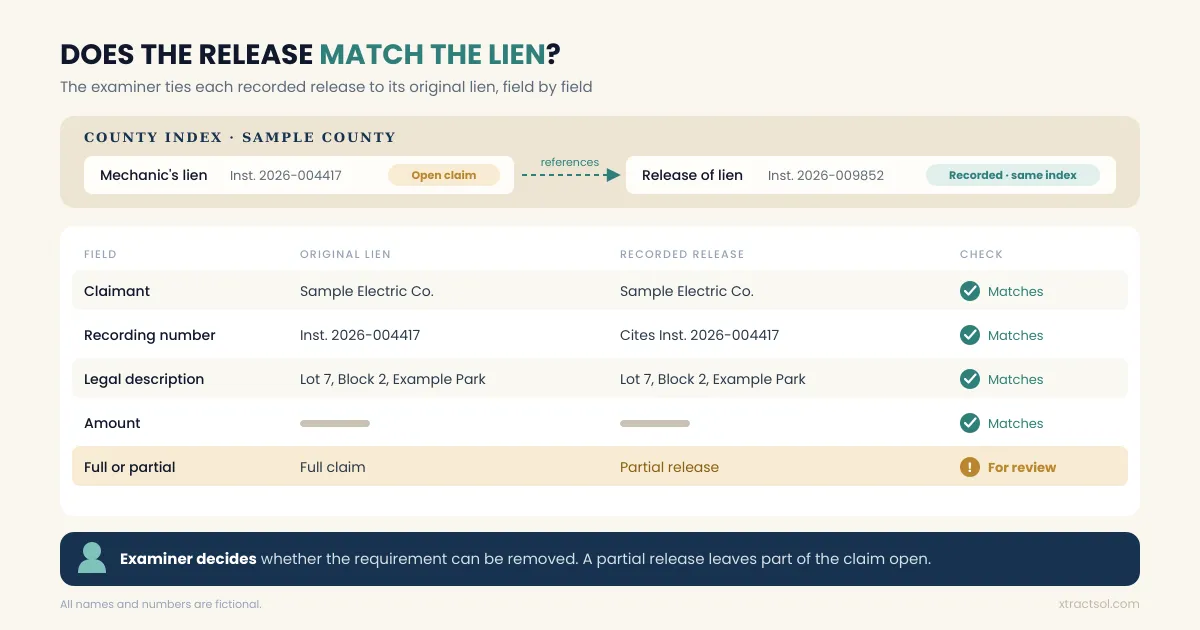
The examiner then checks the claimant name, recording number, legal description, amount, and full or partial status. The claimant records the release after payment; many states require it and allow penalties for delay.
How Do XtractSol Agents Help Examiners Check Lien Releases?
The Agents search county land, tax, and court records in one pass, pulling the recorded lien, any release, and the surrounding chain of title. OCR reads the recorded pages; pages it cannot read cleanly are flagged for the examiner. The examiner compares the release to the lien and decides whether the requirement can be removed. The gain is capacity: examiners spend time on review, not gathering.
The Agents do not verify ownership, clear defects, or make title decisions. The recorded instrument is the evidence, and a title curative review can confirm the release before policy.
A discharge does not automatically remove a lien; 11 U.S.C. § 522(f) avoidance of judicial liens that impair an exemption requires a court order, and tax or consensual liens are treated separately.
Implementation & Operational Considerations
Implementation is a records and workflow decision. Start with the index coverage your counties use, then list the document types that carry lien risk: mechanic's liens, judgment liens, tax liens, and HOA liens. Define what a complete release package looks like for each.
Build an exception queue so a missing release is flagged rather than assumed. Decide who can approve removal of a requirement. If your team uses public record research or e-recording, confirm the recorder returns a recorded image. When a release is delayed near funding, escrow may use an indemnity agreement, but that is an underwriting decision.
Conclusion
A release of lien is a small document with a large operational job. It closes a claim on the record, protects the chain of title, and gives the examiner evidence that a requirement can be removed. The work is repetitive: find the lien, find the release, match the details, and confirm the recording in the right index. Automation helps most at the gathering stage, where county records are scattered and volume is steady. The examiner still reads the evidence and makes the call.
When the release is missing, the file waits. When it is found and verified, the closing moves.
See where AI fits in your title workflow.
Book a free 30-minute workflow review.
Book a Free 30-Minute Workflow Review
Frequently Asked Questions
A lien waiver gives up lien rights for work covered by a payment, usually at each draw or final payment. A release of lien cancels a lien already recorded. Waivers prevent claims.
The release is effective when the county recorder accepts it. Online index refresh varies by county, so a title search should rely on the recorded instrument and its instrument number.
The owner or escrow team can send a written demand, hold funds, require an indemnity, or seek a court order. State statutes set the available remedies and penalties for refusal.
About the Author
Usama Muneer is the Founder and CEO of XtractSol, where he leads the development of AI agents for title search and document intelligence. XtractSol Agents prepare the search package from public records; examiners make every title decision.
See where AI fits in your title workflow.
Stay Updated
Get the latest insights on AI and automation delivered to your inbox.
See where AI fits in your title workflow.
Stay Updated
Get the latest insights on AI and automation delivered to your inbox.
More posts
Product notes, how we build, and what we are learning.
Title Search
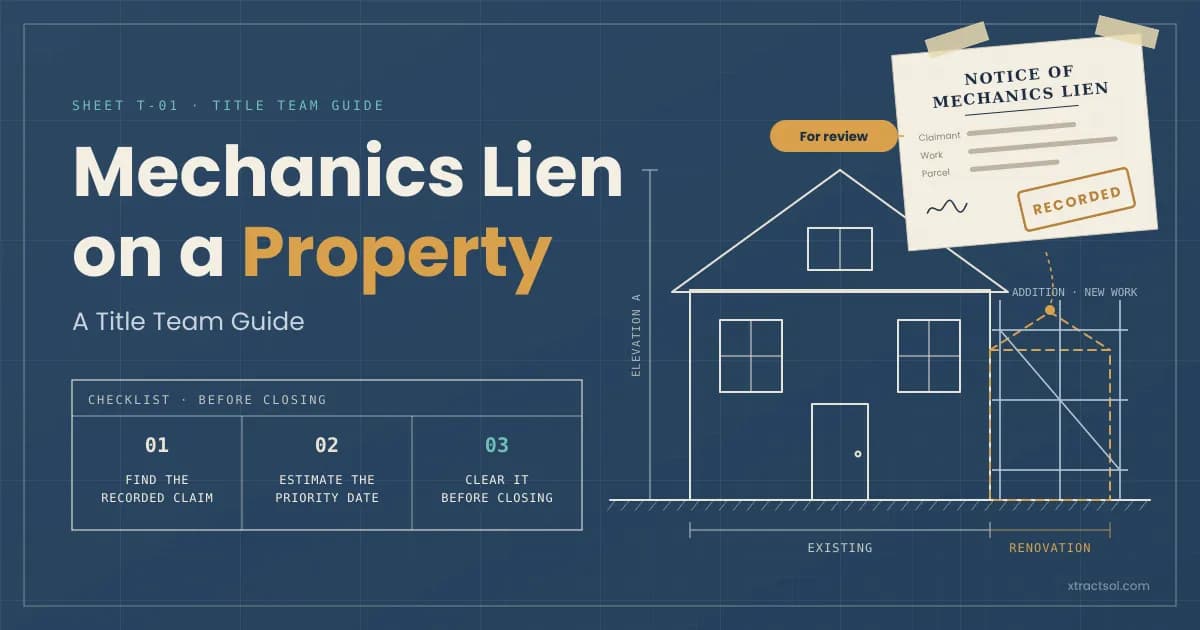
Mechanics Lien on a Property: A 2026 Title Team Guide
Learn how a mechanics lien affects a property sale, how lien priority and release work, and how title teams resolve construction liens before closing.
Read more
Title Search
Satisfaction of Mortgage: Resolving Unreleased Liens
A satisfaction of mortgage releases a paid-off lien, but only when it is recorded. See how title teams verify releases and resolve unreleased mortgage issues.
Read more
Title Search
What is a judgement lien? A 2026 Guide for Title Teams
What is a judgement lien, and how does it block a closing? Learn how liens attach, how long they last, and how title teams clear them before closing.
Read more
Ready to get started?
30 minutes. We walk one of your files from order to closing and send a one-page note on the 2-3 steps worth automating first.