
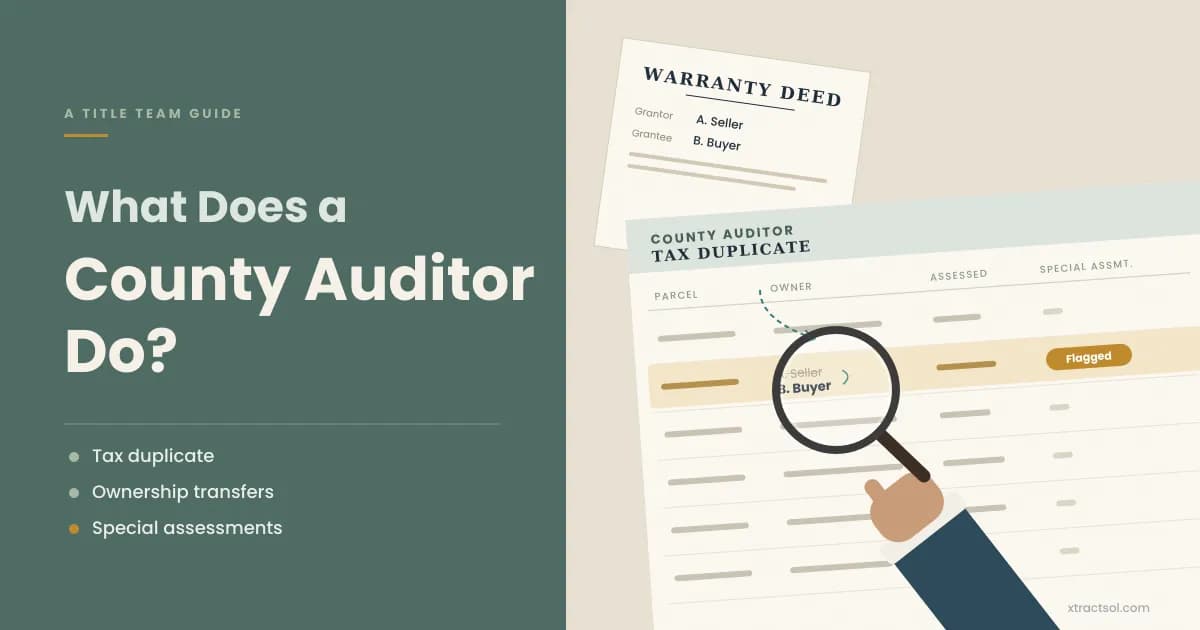
What Does a County Auditor Do? A Title Team Guide
By Usama Muneer, Founder & CEO
• 7 min read
"What does a county auditor do" has a different answer in every state. County auditors review county spending, certify tax levies, and in many counties maintain the property tax roll that tracks ownership changes. That variation is the problem: a search that works in one county can miss a transfer, a special assessment, or a tax proration detail in the next. XtractSol Agents reduce the gathering load by searching county land, tax, and court records in one pass. ALTA explains that title professionals review public records to find liens, recording errors, and encumbrances, which is where auditor records matter (ALTA).
Key Takeaways
- County auditors oversee county finances and often the tax roll.
- Valuation and recording duties split across auditor, assessor, and recorder.
- Title teams check tax duplicates for transfers, prorations, and assessments.
- Assessment appeal deadlines (Ohio's Board of Revision, for example) can decide a commercial file.
What does a county auditor do?
A county auditor is usually a county's chief fiscal or accounting officer and, depending on state law, may also maintain property tax records and move ownership through the tax duplicate.
The auditor reviews county expenditures, certifies available funds, and prepares financial reports for the county board, as McLean County, Illinois describes on its auditor duties page.
The real estate side is where state law changes the job. In some counties, the auditor also values property for tax purposes, certifies levies, and updates the tax roll after a deed transfers. In others, a separate assessor values parcels and a recorder holds the deed images. A team that assumes one model will misread the next.
How is a county auditor different from a county assessor?
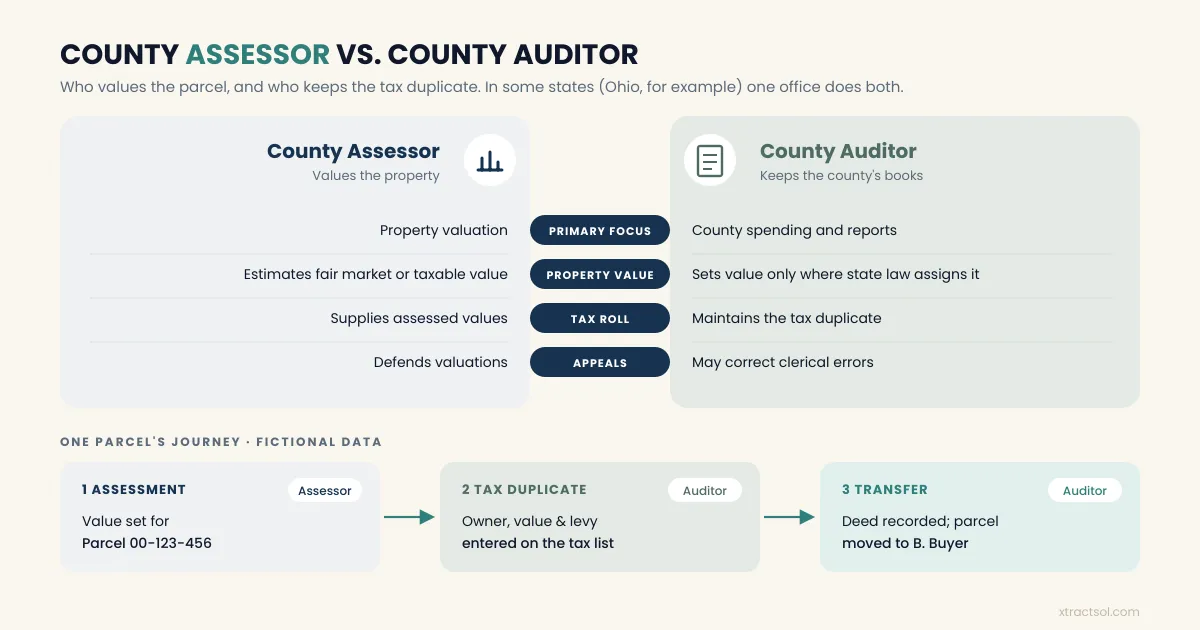
The auditor handles county finances and tax accounting; the assessor values property, though some states combine the roles.
| Duty | County auditor | County assessor |
|---|---|---|
| Primary focus | County spending and reports | Property valuation |
| Property value | Sets value only where state law assigns it | Estimates fair market or taxable value |
| Tax roll | Maintains the tax duplicate | Supplies assessed values |
| Appeals | May correct clerical errors | Defends valuations |
The split is regional. In Ohio, state law makes the county auditor the assessor for tax purposes (Ohio Revised Code § 5713.01). Other states elect or appoint an assessor, and the auditor stays on the financial side. Examiners check the local structure.
How does a county auditor handle property transfers?
The county auditor updates the tax duplicate when a deed transfers ownership, records the transfer for tax purposes, and divides the tax value when a parcel is split.
The deed, the written instrument that transfers an interest in real property, is recorded with the county recorder. The auditor then uses the recorded instrument or a transfer statement to move the parcel to the buyer's name on the tax list. When part of a tract sells, the auditor may split the parcel and divide the tax value.
Transfer tax and conveyance fees may apply, depending on state and local rules, so the title team confirms the local requirement.
Proration depends on them. The escrow officer calculates the closing-day split, but the auditor's tax duplicate supplies the levy, the assessed value, and any unpaid balance. A missed special assessment can turn a clean proration into a post-closing exception.
In Torrens states, a court certificate of title is conclusive proof of ownership, unlike standard title insurance, which covers losses from defects.
What do county auditor records mean for title searches?
Auditor tax records show the assessed value, tax status, and special assessments tied to a parcel, so examiners use them to confirm the tax picture before a policy issues.
A modern title search confirms the tax picture alongside the chain of title. Deeds, mortgages, and releases sit in the grantor-grantee or tract index. Money judgments and court decrees sit in the judgment index. Probate, powers of attorney, and federal tax liens sit in the general index.
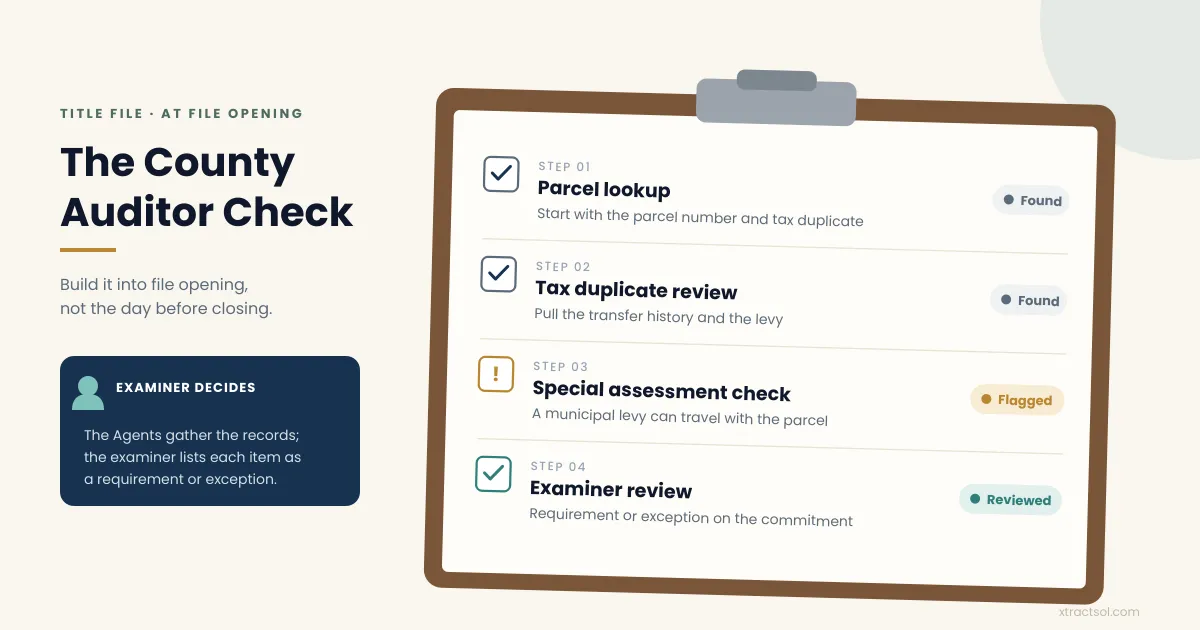
Special assessments are the quiet risk. A municipal improvement levy can attach to a parcel and travel with it; a name search may miss it. The examiner checks the tax duplicate and municipal records, then lists the item as a requirement or exception.
Appeals run on a clock. A commercial owner who contests an inflated assessment files with the Board of Revision or review board inside a strict window. Miss it and the value stands.
Clear title has no open claims, marketable title is free of reasonable doubt, and insurable title is what an underwriter accepts with stated exceptions. The examiner satisfies or removes requirements on the commitment.
Implementation & Operational Considerations
Build the auditor check into file opening, not the day before closing.
Start with the parcel number and tax duplicate, then pull the transfer history, levy, and any special assessment. Confirm the local appeal deadline if the value looks high. Order the tax certificate early to catch an undisclosed delinquency.
Some counties publish data feeds; others require a request. Log the source and date, since the answer can change.
The Agents search county land, tax, and court records in one pass. OCR reads the recorded pages, and pages it cannot read cleanly are flagged for the examiner. Examiners spend time on review, not gathering.
Conclusion
A county auditor can be a financial officer, a tax assessor, a keeper of the tax duplicate, or all three, depending on the state. The title team still has to know which role applies before trusting a search result. Manual work depends on county knowledge, portal access, and careful reading of transfer records. The Agents reduce the gathering load while examiners keep the judgment call, so the file moves faster without lowering the standard.
See where AI fits in your title workflow.
Book a free 30-minute workflow review. Bring the counties you work in and the transfer questions your team handles.
Book a Free 30-Minute Workflow Review
Frequently Asked Questions
Many county auditors do not set values; a separate assessor does that task. Where state law makes the auditor the assessor, the office values parcels on a regular review cycle.
Not always. Appeals usually go to the Board of Revision or a local review board within a strict deadline. The auditor may fix clerical errors, but a value dispute follows the appeal process.
The auditor typically keeps the tax duplicate, levy records, transfer entries, and special assessment data. The recorder keeps the deed images, and the assessor keeps the valuation roll in separate-office states.
About the Author
By Usama Muneer, Founder & CEO
Usama writes about title search operations and practical automation for title and escrow teams.
XtractSol Agents prepare the search package from public records; examiners make every title decision.
See where AI fits in your title workflow.
Stay Updated
Get the latest insights on AI and automation delivered to your inbox.
See where AI fits in your title workflow.
Stay Updated
Get the latest insights on AI and automation delivered to your inbox.
More posts
Product notes, how we build, and what we are learning.
Title Search
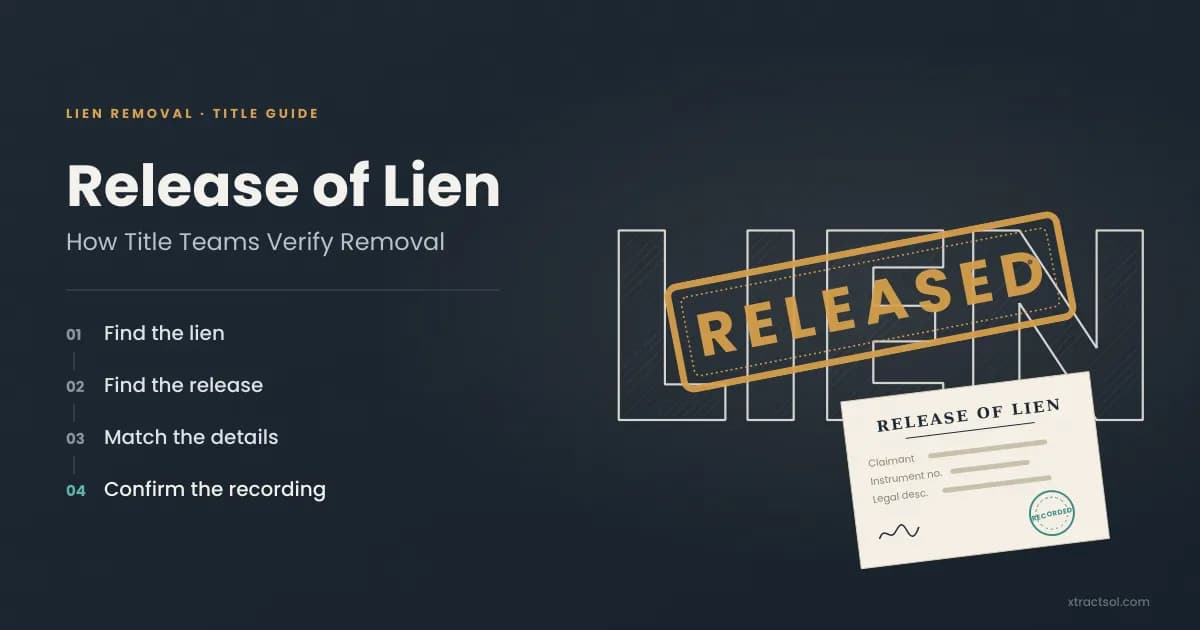
Release of Lien: How Title Teams Verify Removal
Discover how title teams verify a release of lien to clear phantom liens and prevent closing delays. See how a lien waiver differs from a recorded release.
Read more
Title Search
Mechanics Lien on a Property: A 2026 Title Team Guide
Learn how a mechanics lien affects a property sale, how lien priority and release work, and how title teams resolve construction liens before closing.
Read more
Title Search
Satisfaction of Mortgage: Resolving Unreleased Liens
A satisfaction of mortgage releases a paid-off lien, but only when it is recorded. See how title teams verify releases and resolve unreleased mortgage issues.
Read more
Ready to get started?
30 minutes. We walk one of your files from order to closing and send a one-page note on the 2-3 steps worth automating first.