
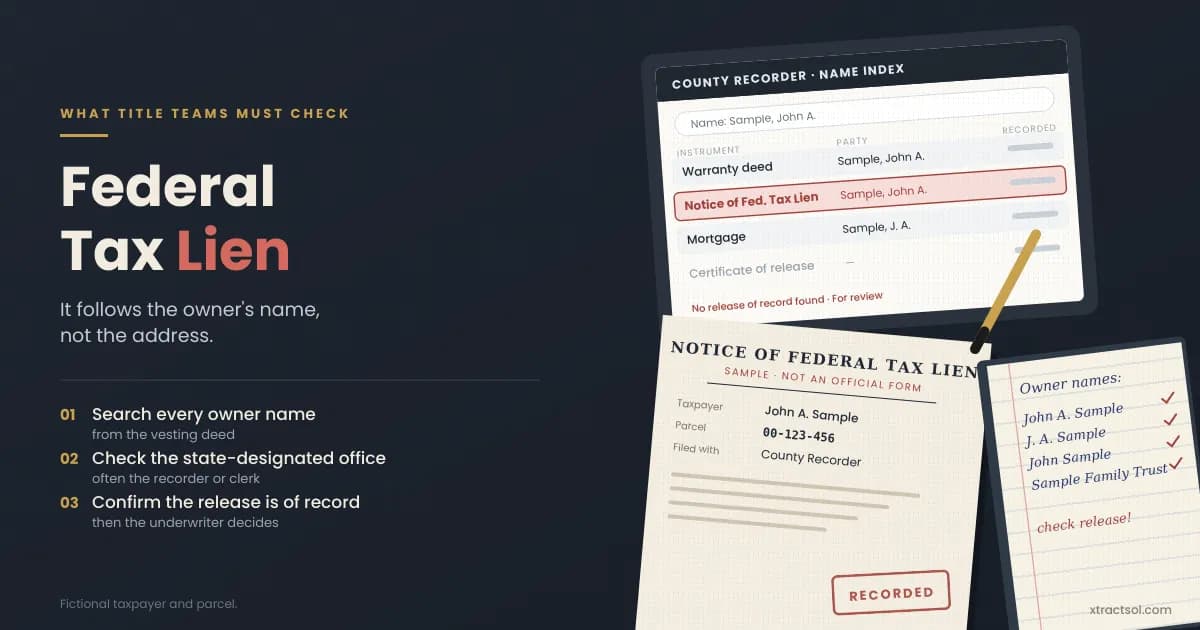
Federal Tax Lien: What Title Teams Must Check
By Usama Muneer, Founder & CEO
• 7 min read
Under 26 U.S.C. § 6321, an unpaid tax becomes a lien for the United States after an IRS demand. The lien reaches all property and rights to property the person owns. The IRS explains that the lien also covers assets the taxpayer acquires while the lien lasts. A federal tax lien can exist before a notice is recorded. A team that reads only the property description can miss the owner's name-based liens. The American Land Title Association (ALTA) describes a lien as a legal claim against a property that may arise from unpaid taxes. Examiners search each owner's name in the offices state law designates. They then confirm a release or satisfaction is of record.
Key Takeaways
- A federal tax lien arises by law after an unpaid tax and covers assets the taxpayer acquires while it lasts.
- The notice is filed in the one office your state designates, so the index is a question of state law.
- Judgment liens and state tax liens follow state rules, each with its own release.
- Title teams match each name hit to the deed and confirm a release of record. The underwriter decides whether the requirement is satisfied.
How Does a Federal Tax Lien Attach to a Property?
The lien attaches by law to every property interest the taxpayer owns, including property the taxpayer acquires while the lien lasts.
The lien starts when the IRS records the tax as owed and the taxpayer does not pay after notice and demand. To warn other creditors, the IRS files a Notice of Federal Tax Lien. Under 26 U.S.C. § 6323, the lien is not valid against certain parties until notice is filed. That group includes a purchaser, a holder of a security interest, a mechanic's lienor, and a judgment lien creditor.
Under § 6323(f), for real estate the notice goes to one office. Your state designates it for the county where the property sits. In practice that is often the county recorder or clerk. Where state law makes a deed's filing effective only when it is indexed, the notice must be indexed. A reasonable inspection of the index must then reveal it (26 U.S.C. § 6323(f)(4)). That is why a county recorder title search starts with the office, index, and owner name.
The lien lasts until the tax is paid or time runs out (26 U.S.C. § 6322). The IRS generally has 10 years from assessment to collect (§ 6502). A notice must be refiled in a one-year window. That window ends 30 days after the 10 years. If it isn't, it is treated as filed on the later refiling date (§ 6323(g)).
Why Do Lien Searches Miss Tax and Judgment Liens?
A search can miss a lien when it uses the address instead of every owner name. It can also miss when it checks one office and the record sits in another.
Start with the vesting deed, not the tax bill. List every owner as the deed spells the name, plus middle names, former names, trusts, and entity names. Common names produce false hits, so the last known address helps narrow the list.
Finding judgment liens on real estate has the same trap. The search covers the county where the property sits, even if the owner lives elsewhere. Index names vary by county. A grantor-grantee index lists parties by name, and a tract index follows the parcel. Judgments or tax liens may sit in a court or general index. So a due diligence search starts with the county's own list, online or in person.
A recorded civil judgment can cloud title and hold a closing. So can an unpaid state tax debt on record.
Federal Tax Lien vs. Judgment Lien vs. State Tax Lien
A federal tax lien follows federal filing rules, while a judgment lien and a state tax lien follow state law.
| Lien | Started by | Filed in | Ended by |
|---|---|---|---|
| Federal tax lien | Unpaid federal tax after demand | State-designated office, often the recorder | Paid or time runs out, shown by a certificate of release; a discharge frees one property; a withdrawal removes the notice |
| State tax lien | Unpaid state tax | State-designated office, often the recorder or clerk | State revenue release |
| Civil judgment lien | A recorded court judgment | Recorder or clerk where docketed | Satisfaction, release, or end of term |
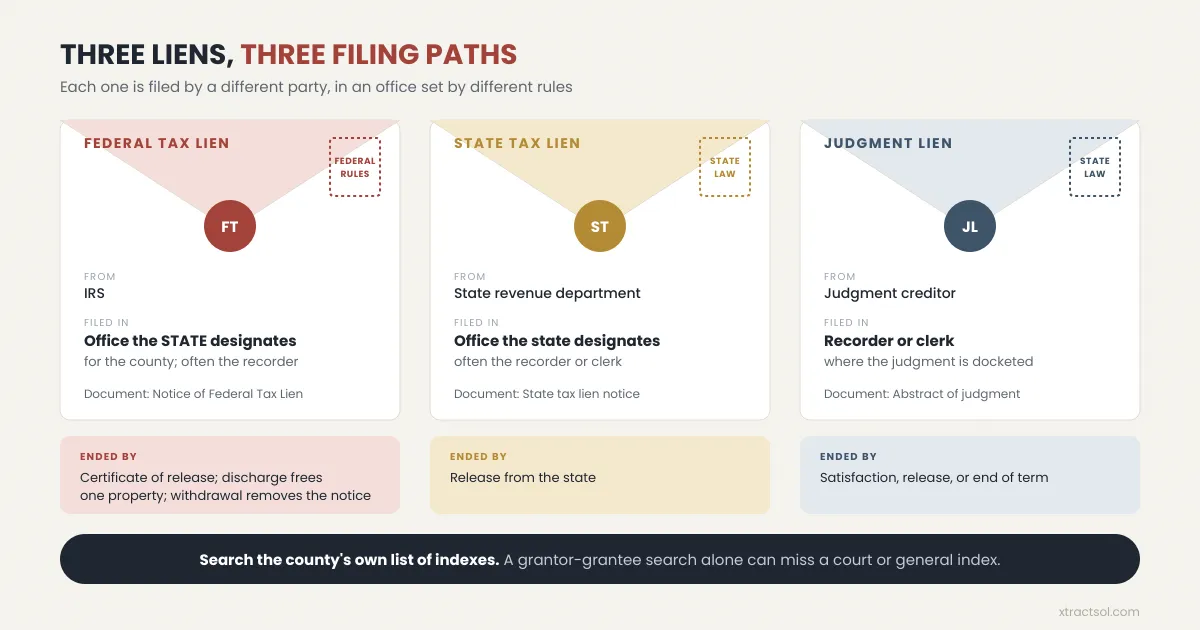
A state tax lien starts with unpaid state tax under state law. A state revenue department records the notice with the office the state designates, and a release comes from the state. A civil judgment lien starts with a court judgment. The creditor records an abstract of judgment with the county recorder or clerk. That short court paper shows the judgment. The term comes from state law and may need renewal.
Property tax bills and payment status records are separate from a state tax lien. They usually sit with the county treasurer or tax collector.
How Is a Federal Tax Lien Released Before Closing?
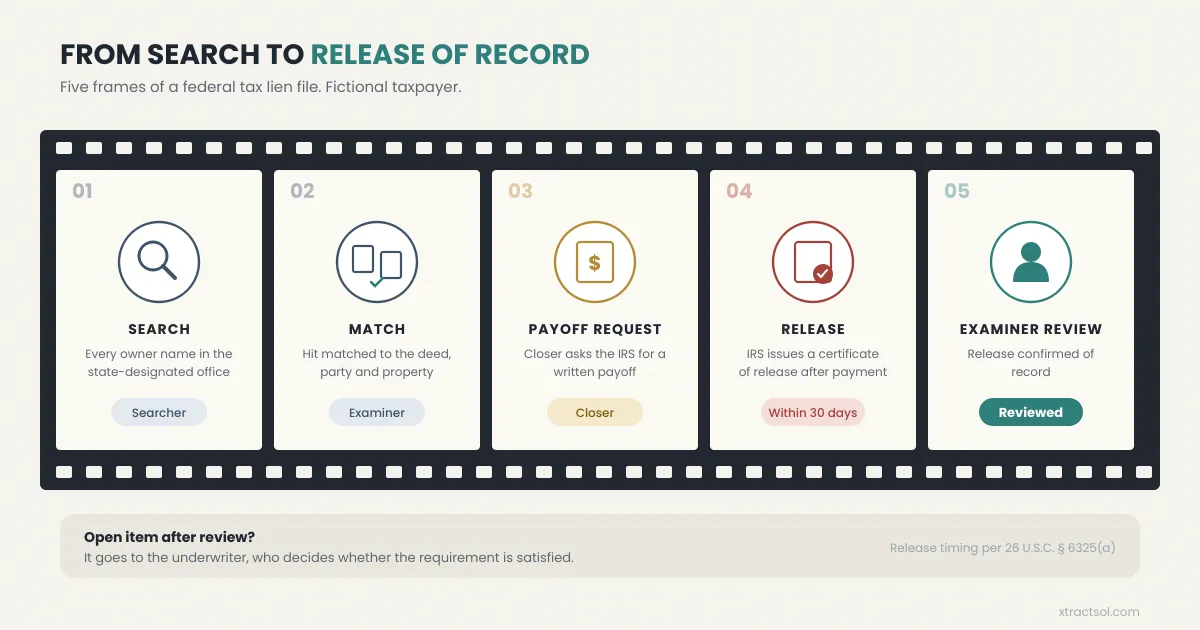
The closer requests a written IRS payoff, the IRS issues the release after payment, and the examiner confirms the document is of record.
Ask the IRS for a payoff, a separate figure from the notice. After payment, the IRS must issue a certificate of release within 30 days. The clock starts when the liability is fully paid or becomes legally unenforceable (26 U.S.C. § 6325(a)). The IRS may issue a certificate of discharge under § 6325(b) for one property, and the debt stays in place. The IRS may also withdraw a notice under § 6323(j).
A release of lien recorded where the judgment was docketed ends that judgment lien. The examiner confirms the recorded document before treating a lien as released. The examiner's job does not change with title search automation: match each hit to the property, then confirm the recorded release.
Implementation & Operational Considerations
The searcher pulls the vesting deed and lists every owner name, including former names. The searcher works through the county's owner-name search steps. The examiner searches those names for federal, state, and judgment liens in the offices the county and state use. Then the examiner matches each hit to the property and the party. The closer orders the payoff and handles funds. The examiner confirms the release, discharge, satisfaction, or withdrawal is of record. Any open item goes to the underwriter for a decision on the requirement.
XtractSol Agents prepare the title search package, every finding linked to the recorded document. The examiner confirms the right documents came back. Examiners make every title decision.
Conclusion
A lien search is only as good as its names and offices. Confirm the recorded release for each hit, and let the underwriter decide whether the requirement is satisfied. That reduces the chance a lien surfaces after closing.
See where AI fits in your title workflow.
Book a Free 30-Minute Workflow Review
Frequently Asked Questions
Search each owner's full legal name in the office your state designates for federal tax liens, often the county recorder or clerk. The notice is usually indexed by taxpayer name, so an address search can miss it.
Yes. The owner can pay the debt and get a release, or the IRS may discharge the lien from that property. The team confirms the release is recorded, and the underwriter decides whether the requirement is met.
Until the tax is paid or becomes unenforceable by lapse of time (§ 6322). The IRS generally has 10 years after assessment to collect (§ 6502), and a notice must be refiled in the § 6323(g) window to keep its filing date.
About the Author
Usama Muneer, Founder & CEO, XtractSol. Usama writes about title search operations, public records, and practical automation for title and escrow teams.
XtractSol Agents prepare the search package from public records; examiners make every title decision.
See where AI fits in your title workflow.
Stay Updated
Get the latest insights on AI and automation delivered to your inbox.
See where AI fits in your title workflow.
Stay Updated
Get the latest insights on AI and automation delivered to your inbox.
More posts
Product notes, how we build, and what we are learning.
Title Search
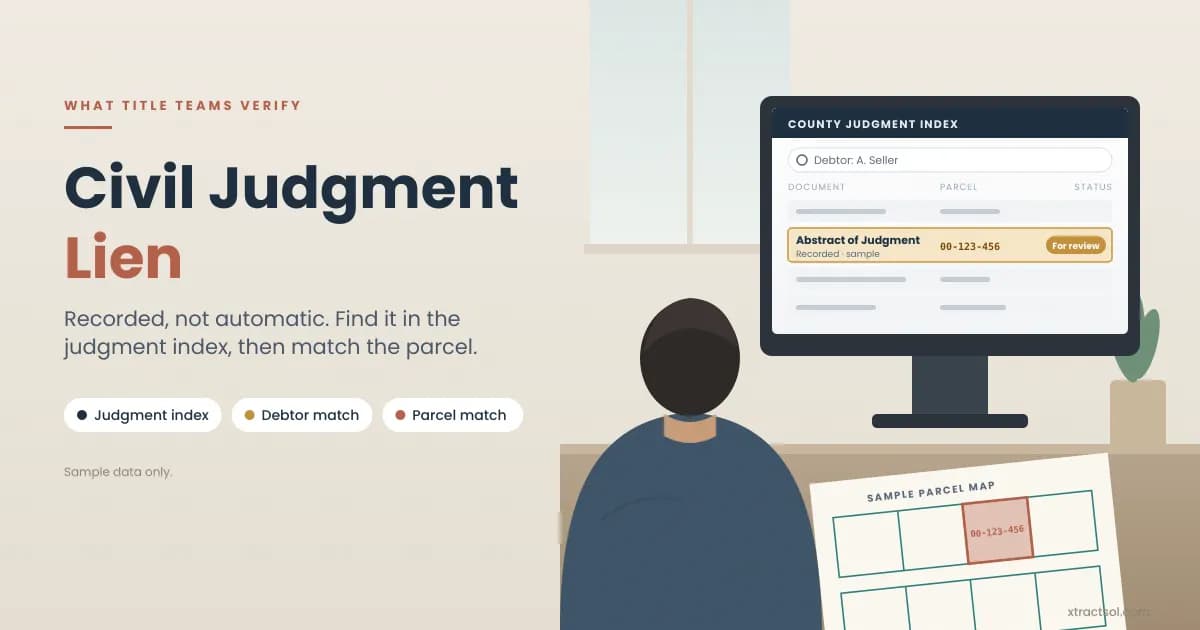
Civil Judgment Lien: What Title Teams Verify
A civil judgment lien attaches to real estate only after the creditor records the judgment. See how title teams find, renew, and release one before closing.
Read more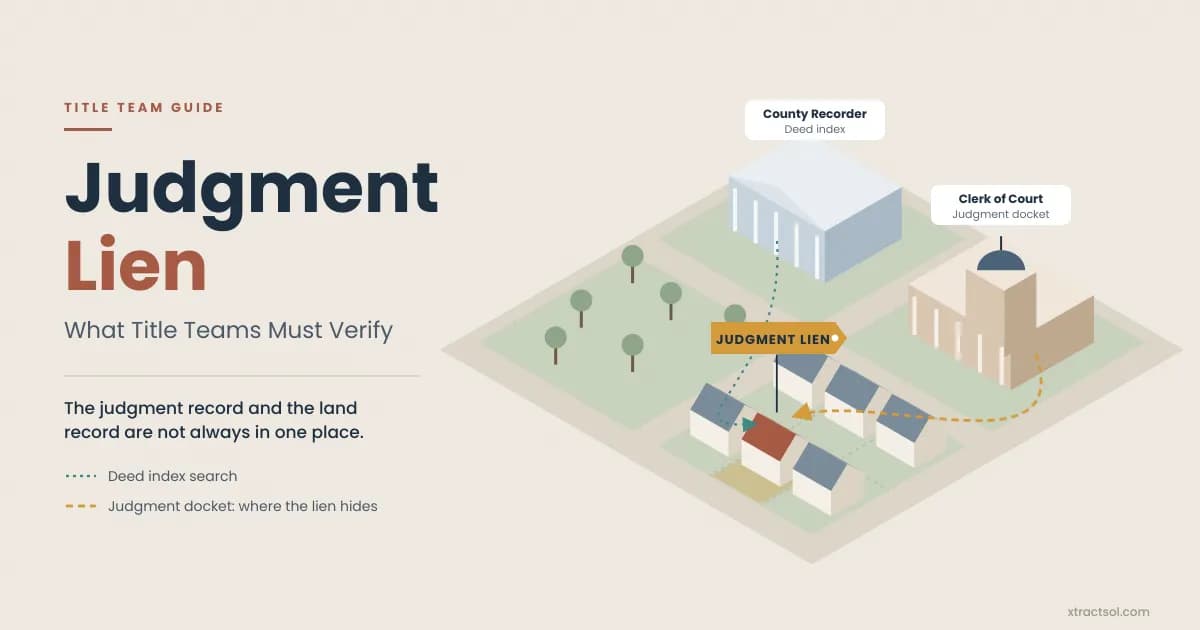
General
Judgment Lien on Real Property: A Title Team Guide
Learn how a judgment lien attaches to real property, how state recording rules and duration work, and how title teams find and resolve liens before closing.
Read more
Title Search
What Is an Auditor? A Guide for Title and Escrow Teams
Learn what an auditor is in real estate, how county auditor and recorder duties vary by state and county, and which records a deed needs before recording.
Read more
Ready to get started?
30 minutes. You walk us through how one file moves from order to closing, and we send a one-page note on the 2-3 steps worth automating first. Nothing to send us.