
How to Transfer Property Title After Divorce
By Usama Muneer, Founder & CEO
• 7 min read
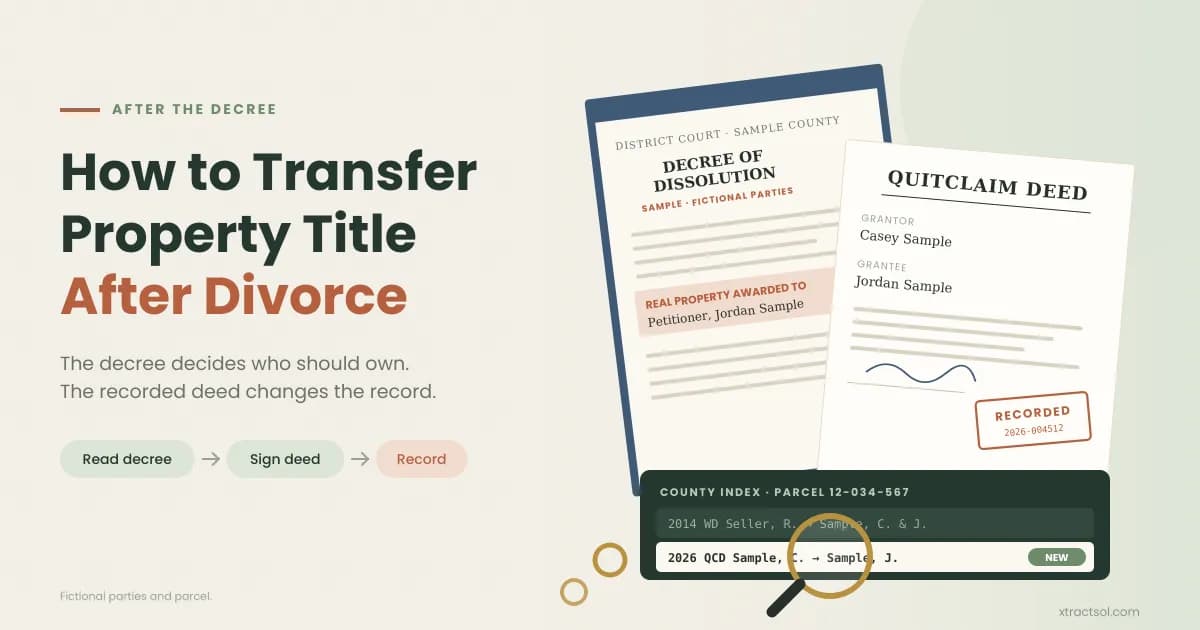
A divorce decree decides who should end up with the house. It does not change the name on the deed of record. Title moves when a written deed is signed and recorded in the county office that holds land records. Cornell Law School's Legal Information Institute defines a deed as the document that transfers title and notes that recording gives public notice. That gap is where the question of how to transfer property title after divorce gets settled. A decree can be final while both names sit on the deed and county index. The team fixes it by reading the decree, picking the right deed, settling the loan, and recording against the parcel. XtractSol Agents prepare the search package from public records, and the examiner reviews it.
Key Takeaways
- A divorce decree usually sets entitlement, but a signed and recorded deed is what changes the county record.
- The spouse who gives up a share often signs a quitclaim or special warranty deed, depending on state practice and the decree.
- A deed does not release either spouse from the mortgage, so the lender handles that separately.
- The examiner confirms the deed recorded against the right parcel with the right description.
Does a divorce decree change property title on its own?
Usually not. A decree can order one spouse to convey the home, but it usually does not move title by itself. Title, the deed, and the chain of title are three different things. Title is the legal right to own and use property. The deed is the signed instrument that passes that right. The chain of title is the record of instruments that shows how ownership reached today. The county index reports the last recorded conveyance, so a decree alone can leave both names on record.
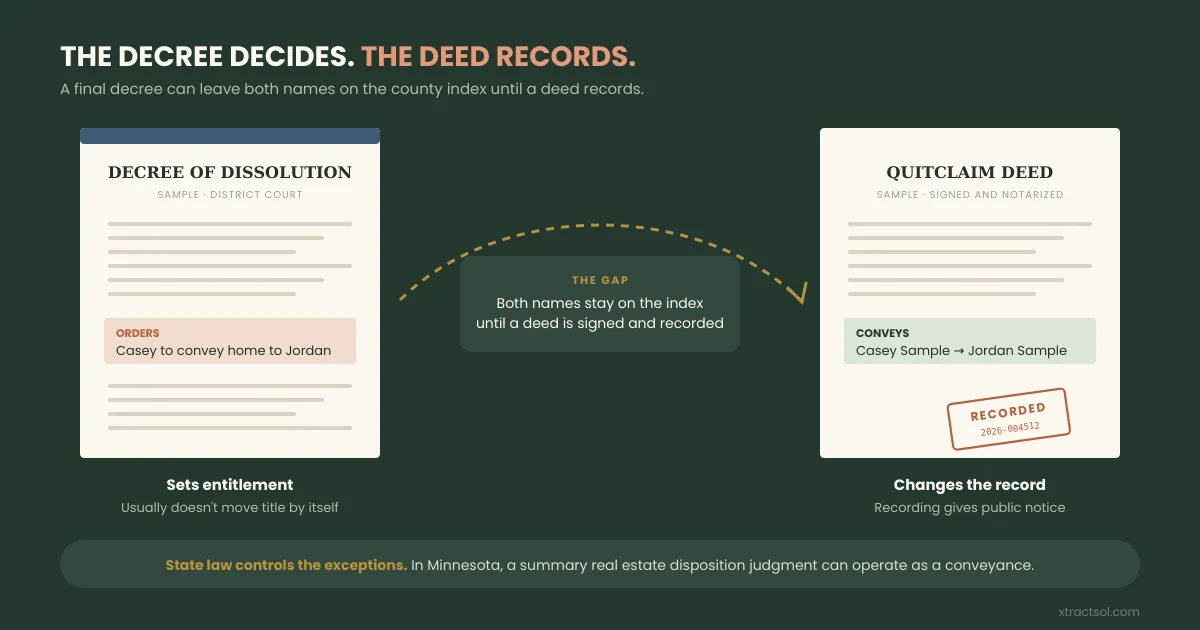
State law controls the exceptions. In Minnesota, for example, a court-approved summary real estate disposition judgment "operates as a conveyance and transfer" of the interests it describes (Minn. Stat. § 518.191, subd. 4). Recording or filing it protects its priority against some later good-faith purchasers (subd. 5). Where the land is registered, the same judgment is filed with the registrar of titles instead (subd. 3). Until the record changes, a buyer or lender may raise an objection. A title team checks the decree and the state rule before assuming a deed is the only path. It then reads the chain of title to see what the record still holds, which is the practical side of the deed versus title distinction.
Which deed transfers a home after divorce?
Post-divorce transfers often use a quitclaim deed or a special warranty deed. A quitclaim deed passes whatever interest the grantor holds, if any, and makes no promise that the title is good. That fits a spouse giving up a known share. A special warranty deed carries a narrow promise about the grantor's own period of ownership. A general warranty deed carries broader promises, though a lender or decree can require one.
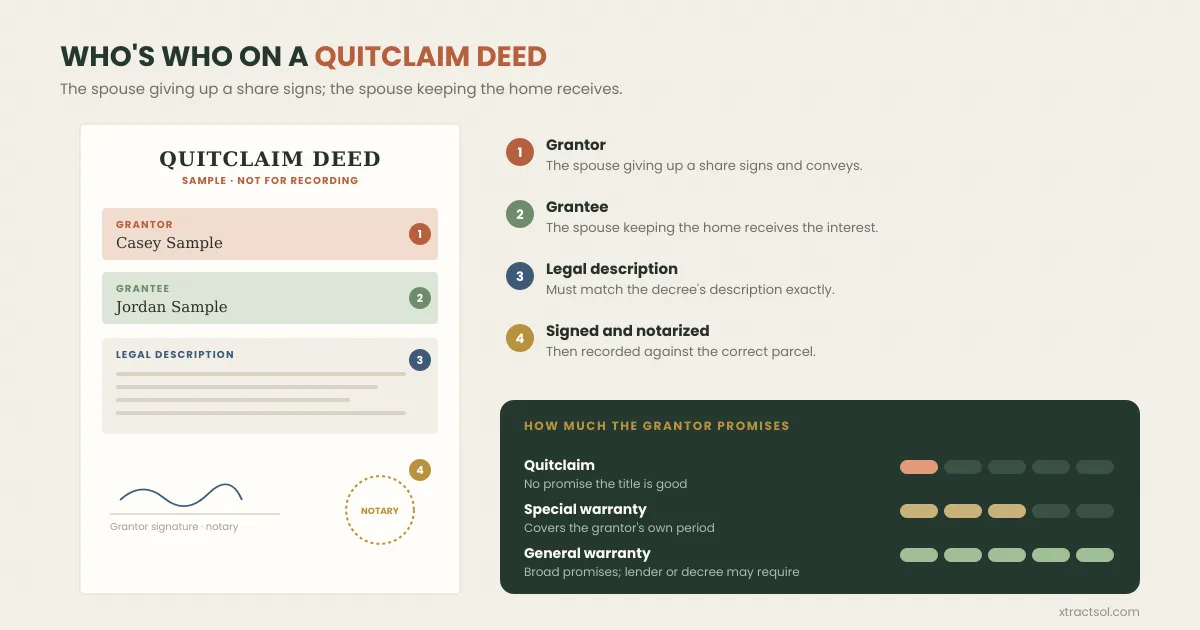
The paperwork often starts with a property settlement agreement. Folded into the decree, it names who keeps the home and who gives up a share. A divorce equity buyout is a related step: one spouse pays the other for their share, and the deed transfers the whole interest to the buyer. The parties' counsel usually prepares the deed, and it should match the decree's legal description exactly. The grantor and grantee are the two parties named on the deed.
What goes wrong between the decree and the recording?
Three problems explain many divorce files. A deed that never records leaves the former spouse on the index and can create a cloud on title that surfaces at the next sale. A description copied from the wrong instrument can record and then fail at closing. The search can also surface an old lien, a missed release, or a judgment against either spouse.
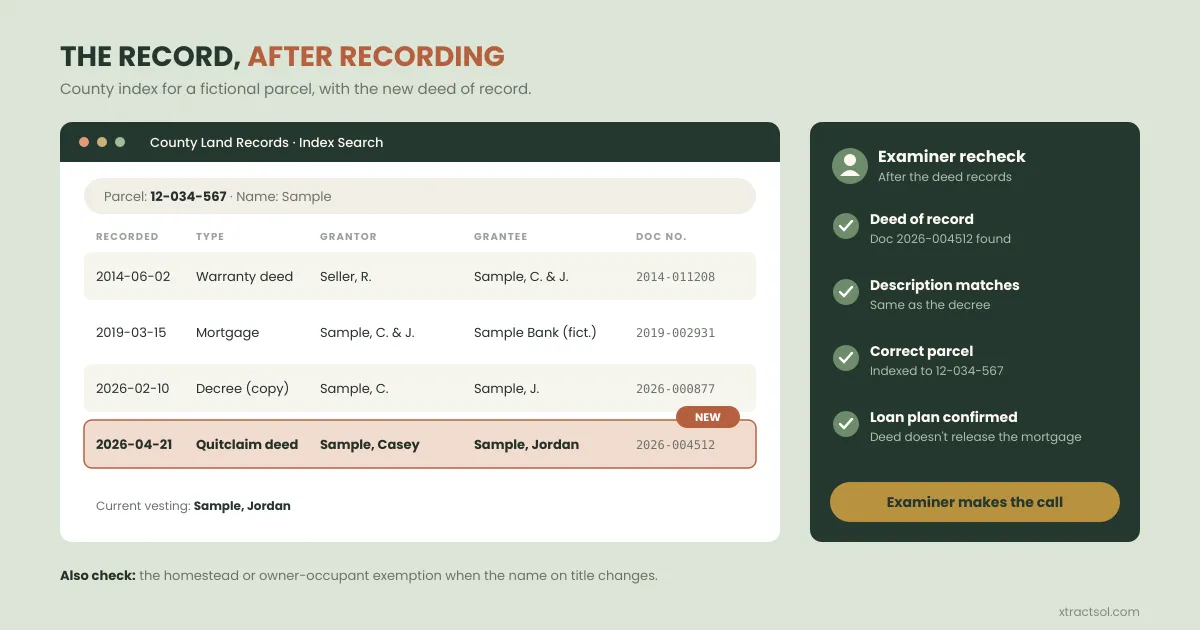
The deed and the mortgage are separate contracts. Signing a deed does not release either spouse from the loan. Some lenders will not remove a borrower unless the loan is paid off or refinanced in the keeping spouse's name, so confirm the loan plan before recording.
How should a title team handle a post-divorce transfer?
Treat the file as an ordered workflow. The parties' counsel chooses the instrument, and a closing agent or attorney records it.
| Check | Who acts | What to confirm |
|---|---|---|
| Read the decree | Examiner | Description and party to convey |
| Pull current deed | Examiner | Names and last conveyance |
| Choose the instrument | Parties' counsel | Quitclaim, special warranty, or a decree that conveys |
| Confirm the loan | Escrow officer or closer | Lender's requirement for removing a borrower |
| Record the deed | Closing agent or attorney | Date, number, parcel |
| Recheck the index | Examiner | Deed of record, description match |
When the name on title changes, the team should also check the homestead or owner-occupant exemption. That exemption is tied to the owner and to a filing with the county office, and the office and rules vary by state and county. In many places, a missed update can raise the tax bill later. When a defect needs follow-up, the team can route it through curative and exception management automation.
Implementation & Operational Considerations
Start with the record, not the paperwork. The examiner pulls the vesting deed, the divorce decree, and the settlement agreement, then compares the legal descriptions. The parties' counsel selects the instrument the state and decree support. The escrow officer or closer confirms the loan plan with the lender before anyone records. A closing agent or attorney records the deed against the correct parcel, and the examiner rechecks the index.
XtractSol Agents prepare the title search package, every finding linked to the recorded document. The examiner confirms the right documents came back. Examiners make every title decision.
The examiner builds the same ownership timeline from recorded deeds, as shown in this chain-of-title case study.
Conclusion
Usually a decree decides who should own the home, and a recorded deed or judgment changes the public record. Read the decree, confirm the state rule, have the parties' counsel choose the instrument, settle the loan, and record against the correct parcel. Teams that follow that order are more likely to find the missing release and wrong description early.
See where AI fits in your title workflow.
Book a Free 30-Minute Workflow Review
Frequently Asked Questions
No. A quitclaim deed is common because the spouse is giving up a known share, but some states accept a special warranty deed. The parties' counsel confirms the choice for the state.
Usually not. The decree sets who is entitled to the property. The name on the deed changes when a new deed is signed and recorded, unless the state allows a recorded decree to act on title.
Order a title search and read the last recorded deed. Confirm the new deed or recorded judgment is of record, its description matches, and it recorded against the correct parcel.
About the Author
Usama Muneer, Founder & CEO, XtractSol. Usama writes about title search operations, public records, and practical automation for title and escrow teams.
XtractSol Agents prepare the search package from public records; examiners make every title decision.
See where AI fits in your title workflow.
Stay Updated
Get the latest insights on AI and automation delivered to your inbox.
See where AI fits in your title workflow.
Stay Updated
Get the latest insights on AI and automation delivered to your inbox.
More posts
Product notes, how we build, and what we are learning.
Title Search
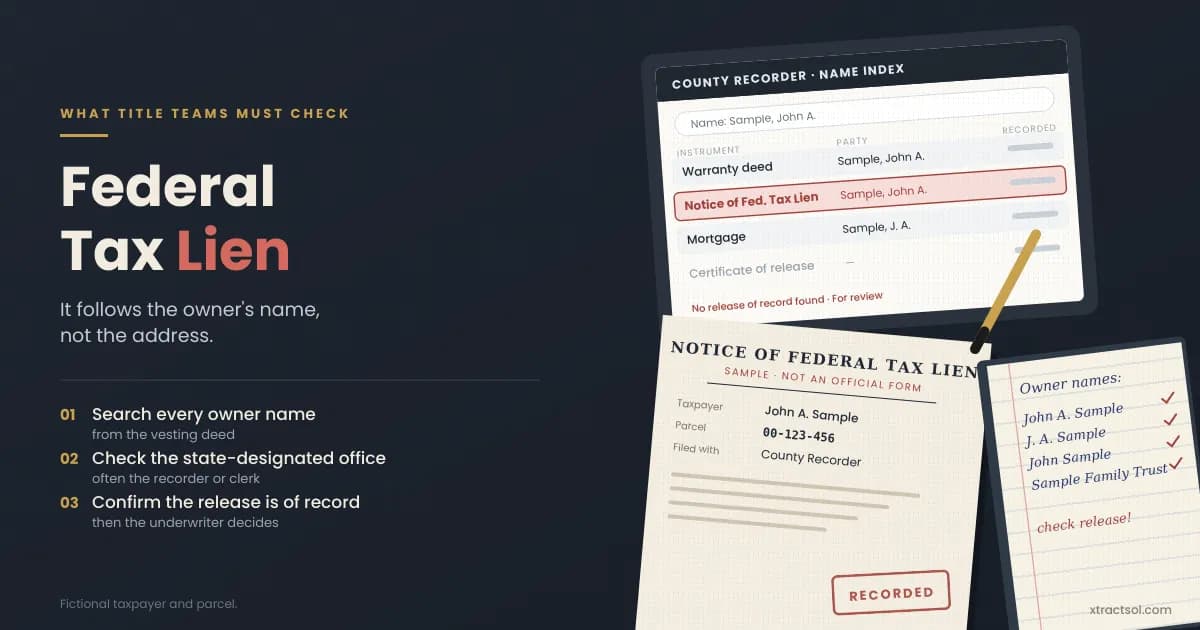
Federal Tax Lien: What Title Teams Must Check
Learn how a federal tax lien attaches, where the notice is filed, how it differs from a judgment lien, and what a title team checks before closing.
Read more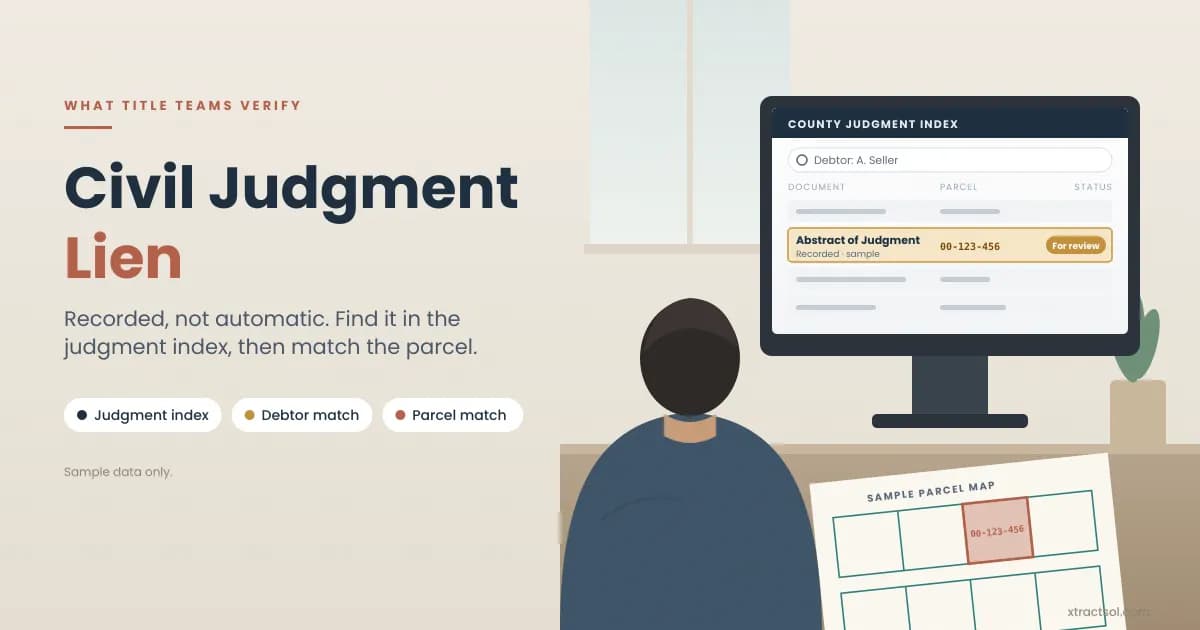
Title Search
Civil Judgment Lien: What Title Teams Verify
A civil judgment lien attaches to real estate only after the creditor records the judgment. See how title teams find, renew, and release one before closing.
Read more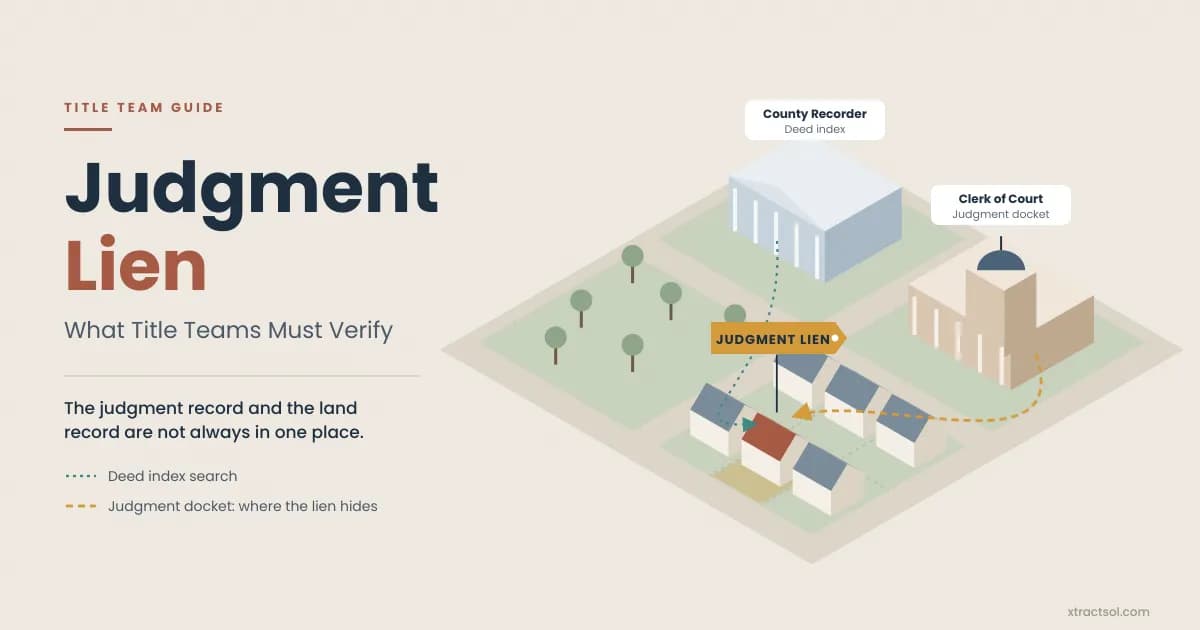
General
Judgment Lien on Real Property: A Title Team Guide
Learn how a judgment lien attaches to real property, how state recording rules and duration work, and how title teams find and resolve liens before closing.
Read more
Ready to get started?
30 minutes. You walk us through how one file moves from order to closing, and we send a one-page note on the 2-3 steps worth automating first. Nothing to send us.