
AI Real Estate Agent: A Guide for Title and Escrow Teams
By Usama Muneer, Founder & CEO
• 7 min read • Updated
An AI real estate agent is software that talks with clients, answers routine questions, and books appointments. For a title or escrow company, that software becomes a Vendor under ALTA's Best Practices 5.0, which list AI agents, chatbots, and virtual assistants and apply even when a company only shares data with the provider. Teams that adopt one without a written scope can end up with answers nobody reviewed. Each tool handles different tasks, so the scope matters more than the label. A short scope, a vetting record, and a review step keep the software in its lane and the decisions with your people.
Key Takeaways
- An AI real estate agent is software that talks with clients, answers routine questions, and books appointments.
- ALTA Best Practices 5.0 list AI agents, chatbots, and virtual assistants as Vendors, even when a company only shares data with them.
- Pillar 7 asks a title company to adopt vendor management and vetting procedures for third-party software and service providers.
- Examiners and closers keep the title and settlement decisions.
What Does an AI Real Estate Agent Do?
The software answers client messages on a website, in text, or by voice. It can book appointments and log each conversation in a customer relationship management (CRM) system. Behind the chat window, it may call an application programming interface (API) to read data from other systems.
Some tools answer written questions only, and others take voice calls or text messages. The label covers all of them, so a title team starts by naming the exact tasks it wants done. The useful tasks are narrow and repeatable. The table shows where the software helps and what your team keeps.
| Task | What the software does | What your team keeps |
|---|---|---|
| Routine questions | Finds an answer in documents you approve | Reviewing answers before they go out |
| Scheduling | Books a call or a signing slot | Confirming the slot with the closer |
| Order intake | Collects the property address and parties | Checking the details against the contract |
| Logging | Saves each conversation to the CRM | Reading the log for gaps |
| Handoff | Passes the client to a person | Deciding when a person must step in |
What Can Go Wrong When Title Teams Use AI Agents?
The first risk is a wrong answer. Software can state a rule that does not exist or apply one state's rule to another. Title rules and office duties vary by state and county, so an answer about recording or taxes needs a human check before a client acts on it.
The second risk is data. ALTA's definition of a Vendor reaches AI products even when a company only shares data or information with the provider. A tool that reads orders or messages can see nonpublic personal information, so you need to know where that data goes.
The third risk is a missing record. If the conversation is not saved, an examiner cannot see what the client was told. The fourth is a handoff that never happens, such as a client with a legal question who keeps talking to the software. None of these risks is a reason to avoid the software. Each one is a reason to write the scope and the review step down before the first client message.
How Do You Vet an AI Real Estate Agent?
Ask each vendor the same questions and write the answers down.
Data and access
Ask what data the software can read and where it is stored. Pillar 7 of ALTA's Best Practices 5.0 asks for due diligence on Vendors and on the sub-vendors they use, so ask which sub-vendors are involved and what each can see.
Source of answers
Ask where answers come from. Software that answers only from documents you approve is easier to review than software that draws on the open web. Ask whether each answer shows the document it came from. Our guide to real estate chatbots covers what to look for in a chatbot.
Handoff to a person
Ask how the software passes a client to a person and what the person sees. The handoff should carry the conversation log so nobody asks the client to repeat it. Keep the vendor's answers to all three questions in one file, so a compliance owner can see what was approved when a feature changes.
How Does an AI Agent Fit a Title Workflow?
Software sits at the edges of the workflow: the first message in and the status update out. The title work in the middle stays with your team.
Inquiries
The software answers routine questions from approved documents and routes the rest to staff. Staff also see the questions the software could not answer, which shows where the approved documents have gaps. Our post on CRM integration for real estate leads shows how conversations reach the CRM.
Order intake
The software collects the property address and parties for a new order. A person checks them against the contract before the search starts. Our guide to document process automation covers the document side of intake.
Examiner review
The examiner reads the search results and writes the exceptions and requirements. The software does not take part in that step.
Implementation & Operational Considerations
Your operations lead lists the tasks the software may do and the ones it may not. Your compliance owner records the vendor review required under Pillar 7 and keeps it on file. An examiner reads a sample of conversations and order entries each week and lists every wrong answer. The team sets a handoff rule for legal questions, and the operations lead reviews the sample results on a regular schedule. Any answer that cites no approved document goes back for correction.
For a worked example of an AI voice workflow for title and escrow calls, see our case study on an AI voice agent for title and escrow calls. Our AI agents service covers the same ground.
XtractSol Agents prepare the title search package, every finding linked to the recorded document. The examiner confirms the right documents came back. Examiners make every title decision.
Conclusion
An AI real estate agent can take routine questions and scheduling off your staff. It needs a written scope, a vendor review under Pillar 7, and a person who reads its answers. As a next step, list the three tasks you would hand to the software and the review step for each.
See where AI fits in your title workflow.
Book a Free 30-Minute Workflow Review
Frequently Asked Questions
Yes. ALTA's 5.0 framework lists AI agents, chatbots, virtual assistants, and similar AI products in its definition of a Vendor, even when the company only shares data or information with the provider.
No. It can answer routine questions and book appointments. Title decisions stay with the examiner, and settlement decisions stay with the closer.
Questions about title requirements, liens, recording, taxes, or legal effect. State and county rules differ, so a person should answer them.
An examiner or closer reads a sample of conversations on a regular schedule and marks each answer right or wrong. Wrong answers go back to the vendor and into the approved documents, and the sample results go in a review file.
About the Author
Usama Muneer, Founder & CEO, XtractSol. Usama writes about title search operations, public records, and practical automation for title and escrow teams.
XtractSol Agents prepare the search package from public records; examiners make every title decision.
See where AI fits in your title workflow.
Stay Updated
Get the latest insights on AI and automation delivered to your inbox.
See where AI fits in your title workflow.
Stay Updated
Get the latest insights on AI and automation delivered to your inbox.
More posts
Product notes, how we build, and what we are learning.
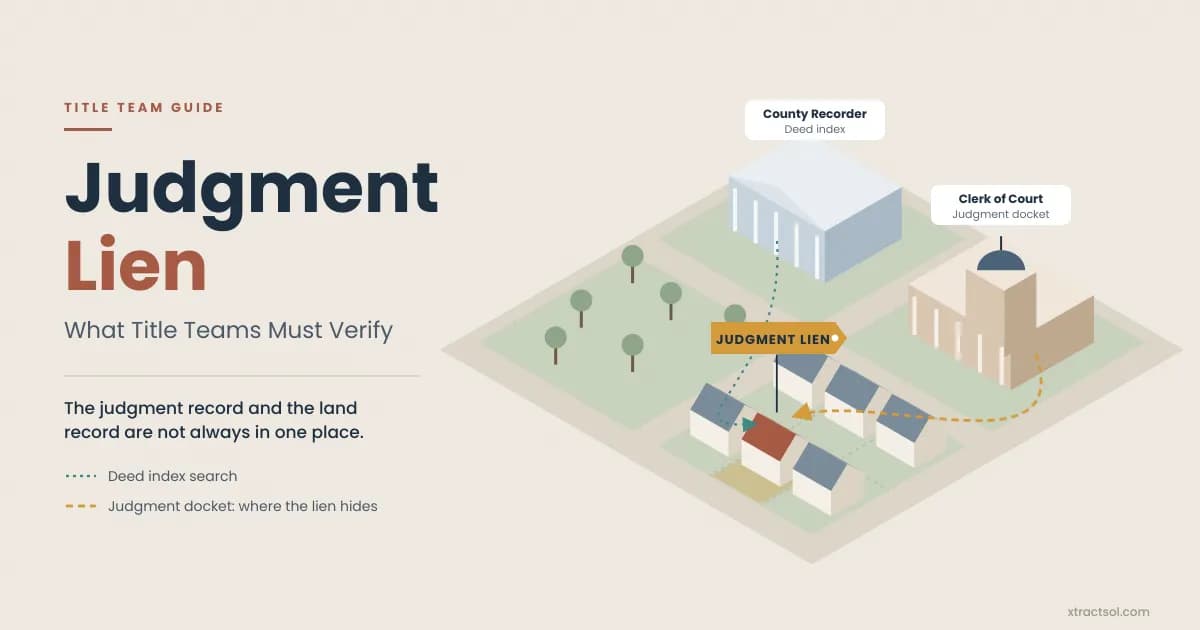
General
Judgment Lien on Real Property: A Title Team Guide
Learn how a judgment lien attaches to real property, how state recording rules and duration work, and how title teams find and resolve liens before closing.
Read more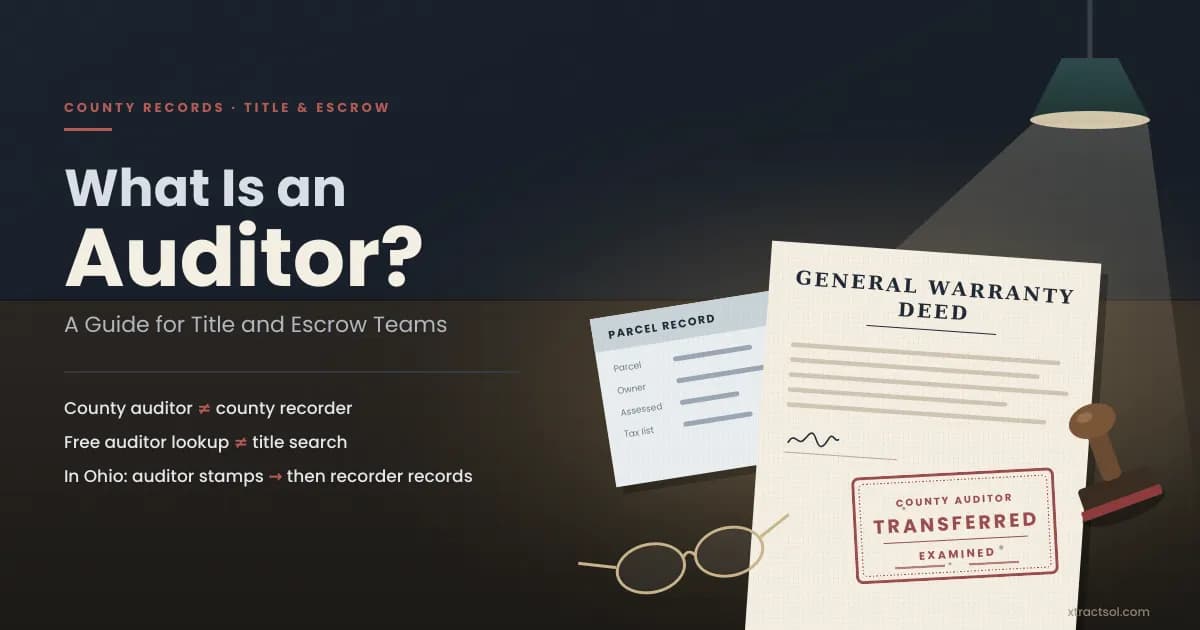
Title Search
What Is an Auditor? A Guide for Title and Escrow Teams
Learn what an auditor is in real estate, how county auditor and recorder duties vary by state and county, and which records a deed needs before recording.
Read more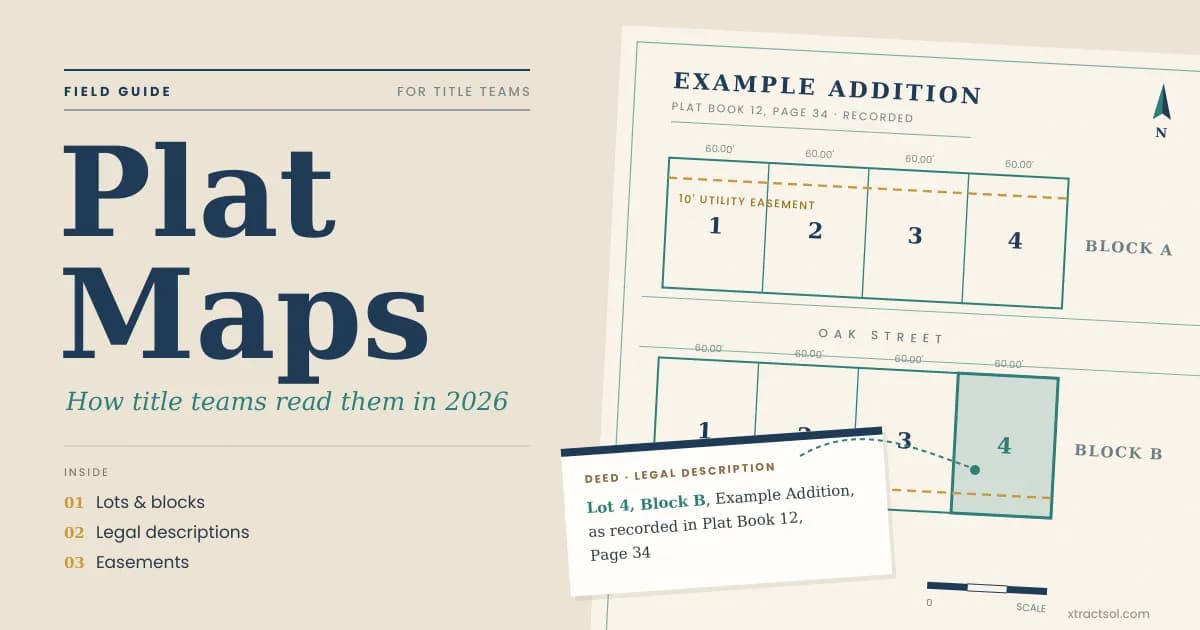
Title Search
Plat Maps Explained: A Guide for Title Teams (2026)
Learn how plat maps define lots, blocks, and easements, and how title teams use recorded plats to support more accurate property searches and commitments.
Read more
Ready to get started?
30 minutes. You walk us through how one file moves from order to closing, and we send a one-page note on the 2-3 steps worth automating first. Nothing to send us.