
Chain of Title vs Abstract of Title: What's the Difference?
By Usama Muneer, Founder & CEO
• 7 min read • Updated
Every title team needs to know how ownership moved from one person to the next, and what else affects the property along the way. Chain of title vs abstract of title is the question behind that work. A chain of title shows the history of transfers. An abstract of title summarizes the important recorded facts. Mixing them up can send a search in the wrong direction, and title and deed issues were behind 11% of delayed closings in April 2018. XtractSol Agents prepare the search package from public records, and the examiner reviews it.
Key Takeaways
- A chain of title traces who owned the property and how each transfer happened.
- An abstract of title summarizes recorded facts, such as liens and transfers.
- An abstract reports what the records show. It does not give a legal opinion.
- Both rely on the source records, so keep each finding linked to its document.
What Is the Difference Between a Chain of Title and an Abstract of Title?
The two terms are related, but they answer different questions. One follows ownership. The other gathers the important facts. The table shows the main differences.
Chain of title
Cornell Law School describes chain of title as a documented history of each time property changed hands. In real estate, each recorded deed is a link between one owner and the next. The examiner reads the links in order and looks for gaps, such as a missing deed or a name that does not match.
Abstract of title
Cornell also describes an abstract of title as a summary of public records that notes liens, claims, and transfers. It reports what the land records show and does not explain what they mean legally. An abstract makes a large record easier to read, but the source documents still matter when an issue needs a closer look.
| Feature | Chain of title | Abstract of title |
|---|---|---|
| What it shows | Order of ownership transfers | Summary of important recorded matters |
| Main question | How did ownership move? | What affects the title? |
| Typical contents | Deeds and related transfers | Transfers, liens, assignments, encumbrances |
| Format | Links in date order | Short written summary |
| Main use | Finding gaps in ownership | Giving reviewers a short view |
How Is Each One Prepared?
Both start with the same step: finding the recorded documents. They differ in what the examiner does next.
To trace a chain of title, the examiner starts with the current owner's deed and works backward through earlier transfers. Each owner has to connect to the next. Depending on the property and the county, the search can also involve mortgages, assignments, releases, probate files, tax records, and court records. The examiner checks names and legal descriptions at each link, because a small difference can hide a break.
To prepare an abstract, the abstractor reviews the same records and writes down the important facts. These include transfers, liens, assignments, and other recorded matters. A good abstract points back to the source document, so a reviewer can open it when something looks off. Our guide to title abstracting explains the abstractor's work in more detail.
Why Does Title History Matter, and What Problems Show Up?
A problem in the record can stop a closing. If a mortgage was never released, or two people claim the same interest, someone has to fix it before the sale can move forward. That fixing is called curative work, and our guide to title curative shows how it works.
A break in the chain can also leave doubt about how ownership passed from one person to another. Depending on the issue and the state, fixing it may take new documents, corrective instruments, or a court case.
Common problems in the record include:
- Missing records or gaps in the file
- Unreleased liens or other encumbrances
- Name variations or spelling errors
- Conflicting ownership claims
- Gaps caused by missing or badly recorded documents
- Forged or fraudulent documents
Recording a document does not prove that everything in it is accurate. That is why examiners read the underlying documents and do not rely on the recording alone.
Which Is More Reliable, and How Do They Fit in a Title Search?
Neither is more reliable, because they do different jobs. A chain of title answers how ownership got to the current owner. An abstract gives a short list of what the records show. The examiner needs both views.
An abstract can speed up review, but it can also hide a mistake. If a source record was missed or summarized wrongly, the summary carries the error forward. A chain can have the opposite problem, because tracing many records takes detailed work. A reliable process keeps each finding linked to its source document.
In a title search, the steps look like this:
- Collect records from county offices, courts, and tax authorities.
- Trace the transfers and review related documents.
- List liens, easements, judgments, and releases.
- Put the findings into a report or abstract.
- Review the results for gaps and defects.
Our posts on what a title search is and how to search public property records cover the steps in more detail.
Implementation & Operational Considerations
Your operations lead picks one step to improve first. For many teams, this is the record gathering that comes before the chain is built. The team lists the sources it uses, who reviews each result, and how gaps are reported. A few real orders go through first, and the examiner compares the output with a manual search.
XtractSol's title search automation service gathers records from county recorders, clerks, tax authorities, and title plants. It assembles the chain of title in date order, flags encumbrances without resolving them, and delivers a package where each document links to its source. To see how this works on deed records, read our case study on automated chain of title from deeds to an ownership timeline.
Keep a rule for records that are not online: a person retrieves them, and the package says so.
XtractSol Agents prepare the title search package, every finding linked to the recorded document. The examiner confirms the right documents came back. Examiners make every title decision.
Conclusion
A chain of title shows how ownership moved, and an abstract of title summarizes what the records disclose. Both depend on the quality of the source records and the care of the review. As a next step, check whether your team's reports link each finding back to its recorded document.
See where AI fits in your title workflow.
Book a Free 30-Minute Workflow Review
Frequently Asked Questions
A chain of title traces the order of ownership transfers. An abstract of title summarizes recorded facts that affect the title, such as transfers, liens, and assignments.
It helps title professionals trace ownership and find gaps, mismatches, or competing claims before a transaction goes forward.
No. An abstract is a useful summary, but it does not replace the source records or the examiner's review. What else is needed depends on the transaction, the state, and underwriting rules.
It can gather records, extract names and dates, organize the ownership history, and link each finding to its source. The examiner then reviews exceptions and decides.
Missing records, unreleased liens, name variations, conflicting ownership claims, gaps in the chain, and other recorded matters that need more research.
About the Author
Usama Muneer, Founder & CEO, XtractSol. Usama writes about title search operations, public records, and practical automation for title and escrow teams.
XtractSol Agents prepare the search package from public records; examiners make every title decision.
See where AI fits in your title workflow.
Stay Updated
Get the latest insights on AI and automation delivered to your inbox.
See where AI fits in your title workflow.
Stay Updated
Get the latest insights on AI and automation delivered to your inbox.
More posts
Product notes, how we build, and what we are learning.
General
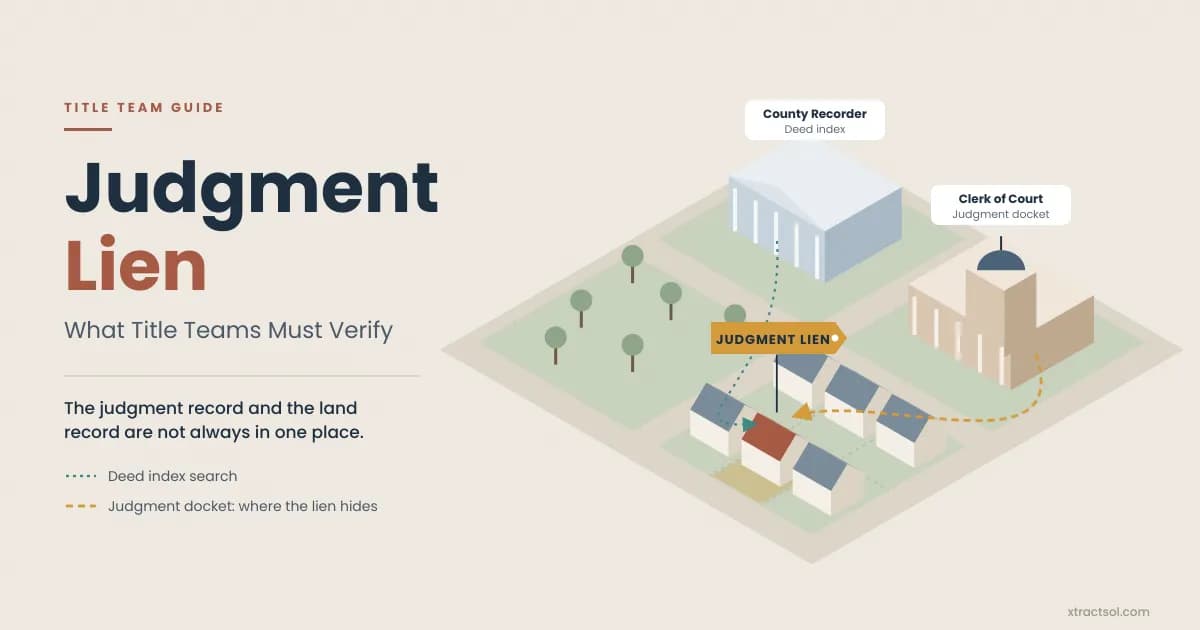
Judgment Lien on Real Property: A Title Team Guide
Learn how a judgment lien attaches to real property, how state recording rules and duration work, and how title teams find and resolve liens before closing.
Read more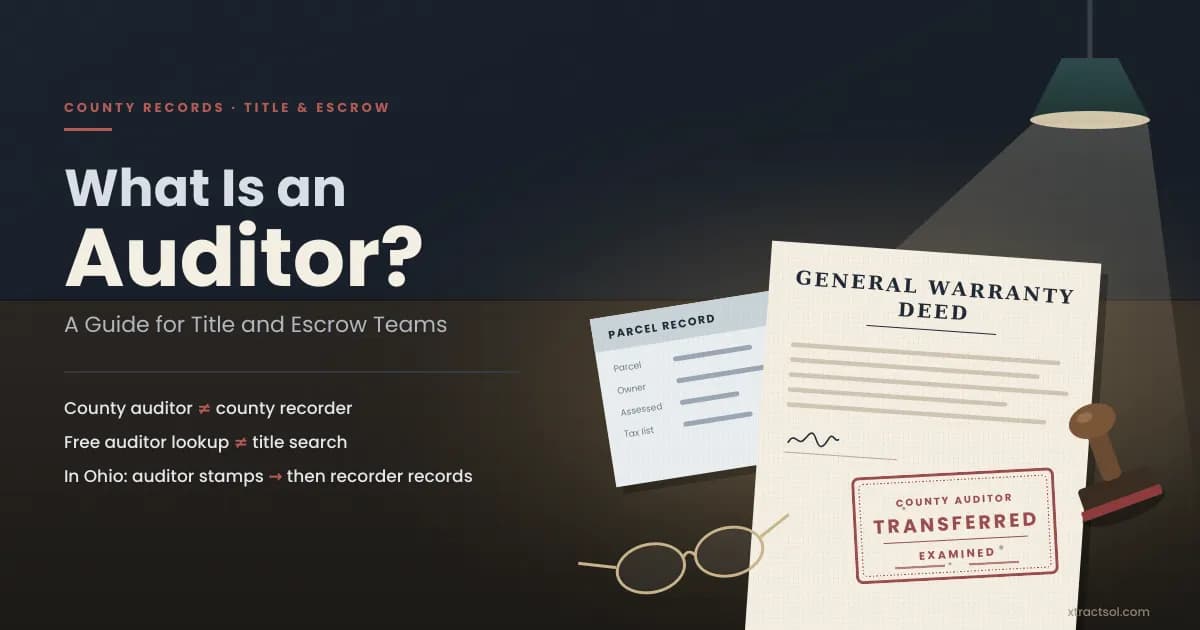
Title Search
What Is an Auditor? A Guide for Title and Escrow Teams
Learn what an auditor is in real estate, how county auditor and recorder duties vary by state and county, and which records a deed needs before recording.
Read more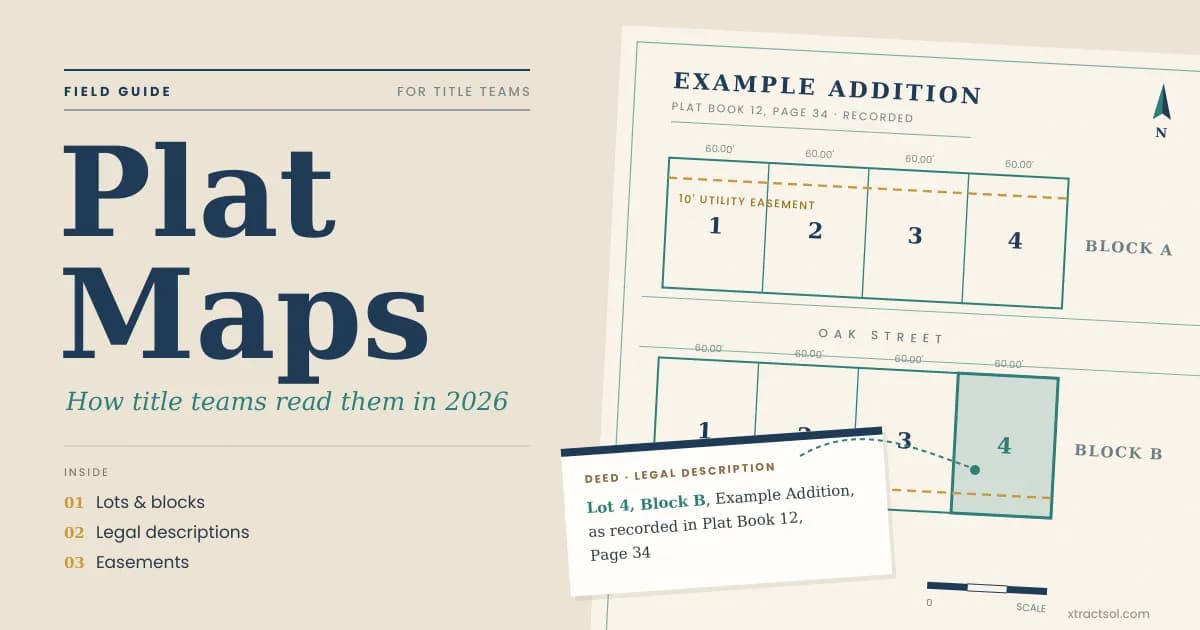
Title Search
Plat Maps Explained: A Guide for Title Teams (2026)
Learn how plat maps define lots, blocks, and easements, and how title teams use recorded plats to support more accurate property searches and commitments.
Read more
Ready to get started?
30 minutes. You walk us through how one file moves from order to closing, and we send a one-page note on the 2-3 steps worth automating first. Nothing to send us.