
How to Start a Title Company: A Practical Startup Guide
By Usama Muneer, Founder & CEO
• 7 min read • Updated
A title company searches property records and sells title insurance, which Cornell's Legal Information Institute describes as coverage that protects buyers against problems with a property's title. If you are working out how to start a title company, begin with the license. Rules differ by state, and ALTA's Best Practices open with a pillar that asks a company to establish and maintain the licenses required for title insurance and settlement work. Then write the trust account procedures and the search workflow before the first order arrives, and give each step a named owner.
Key Takeaways
- Licensing for title insurance and settlement work is set by each state, so start with your state's department of insurance.
- ALTA's Best Practices open with Pillar 1, which asks a company to establish and maintain the licenses its work requires.
- A written workflow from order intake to recording keeps every file on the same steps.
- Examiners read the records and decide what each commitment requires.
What Does It Take to Start a Title Company?
A title company needs a license, a way to issue policies, written procedures, and a team that can search and examine records. Whether you set up as an agency that issues policies for an underwriter or as a company that underwrites is a question for your state's department of insurance. Plan for the team as well. A new company needs people who can search records, examine them, and handle closings, and a plan for who covers each role when someone is out.
ALTA's Best Practices give a useful setup list. The table pairs each pillar with what a new company writes down.
| ALTA pillar | What it asks | What you set up |
|---|---|---|
| 1. Licenses | Keep current the licenses the work requires | A list of required licenses and renewal dates |
| 2. Funds and Escrow Trust Accounts | Written procedures and controls for trust accounts | Account rules, reconciliation steps, and who signs |
| 4. Settlement | Standard settlement policies and procedures | A closing checklist and a handoff for each step |
| 5. Title Insurance Policies | Written procedures for policy production, delivery, reporting, and premium remittance | A policy file routine with a named owner |
| 6. Insurance and Fidelity Coverage | Appropriate insurance and fidelity coverage | Coverage quotes compared with your state's rules |
| 7. Vendor Management | Vetting for third-party software and service providers | A review file for each tool you buy |
Why Do New Title Companies Stall?
The first stall is licensing. Requirements differ by state, so a checklist from another state can send you down the wrong path. Our guide to title company requirements and compliance covers the documents a company keeps on file.
The second is trust accounts. Handling client funds without written procedures and reconciliation steps invites errors, and ALTA's Pillar 2 asks for exactly those controls.
The third is an unwritten search workflow. When each examiner searches in a different order, the files look different and review takes longer. The fourth is client communication. Without a set status update, clients call for news and staff stop work to answer. Each of these is easier to fix before the first closing than after it. Ongoing compliance review is the last piece, since rules change and a company that checked once can fall behind.
How Do You Set Up Title Company Workflows?
Write the workflow as steps with a named owner for each one. A short written step list also helps when you hire, since a new employee can see what happens at each stage.
Order intake
Collect the contract, the earnest money details, and the contacts. Record them in one place so every later step reads the same data.
Search and examination
Search the county records and examine the findings. Our guide to a title search walks through the steps. An examiner reads each document and writes the exceptions and requirements.
Commitment
Assemble the commitment from the findings in a set format, so each file reads the same way.
Closing and recording
Schedule the closing, prepare the settlement documents, and handle funding. After closing, confirm each document is of record in the right county and that the policy issues.
How Do You Choose Tools for a New Title Company?
Start with the title production system. It holds orders, documents, and status, and everything else connects to it. Our guide to title management software covers what to compare.
Search tools
Ask each vendor which counties and record types it covers and whether each finding links to the recorded document. A tool that flags a gap is safer than one that skips it without saying so.
Vendor vetting
Pillar 7 of ALTA's Best Practices asks a company to adopt vetting procedures for third-party software and service providers, including due diligence on their sub-vendors. Keep the answers on file so a compliance owner can see what was approved when a feature changes.
In-house or outsourced work
Some work can go to an outside provider. Our guide to outsourcing title processing covers which tasks to hand off and how to vet a provider.
Implementation & Operational Considerations
You start by confirming the required licenses with your state's department of insurance and listing renewal dates. Your operations lead writes the workflow and names an owner for each step. An examiner checks a small first batch against the recorded documents and lists every gap. Your compliance owner records the vendor review under Pillar 7 and the trust account procedures under Pillar 2, then sets a regular review of both. The owner of each pillar reports gaps to you, and you decide what to fix first.
For a worked example of automated record gathering, see our case study on automated title search aggregation. Our title search automation service follows the same steps.
XtractSol Agents prepare the title search package, every finding linked to the recorded document. The examiner confirms the right documents came back. Examiners make every title decision.
Conclusion
Starting a title company means getting the license right for your state, writing procedures for trust accounts and policies, and fixing the workflow before volume arrives. As a next step, list the licenses your state requires and the owner for each ALTA pillar in the table above.
See where AI fits in your title workflow.
Book a Free 30-Minute Workflow Review
Frequently Asked Questions
Each state sets its own licensing rules for title insurance and settlement work. Check your department of insurance for the license types, education, bonding, and insurance it requires, and keep the licenses current.
ALTA's Best Practices include licenses, escrow trust accounts, settlement procedures, policy production and remittance, and insurance and fidelity coverage. Version 5.0 also treats vendor management as its own pillar. State law adds its own rules.
It depends on how you set up and on your state. A company that issues policies for an underwriter needs an agreement with it. Ask your department of insurance which structure applies to you.
A title company searches and examines records, prepares the commitment, handles settlement, and manages recording and policy issuance after closing. Which services you offer depends on your license and your state.
About the Author
Usama Muneer, Founder & CEO, XtractSol. Usama writes about title search operations, public records, and practical automation for title and escrow teams.
XtractSol Agents prepare the search package from public records; examiners make every title decision.
See where AI fits in your title workflow.
Stay Updated
Get the latest insights on AI and automation delivered to your inbox.
See where AI fits in your title workflow.
Stay Updated
Get the latest insights on AI and automation delivered to your inbox.
More posts
Product notes, how we build, and what we are learning.
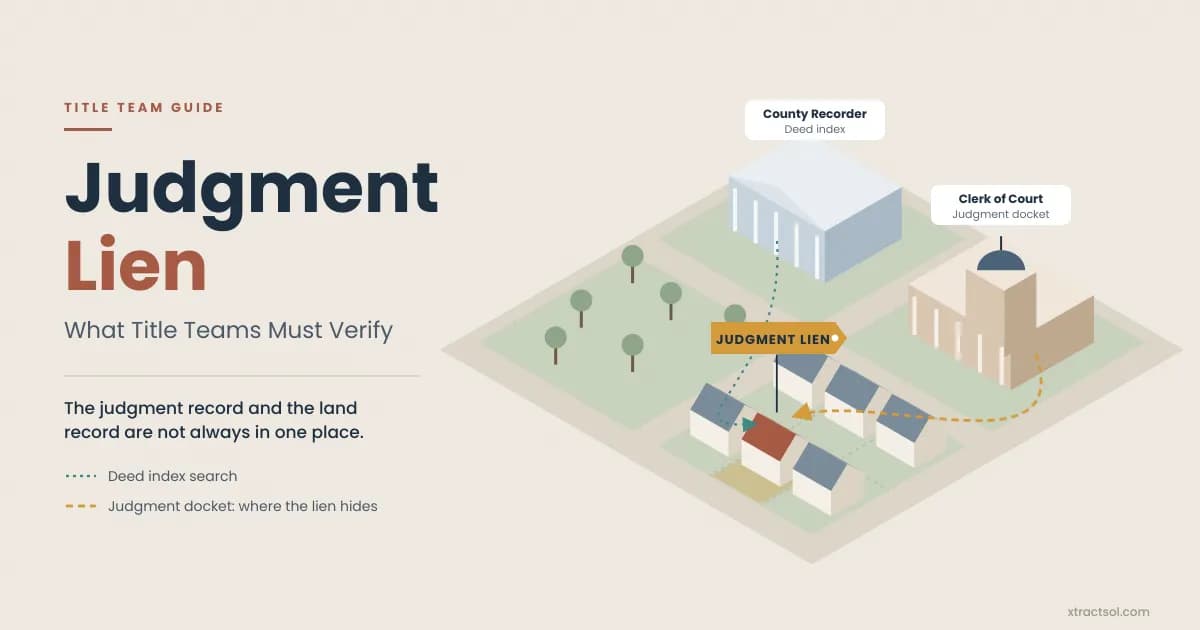
General
Judgment Lien on Real Property: A Title Team Guide
Learn how a judgment lien attaches to real property, how state recording rules and duration work, and how title teams find and resolve liens before closing.
Read more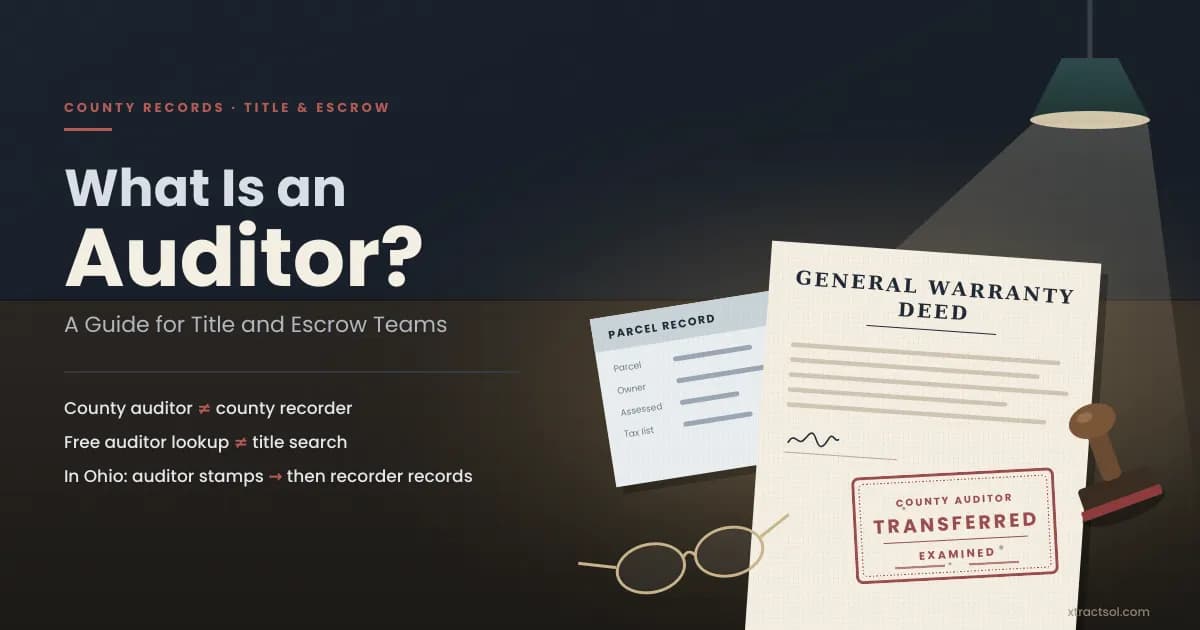
Title Search
What Is an Auditor? A Guide for Title and Escrow Teams
Learn what an auditor is in real estate, how county auditor and recorder duties vary by state and county, and which records a deed needs before recording.
Read more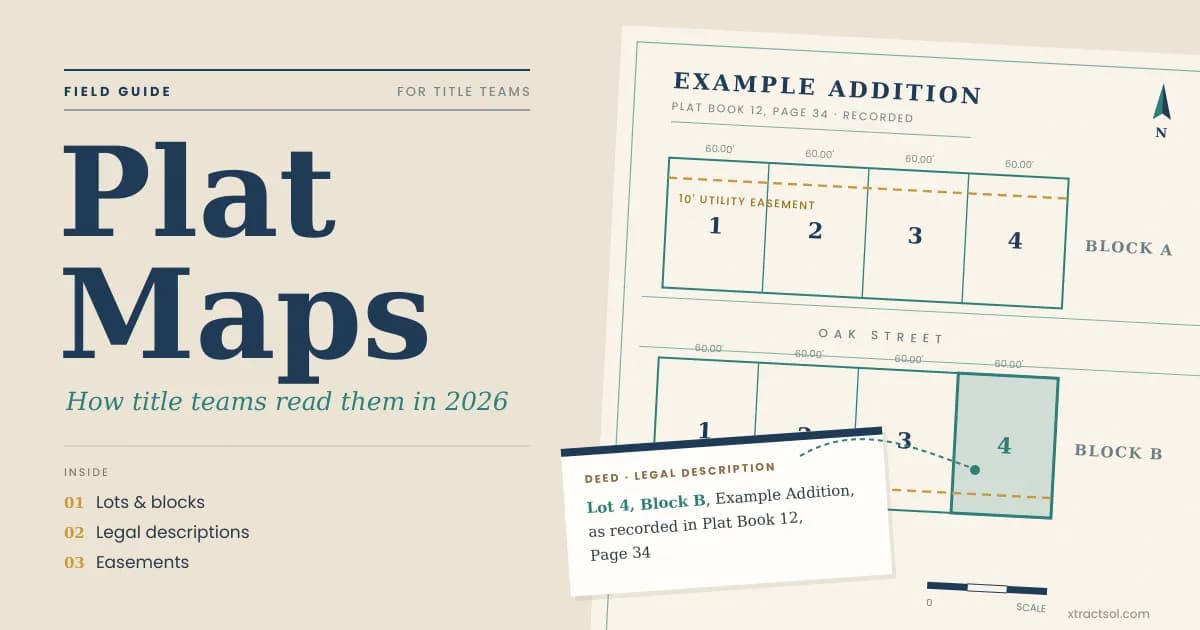
Title Search
Plat Maps Explained: A Guide for Title Teams (2026)
Learn how plat maps define lots, blocks, and easements, and how title teams use recorded plats to support more accurate property searches and commitments.
Read more
Ready to get started?
30 minutes. You walk us through how one file moves from order to closing, and we send a one-page note on the 2-3 steps worth automating first. Nothing to send us.