
Title Company Requirements: Documents & Compliance Guide
By Usama Muneer, Founder & CEO
• 7 min read • Updated
Title company requirements are not one list. They come from four directions that do not coordinate: state regulators, federal rules, underwriters, and lenders. Each one asks for different documents on a different schedule. An error at intake can then travel all the way to closing. This guide follows the requirements in the order a file moves, so each stage feeds the next. Even the standard ALTA commitment form, now the 2021 version, is voluntary unless a law requires it. XtractSol Agents prepare the search package from public records, and the examiner reviews it.
Key Takeaways
- Most requirements come down to four jobs: prove ownership, resolve defects, verify the parties, and disclose on time.
- A title file is built in layers, and each layer must hold up if someone questions it later.
- The commitment separates requirements to meet from exceptions to coverage.
- Software can gather and organize records, but examiners make every title decision.
What Are the Key Title Company Requirements?
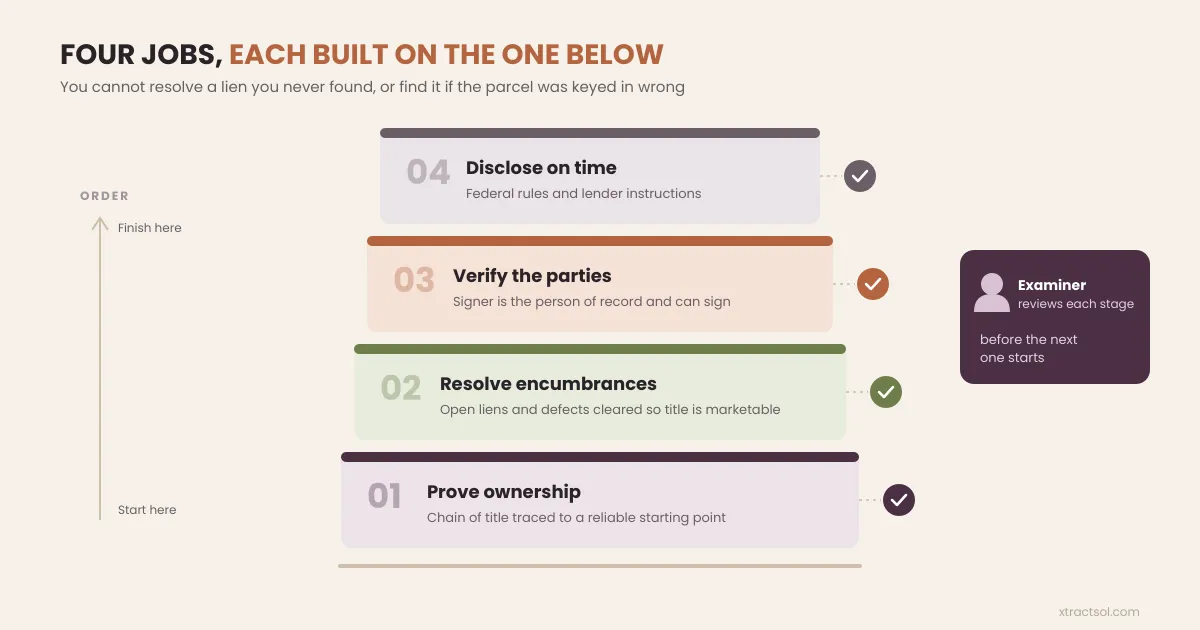
Take away the state-by-state detail, and every requirement fits four jobs that run in order. First, prove ownership by tracing the chain of title back to a reliable starting point. Second, find and resolve defects, such as open liens, so the title is marketable. Third, verify the parties. Confirm the signer is the person of record and can sign. Fourth, disclose accurately and on time. This is where federal rules and lender instructions come in.
Title insurance is regulated by each state, so licensing and escrow rules differ. A team that works in more than one state should map those differences instead of assuming them.
The order matters. You cannot resolve a lien you never found. You will not find it if the parcel was keyed in wrong. So the file starts with documents.
Which Documents and Records Does a Title File Need?
A title file is built in layers. The ownership layer holds deeds, mortgages, assignments, and releases. It also holds easements, plats, and anything else that touches the legal description. The transaction layer holds the purchase contract, amendments, and seller authorization. The party layer holds identification, entity or trust papers, and proof of signing authority. The closing layer holds the settlement statement, the Closing Disclosure on financed deals, and the recording package.
Files rarely go wrong because a document type is missing. They go wrong because a name is spelled two ways across three papers. Or a legal description does not match the deed of record. Check names, parcel numbers, and legal descriptions early, before the search begins.
Documents alone do not prove ownership. The public record does. So the examiner reads county recorder and clerk records, tax records, court dockets, and probate and bankruptcy filings. Then the examiner builds the chain and checks that each mortgage has a recorded release. Our guide to release of lien shows what to confirm.
How Do Defects and the Title Commitment Work?
Fixing defects means resolving what stands between the record and a title that can be insured. Examples are open mortgages, tax liens, judgments, and boundary problems. The work ends up in the title commitment.
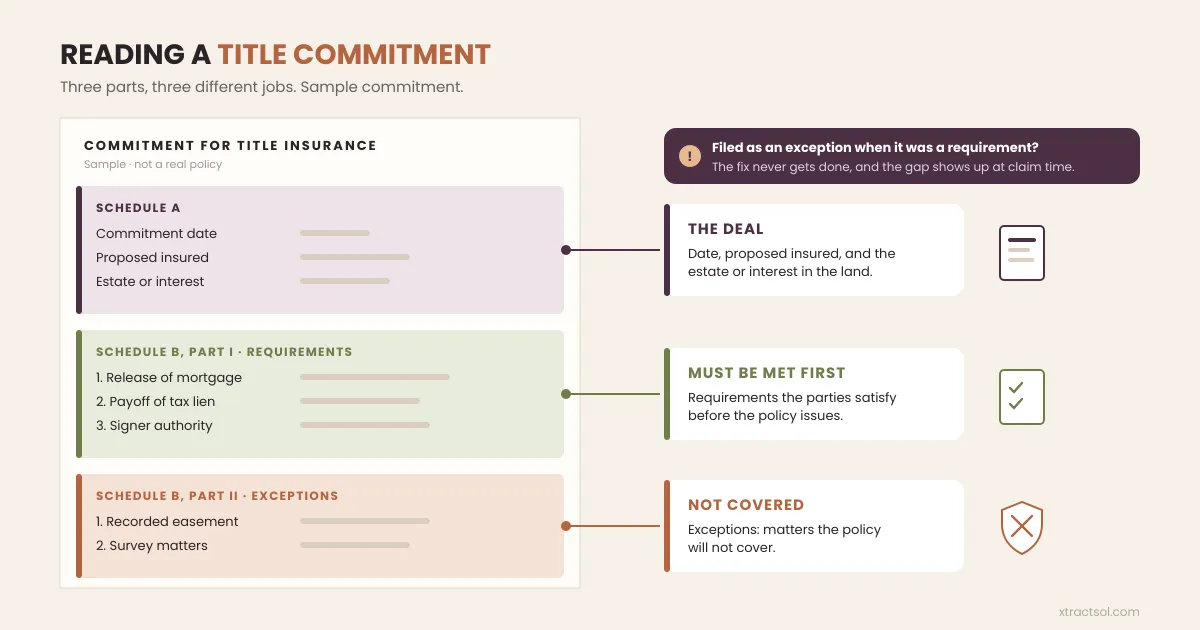
In the ALTA commitment, Schedule A names the deal. It lists the commitment date, the proposed insured, and the estate or interest in the land. Schedule B, Part I lists the requirements that must be met before the policy issues. Schedule B, Part II lists exceptions, which are matters the policy will not cover.
The line between the two parts matters. Sometimes an item is filed as an exception when it belonged in the requirements. Then a fix never gets done, and the gap shows up only when a claim arrives. A short note on each open requirement, with its proof, makes the file easy to hand off. Our guide to title commitment workflow automation covers the schedules in more detail. Our guide to title curative explains how defects get fixed.
What Do Parties, Escrow, and Lenders Add?
Fixing the record is half the file. The other half is the people and the money. That means government ID, entity and authority papers, required disclosures, and a separate check of wire instructions before funds go out. Our post on wire fraud in real estate covers that last step. Escrow rules for trust accounts and disbursements vary by state, so build those controls into closing.
On a financed deal, the lender sets the calendar. Under TRID, the borrower must receive the Closing Disclosure at least three business days before closing. Only three changes restart that wait. They are an APR that becomes inaccurate, a change in loan product, and an added prepayment penalty. Ask the lender for its conditions early, in writing. Lenders also set required endorsements, survey rules, and funding instructions that must be followed exactly. Give each condition an owner and a due date, so nothing waits until the last day.
Federal rules can change too. A federal court vacated FinCEN's Residential Real Estate Rule on March 19, 2026, and FinCEN appealed. While the order stands, reporting persons do not have to file. Recheck the page before a closing.
Implementation & Operational Considerations
Software helps most where volume is high and judgment is low: intake and search. The table shows where it fits at each stage.
| Stage | Manual | With automation |
|---|---|---|
| Intake | Re-keyed from email and PDFs | Fields extracted with source links |
| Title search | Examiner collects from many sources | Records pulled into one package |
| Examination | Judgment plus gathering | Examiner focuses on judgment |
| Commitment | Assembled by hand | Draft built from extracted data |
| Records trail | Rebuilt when questioned | Each field links to its source |
Start with intake and search, test the output on real files, and then extend toward closing. XtractSol's title search automation service gathers records, builds the chain, and flags defects without resolving them. For an example across several sources, read our case study on automated title search aggregation.
XtractSol Agents prepare the title search package, every finding linked to the recorded document. The examiner confirms the right documents came back. Examiners make every title decision.
Conclusion
Title company requirements change little: prove ownership, resolve defects, verify the parties, and disclose on time. What changes is the volume of records and the rules on top, as the FinCEN case shows. Your next step is to map your intake and search steps. Mark where gathering slows the examiner.
See where AI fits in your title workflow.
Book a Free 30-Minute Workflow Review
Frequently Asked Questions
It must verify recorded ownership, the chain of title, open liens and judgments, and the legal description. It must also verify who the parties are and who can sign. On financed deals, it checks lender conditions and disclosure timing.
Schedule A states the deal details. Schedule B, Part I lists requirements to meet before the policy issues. Schedule B, Part II lists exceptions the policy will not cover.
Not while the March 2026 court order stands, but the rule is under appeal. Confirm the current status before closing.
It reduces manual collecting and re-keying. The examiner stays responsible for the final decision.
About the Author
Usama Muneer, Founder & CEO, XtractSol. Usama writes about title search operations, public records, and practical automation for title and escrow teams.
XtractSol Agents prepare the search package from public records; examiners make every title decision.
See where AI fits in your title workflow.
Stay Updated
Get the latest insights on AI and automation delivered to your inbox.
See where AI fits in your title workflow.
Stay Updated
Get the latest insights on AI and automation delivered to your inbox.
More posts
Product notes, how we build, and what we are learning.
Title Search
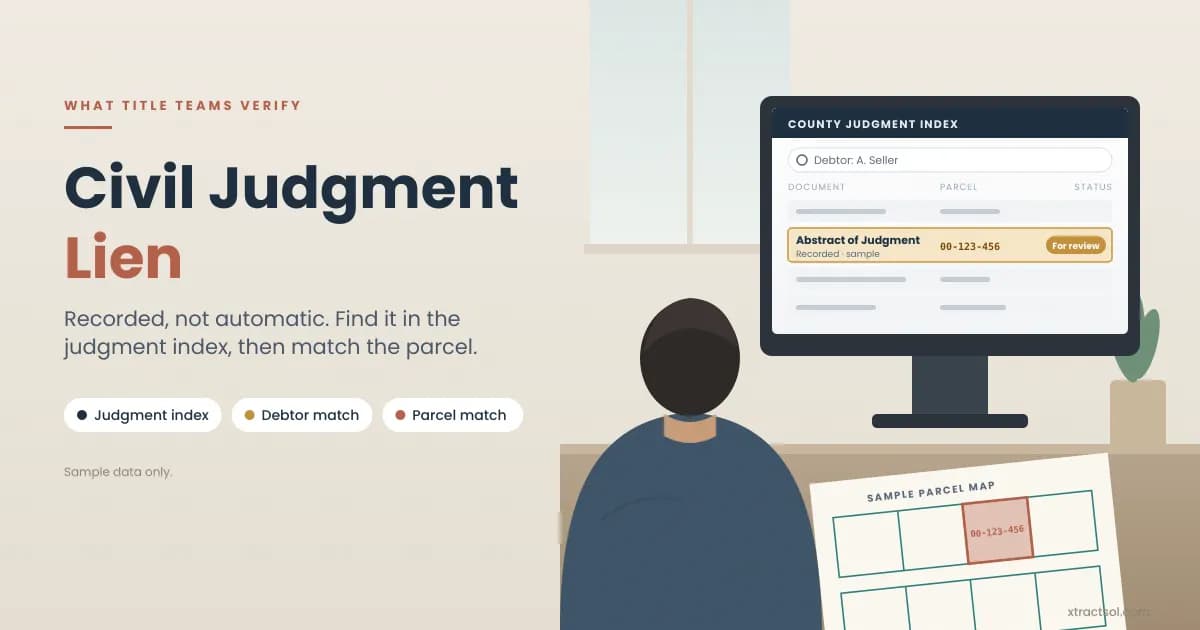
Civil Judgment Lien: What Title Teams Verify
A civil judgment lien attaches to real estate only after the creditor records the judgment. See how title teams find, renew, and release one before closing.
Read more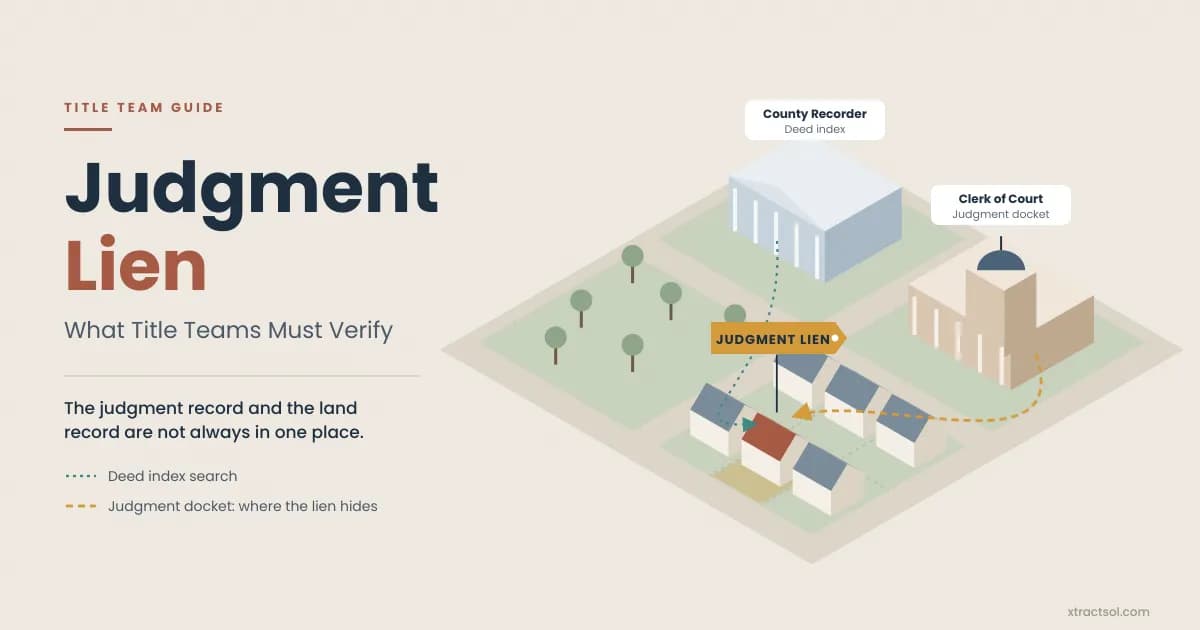
General
Judgment Lien on Real Property: A Title Team Guide
Learn how a judgment lien attaches to real property, how state recording rules and duration work, and how title teams find and resolve liens before closing.
Read more
Title Search
What Is an Auditor? A Guide for Title and Escrow Teams
Learn what an auditor is in real estate, how county auditor and recorder duties vary by state and county, and which records a deed needs before recording.
Read more
Ready to get started?
30 minutes. You walk us through how one file moves from order to closing, and we send a one-page note on the 2-3 steps worth automating first. Nothing to send us.