
What Is Title Abstracting? A Guide for Title Teams
By Usama Muneer, Founder & CEO
• 9 min read • Updated
What is title abstracting? It is the work of compiling an abstract of title, which Cornell's Legal Information Institute describes as a condensed record of documented facts showing who owns real estate, including liens, other claims, and transfers. Each county keeps its own records, so the same search can look different from one county to the next. The risk is a gap: a deed or lien that is missing from the abstract can reach the commitment. A reliable abstract names the county records searched, links each entry to the recorded document, and goes to an examiner who decides what it means.
Key Takeaways
- An abstract of title is a condensed record of documented facts about who owns real estate and what claims affect it.
- An abstract reports what the land records show and does not give an opinion on legal effect.
- A missing deed or lien can reach the commitment, so each entry should link to the recorded document.
- An examiner reads the abstract and decides what the commitment requires.
Table of Contents
- What Does an Abstract of Title Contain?
- Where Do Abstracts Go Wrong?
- How Does an Abstractor Research Land Records?
- How Does Abstracting Fit the Title Search Workflow?
- Implementation & Operational Considerations
- Conclusion
- Frequently Asked Questions
What Does an Abstract of Title Contain?
An abstract lists the major events that affect ownership, in order. The first item is the chain of title. Cornell describes chain of title as the historical record of each ownership transfer, and our post on chain of title vs. abstract of title shows how the two differ.
| Component | What the abstract lists | What the examiner checks |
|---|---|---|
| Ownership transfers | Each deed, in order | Gaps between one owner and the next |
| Mortgages | Recorded mortgages and assignments | Whether a satisfaction is recorded |
| Liens and judgments | Recorded liens and judgments | Which index holds them in that county |
| Tax records | Taxes owed or delinquent | Treasurer or tax collector records, which vary by state |
| Easements and restrictions | Recorded easements and covenants | Whether they affect the property |
| Court and probate | Filings that touch ownership | Court or probate court records |
The abstract does not argue a conclusion. It lists facts, and the examiner turns them into requirements and exceptions. Index names and office duties vary by state and county. The abstract should say which records were searched, so the examiner knows what is covered and what is not.
Where Do Abstracts Go Wrong?
The most common failure is a gap in the chain. A deed that was overlooked or indexed under another name leaves a hole between two owners, and a missed lien can reach the commitment as an unlisted item.
A second failure is a misread legal description. If the abstractor follows the wrong parcel, every entry after that point belongs to a different property.
A third is mixed sources. Records from different counties and databases come in different formats, and merging them without one standard produces inconsistent entries. A fourth is the unlinked entry. When a line has no link to the recorded document, the examiner has to find the document again, which adds rework.
Each failure has the same remedy: a written search order and a link on every line, so a second examiner can repeat the search and get the same entries. Cornell notes that a buyer whose seller lacks valid title may pay for property that belongs to someone else, which is why the abstract's accuracy matters.
How Does an Abstractor Research Land Records?
Each county differs, so the abstractor works through the same sources in a set order.
County recorder records
The abstractor searches the recorder's indexes for deeds, mortgages, easements, plats, and releases. Our guide to the county recorder title search covers the search order, and our post on grantors and grantees explains how name indexes are organized.
Tax and court records
The abstractor checks tax records for delinquent amounts and court dockets for judgments and other claims. Probate records sit in probate court, and where judgments and tax liens are indexed varies by county. Lien notices may be filed in different offices from state to state, so the abstractor checks the county's own index list instead of assuming one office.
One consistent format
Several people may touch one file, and one format keeps their entries comparable. The abstractor enters every finding in one format: county, document type, recording date, document number, and a link to the recorded document.
How Does Abstracting Fit the Title Search Workflow?
Abstracting sits between the search and the examination. After order intake, the team searches the records, the abstractor compiles the abstract, and the examiner reviews it before the commitment is drafted. Our guide to a title search shows the whole sequence. Because each step feeds the next, an error in the abstract carries into the commitment, so the examiner checks the abstract against the recorded documents and not only against the summary.
Cornell notes that an abstract of title recites what the land records disclose and gives no opinion on legal effect. That opinion belongs to the examiner, who reads the documents, writes the exceptions and requirements, and decides what goes into the commitment. Our guide to title commitment workflow automation covers the step that follows.
Implementation & Operational Considerations
Your operations lead lists the counties you abstract most and notes how each one indexes its records. An examiner sets the entry format and the order of sources. The abstractor links every entry to its recorded document. The team then checks a small first batch against the recorded documents and lists every gap, and the operations lead reviews gaps and rework on a regular schedule. Any entry without a link goes back to the abstractor before the examiner sees it.
For a worked example of automated record gathering, see our case study on automated title search aggregation. Our automated title search service follows the same steps.
XtractSol Agents prepare the title search package, every finding linked to the recorded document. The examiner confirms the right documents came back. Examiners make every title decision.
Conclusion
Title abstracting turns scattered land records into one ordered record that an examiner can read. Its value depends on the sources searched and on a link from each entry to the recorded document. As a next step, pick one county and check a recent abstract entry by entry against the recorded documents.
See where AI fits in your title workflow.
Book a Free 30-Minute Workflow Review
Frequently Asked Questions
An abstract records what the land records show about ownership and claims. A title commitment is the insurer's offer to issue a policy, with its requirements and exceptions. The examiner uses the abstract and the documents to prepare it.
No. Cornell cites a court describing an abstract as reciting what the land records disclose without an opinion on legal effect. The examiner reads the documents and decides what they mean.
Deeds, mortgages and assignments, liens and judgments, tax records, easements and restrictions, and court or probate filings that touch ownership. Which office holds each one varies by state and county.
A link lets the examiner open the recorded document and confirm the entry without searching again. It also leaves a record of where each finding came from, which helps when a second examiner reviews the file or a question comes up after closing.
About the Author
Usama Muneer, Founder & CEO, XtractSol. Usama writes about title search operations, public records, and practical automation for title and escrow teams.
XtractSol Agents prepare the search package from public records; examiners make every title decision.
Reference Block (not part of the article, not counted)
Primary keyword (assumed from the page title and URL): what is title abstracting
SEO title (46 characters): What Is Title Abstracting? Steps and Key Parts
Meta description (146 characters): What is title abstracting? Learn what an abstract of title contains, where abstracts go wrong, and how examiners check each entry against records.
Sources:
- Cornell LII, Abstract of title: https://www.law.cornell.edu/wex/abstract_of_title
- Cornell LII, Chain of title: https://www.law.cornell.edu/wex/chain_of_title
Word count: 1248 words (H1 through FAQ answers; minimum 1,200 PASS, maximum 1,300 PASS)
Hard check: PASS, 15 strings checked, 0 matches
Facts I must verify:
- No ALTA page was used. The skill asks for one ALTA link in the Introduction; I did not find an ALTA page about abstracting that I could open and read, so the Introduction links Cornell LII instead. Add an ALTA link if you have a page that fits.
- Cornell's abstract page: the statement that an abstract recites what land records disclose without an opinion comes from a court case (Lunn v. Cummings & Lockwood) quoted on that page; the FAQ words it as 'a court describing an abstract'.
- Cornell's chain of title page: the 'seller lacks valid title' sentence paraphrases the page; recheck the wording if you edit it.
- Where liens, judgments and tax records are indexed varies by state and county; check the county's index list before naming an office.
- Title tag is 46 characters to fit your 40-50 range; the skill's own range is 55-60.
- Author name and role were taken from your earlier fix list; confirm for this post.
- Byline has no reviewer, date, or read time; add them in the CMS.
See where AI fits in your title workflow.
Stay Updated
Get the latest insights on AI and automation delivered to your inbox.
See where AI fits in your title workflow.
Stay Updated
Get the latest insights on AI and automation delivered to your inbox.
More posts
Product notes, how we build, and what we are learning.
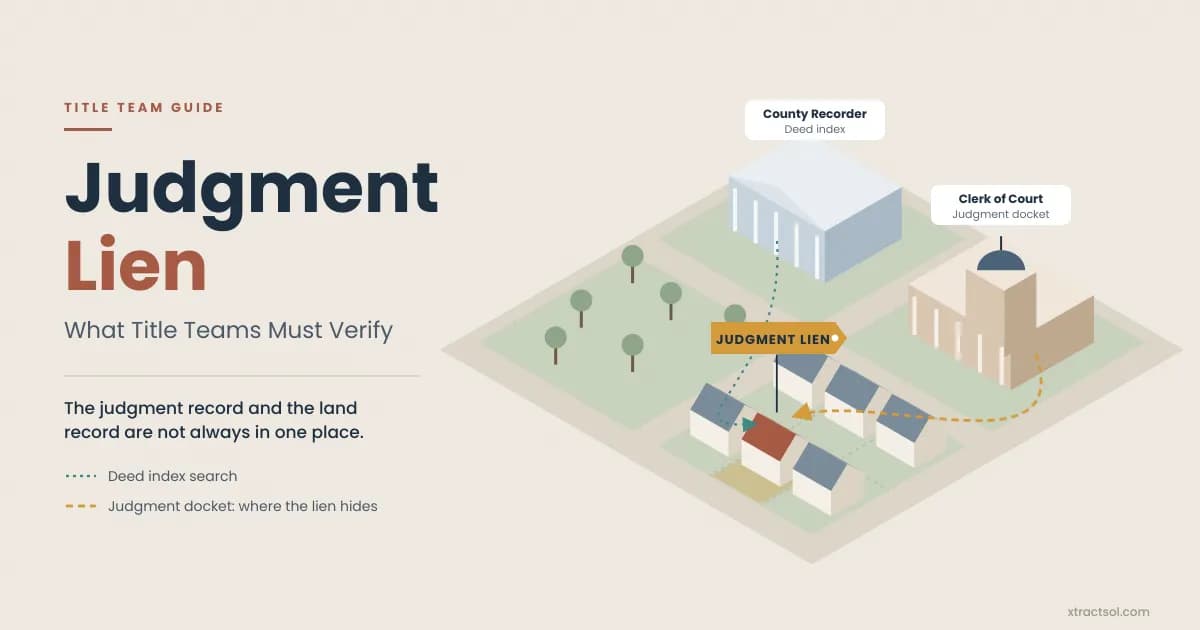
General
Judgment Lien on Real Property: A Title Team Guide
Learn how a judgment lien attaches to real property, how state recording rules and duration work, and how title teams find and resolve liens before closing.
Read more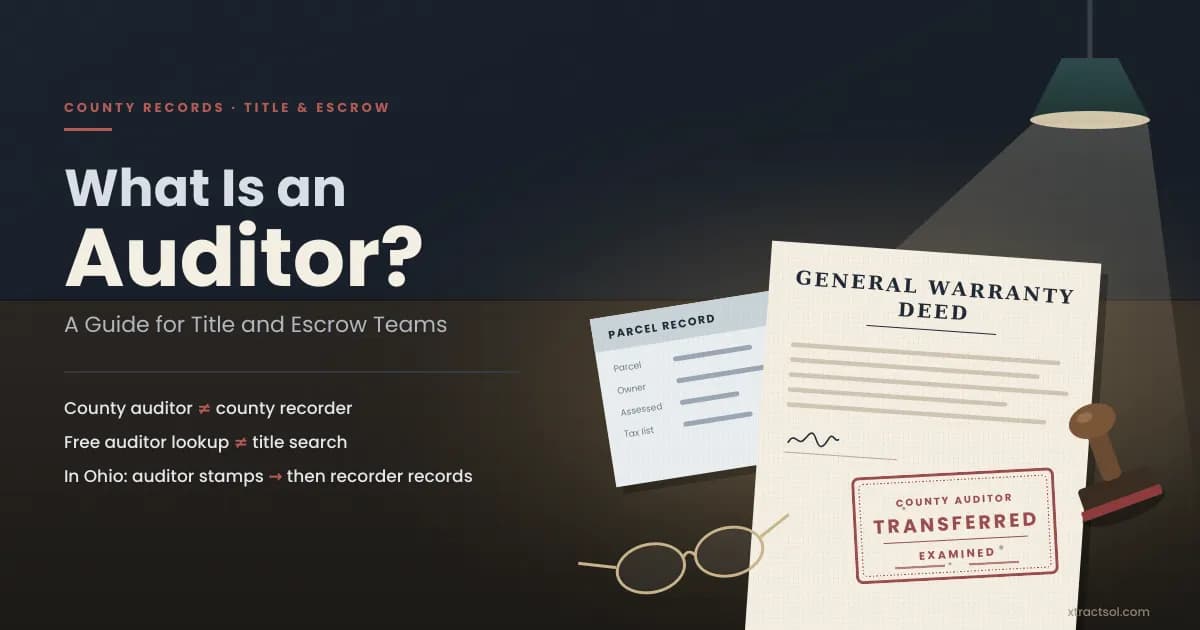
Title Search
What Is an Auditor? A Guide for Title and Escrow Teams
Learn what an auditor is in real estate, how county auditor and recorder duties vary by state and county, and which records a deed needs before recording.
Read more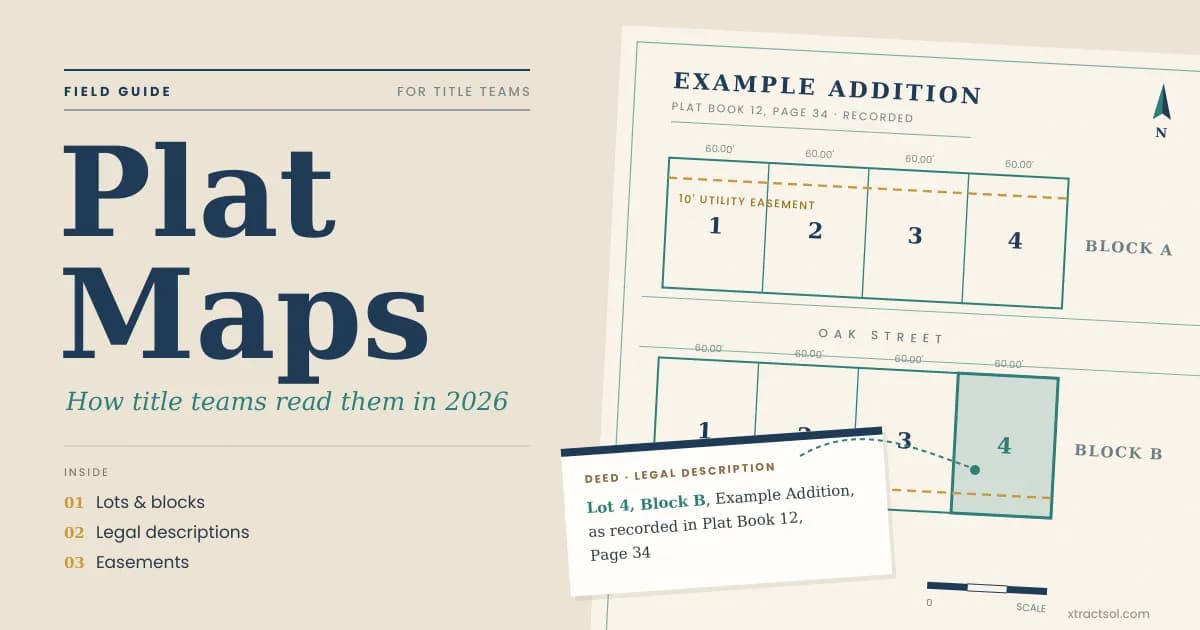
Title Search
Plat Maps Explained: A Guide for Title Teams (2026)
Learn how plat maps define lots, blocks, and easements, and how title teams use recorded plats to support more accurate property searches and commitments.
Read more
Ready to get started?
30 minutes. You walk us through how one file moves from order to closing, and we send a one-page note on the 2-3 steps worth automating first. Nothing to send us.