

Document Fraud Detection: How AI Detects Altered Documents
By Usama Muneer, Founder & CEO
• 7 min read • Updated
Document fraud detection checks a file for signs that it was altered, made up, or does not match other documents, and it gives a person a risk signal, not a verdict. Most fraud is not a crude fake. It is often a real-looking document with one number changed. ALTA's study found that more than 80% of purchase transactions require reviewing at least 11 documents, so a small change is easy to miss. The fix is to combine several weak signals, compare documents with each other, and send uncertain files to a person. XtractSol Agents prepare the search package from public records, and the examiner reviews it.
Key Takeaways
- Detection works by adding up several weak signals, not by finding one sure sign.
- Comparing documents with each other can show changes that one document hides.
- A fraud score is a reason to look closer, not proof of fraud.
- Test any tool on your own documents, including poor scans and honest oddities.
How Does AI Detect a Fraudulent Document?
No single sign proves a document was altered, so the tool works in steps. First, it identifies what the document is, such as a deed, bank statement, or settlement statement. Second, it reads the page into text with optical character recognition (OCR) and pulls out amounts, dates, and names.
Third, it looks at the image for odd compression, pasted areas, and edit edges. Fourth, it reads any metadata, such as when the file was made and changed. Fifth, it compares names, addresses, dates, and amounts against related documents.
Sixth, it combines the signals into a review priority, not a pass or fail. Seventh, it sends uncertain or high-risk files to a person. The early steps tell the tool what it is looking at. The middle steps look for evidence. The last steps decide who looks next.
Which Signals Matter, and Which Do Not Work?
Signals worth checking
Pixel checks look for uneven compression or regions that do not match the rest of a scan. They help with scans and photos, and less with native PDFs. Layout checks compare where fields sit against what the document type should look like. Inscribe's 2026 report found that 1 out of every 5 flagged documents showed signs of template-based manipulation, up from 1 out of every 14 in 2024. The same report said about 6% of documents it processed in 2025 were flagged as fraudulent.
Font checks look for characters that do not match in type, size, or rendering, which can point to an inserted value. Metadata checks are supporting evidence only, because honest workflows can rewrite metadata. Cross-document checks compare a contract, deed, ID, and settlement statement. If they disagree on a date or amount, risk goes up even when each page looks fine.
Assumptions that fail
Looking at the page is no longer enough, because software can make convincing documents. Metadata proves nothing in either direction. One signal alone fails when fraud methods change. A fraud score is not an investigation, because a high score means a document needs a closer look, not that someone meant harm. Reviewing documents one at a time misses mismatches that only show up side by side.
Where Does Document Fraud Matter Most in Title and Mortgage Work?
It matters wherever a document proves identity, ownership, authority, or money. That includes deeds, purchase contracts, mortgages, settlement statements, bank statements, tax records, powers of attorney, and entity papers.
A records search shows what was recorded. It cannot confirm that every submitted document is real. A deed may be recorded properly yet involve an impersonated seller. A bank statement may be real while one amount was changed. A contract may be valid while a later amendment changes key terms. Document checks add a layer by examining the papers themselves.
Mortgage work faces the same issue. Cotality's Q2 2026 index reached 132, and it estimated that 1 in 119 mortgage applications showed indications of fraud risk. Purchase loans rose to 72% of volume. A records search checks the history. A document check tests the information inside each file. Together they work better than either alone.
How Does Automated Detection Compare, and How Do You Start?
The table shows what changes and what stays with people.
| Task | Manual review | Automated detection |
|---|---|---|
| Classifying | Reviewer identifies each document | Tool sorts by content and layout |
| Reading fields | Typed by hand | Pulled out by software |
| Visual oddities | Depends on attention | Applied the same way each time |
| Cross-document checks | Rarely done in full | Practical across many files |
| Order of review | Reviewer picks | Queue ranked by risk |
| Uncertain cases | Human judgment | Sent to a person |
Consider a made-up refinance file with a bank statement, a pay stub, and an ID. Font analysis flags one amount on the statement. That is weak evidence alone. Then cross-document checks find the employer's name spelled two ways. Together the signals justify a closer look. The reviewer contacts the employer and asks the bank for statements directly. The tool decided nothing. It made sure the right file reached a person.
To start, map how documents are reviewed today. Build a test set with real documents, known changes, poor scans, and phone photos. Choose the signals that fit each document type. Set rules for what gets held. Track both false alarms and missed changes. Expand only after the first workflow works well.
Implementation & Operational Considerations
Your operations lead picks one document type with real risk, such as bank statements. The team lists who reviews it, which fields they check, and what sends it up for review. A small batch of real files goes through first. The team reviews every flag, writes down what the tool missed, and adjusts the rules before adding more files. Each change is recorded with the name of the person who approved it.
XtractSol's OCR and intelligent data extraction service reads fields such as names, dates, and amounts, links each value to its place on the page, and flags uncertain values for human review. It is a reading step, not a fraud verdict. For cross-document comparison, see our case study on AI deed and mortgage matching for title examiners. It scores records from a name search against the subject parcel using address, parcel number, and owner.
Related reading: our guides to OCR automation and intelligent document automation, our post on wire fraud in real estate, and our guide to title company requirements.
XtractSol Agents prepare the title search package, every finding linked to the recorded document. The examiner confirms the right documents came back. Examiners make every title decision.
Conclusion
Document fraud detection works when it adds up many weak signals, compares documents with each other, and leaves the decision to a person. As a next step, pick the document type your team trusts most and ask what in your process would show a single changed number.
See where AI fits in your title workflow.
Book a Free 30-Minute Workflow Review
Frequently Asked Questions
It can spot signals such as odd structure, layout changes, metadata conflicts, and values that disagree with other documents. The result is a risk signal, so a person should review it.
Sometimes. Tools combine visual, structure, metadata, and content signals, because one signal can stop working when methods change.
No. OCR turns images into text. Fraud detection can use that text and add metadata checks, visual checks, cross-document checks, and risk scoring.
Yes, especially when a document affects ownership, lending, identity, or compliance. The tool ranks and supports the review, and people decide.
About the Author
Usama Muneer, Founder & CEO, XtractSol. Usama writes about title search operations, public records, and practical automation for title and escrow teams.
XtractSol Agents prepare the search package from public records; examiners make every title decision.
See where AI fits in your title workflow.
Stay Updated
Get the latest insights on AI and automation delivered to your inbox.
See where AI fits in your title workflow.
Stay Updated
Get the latest insights on AI and automation delivered to your inbox.
More posts
Product notes, how we build, and what we are learning.
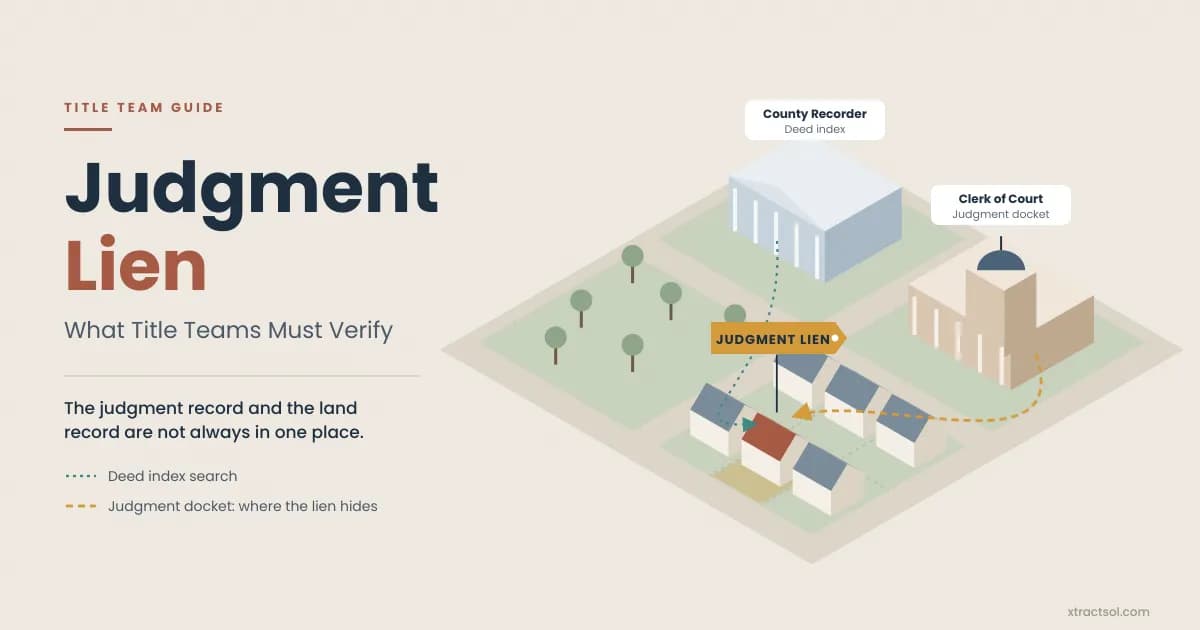
General
Judgment Lien on Real Property: A Title Team Guide
Learn how a judgment lien attaches to real property, how state recording rules and duration work, and how title teams find and resolve liens before closing.
Read more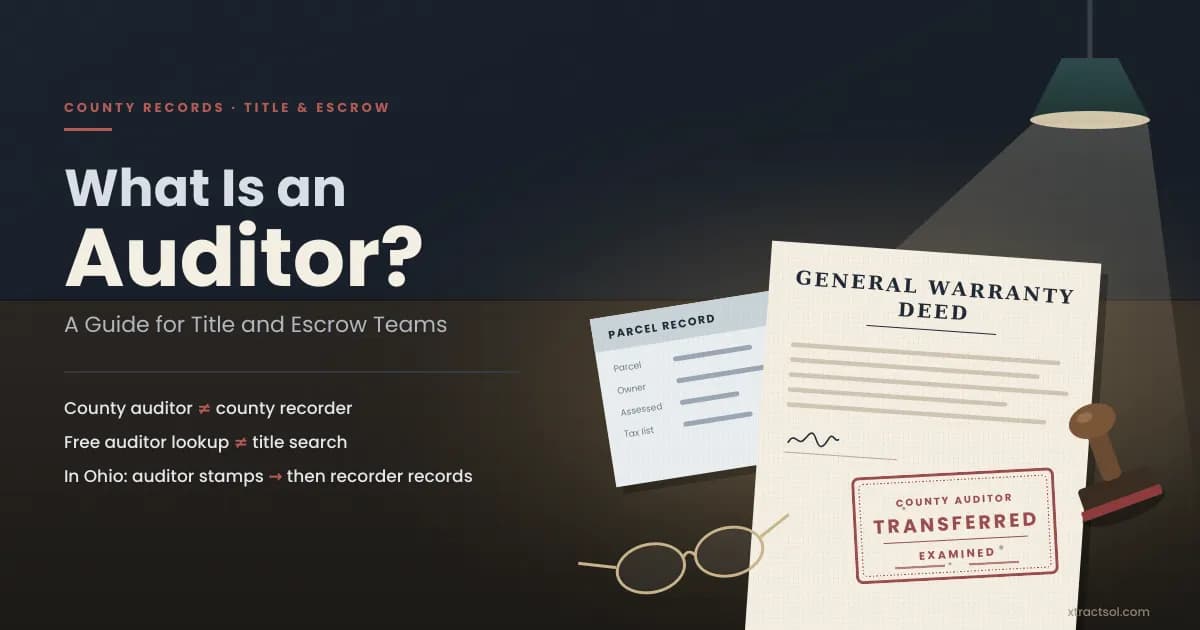
Title Search
What Is an Auditor? A Guide for Title and Escrow Teams
Learn what an auditor is in real estate, how county auditor and recorder duties vary by state and county, and which records a deed needs before recording.
Read more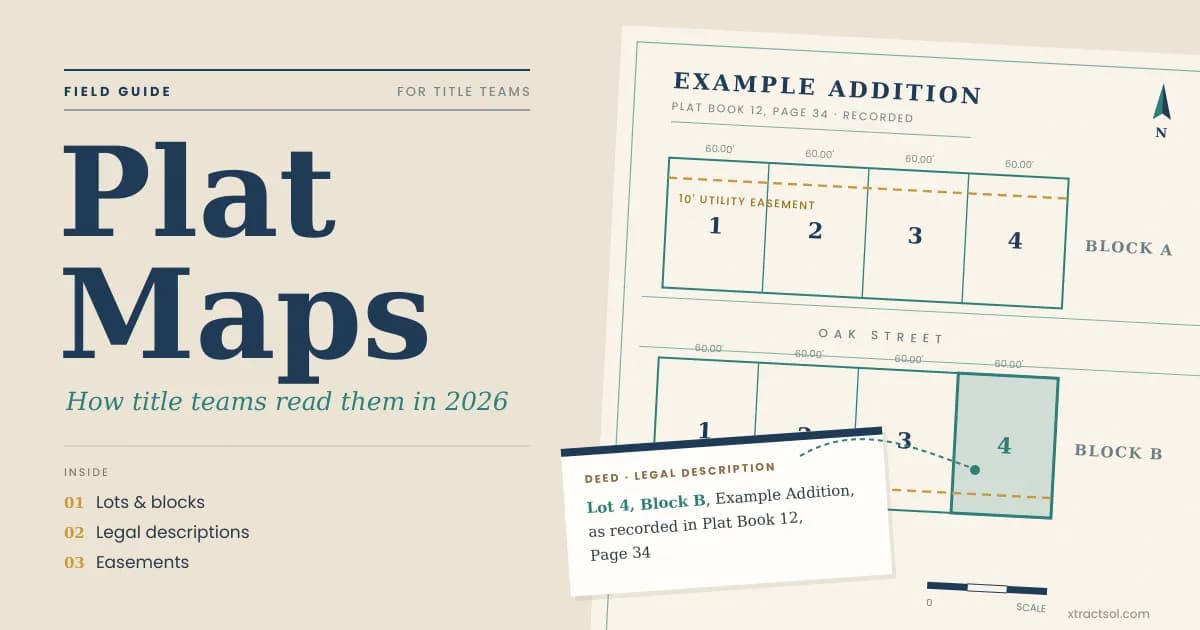
Title Search
Plat Maps Explained: A Guide for Title Teams (2026)
Learn how plat maps define lots, blocks, and easements, and how title teams use recorded plats to support more accurate property searches and commitments.
Read more
Ready to get started?
30 minutes. You walk us through how one file moves from order to closing, and we send a one-page note on the 2-3 steps worth automating first. Nothing to send us.