
OCR Mortgage Underwriting: Mortgage Underwriting Automation in 2026
By Usama Muneer, Founder & CEO
• 7 min read • Updated
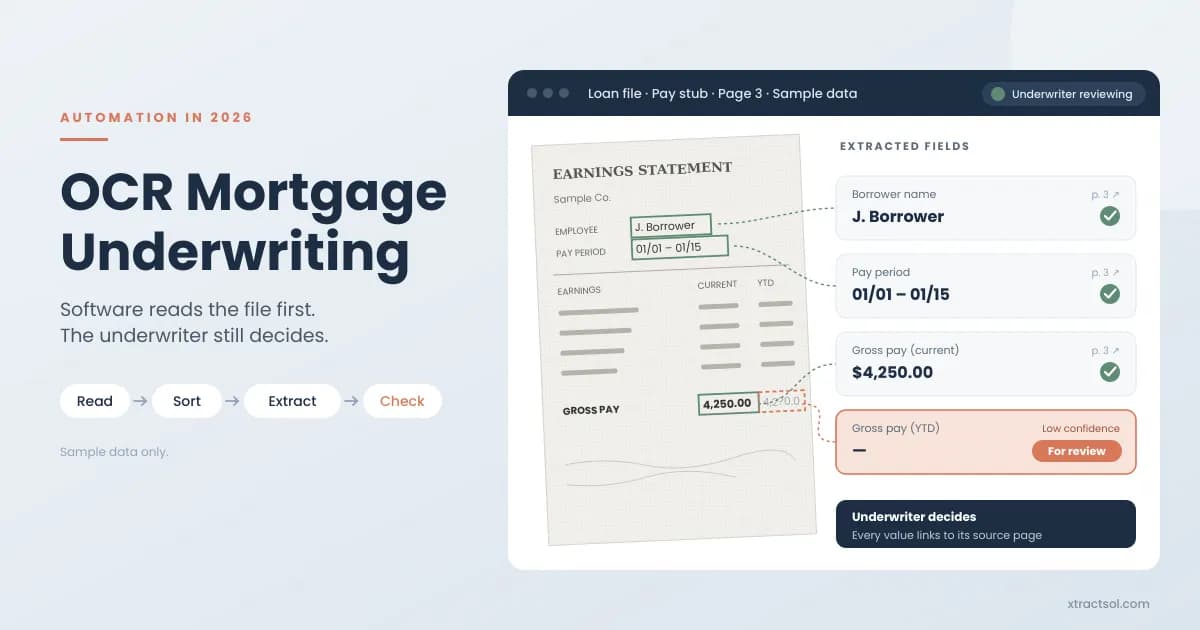
Before a loan is approved, someone has to read a pile of borrower and property documents. One file can run to a hundred pages. Typing the numbers by hand is slow and easy to get wrong. OCR mortgage underwriting uses software to read each document. It sorts the pages, pulls out key fields, and checks them against the lender's rules. Fannie Mae reports that loans with at least one digital validation component are 33% less likely to have defects. XtractSol Agents prepare the search package from public records, and the examiner reviews it.
Key Takeaways
- OCR turns a scanned document into text, and AI sorts it and pulls out fields.
- The software checks values against the lender's rules and flags what does not match.
- A person still reviews flagged items and makes the underwriting decision.
- Start with one document type, and keep every value linked to its source page.
How Does OCR Fit Into Mortgage Underwriting?
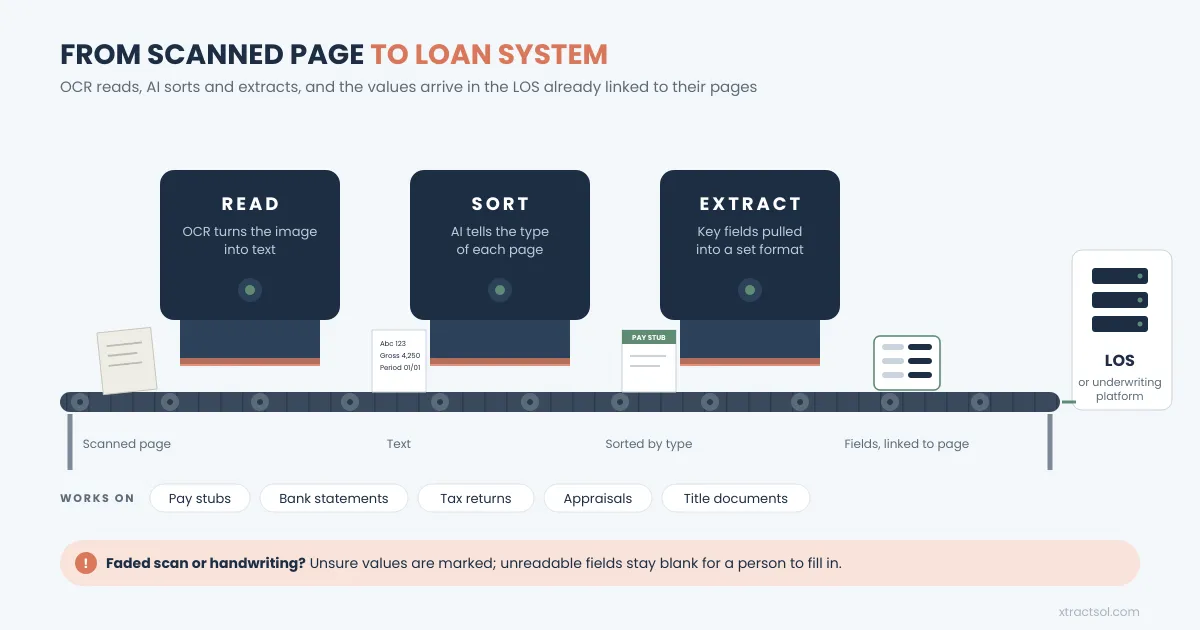
Optical character recognition (OCR) reads a scanned page and turns the picture into text a computer can use. That works on pay stubs, bank statements, tax returns, appraisals, and title documents. AI then tells what type of document each page is. It finds the fields that matter and puts them in a set format.
That set format connects paper files to a loan origination system (LOS) or an underwriting platform. Without it, someone reads each page, types each value, and then checks the typing again.
Not every page reads well. Faded scans, crooked phone photos, and handwriting can confuse OCR. A good tool marks values it is unsure about and leaves unreadable fields blank, so a person fills them in and nothing is guessed.
Think of the software as a first reader. It does the reading and the typing. The underwriter gets the values, and each one links to its page. Then the underwriter judges the loan.
Title teams use the same idea with deeds and mortgages. Our post on OCR automation explains how reading and extraction work in more detail.
What Problems Does Data Extraction Solve?
A loan file is big and messy. One application can include bank statements, tax returns, pay stubs, an appraisal, and title documents. Automated sorting groups the pages by type and pulls out only the fields underwriting needs.
It also reduces typing mistakes. Extracted values are checked against the lender's rules, so a missing or mismatched value shows up before it reaches the underwriter. AWS describes a pipeline where extraction runs beside tampering checks and sends low-confidence results to human reviewers.
Tools that do not connect are a third problem. Once the data has a set format, it can move to the LOS and other tools. No one has to retype it.
Each fix works only if the source stays attached. A value with no link to its page is hard to check, so a good setup keeps the link. For related ground, see our guide to intelligent document automation.
How Does Verification Support Compliance?
Verification runs beside OCR. It compares extracted values with the lender's rules and, at times, with outside data. Missing documents and values that do not match are flagged before the loan moves on.
This helps in three ways. First, the same underwriting policy is applied the same way on every file. Second, problems show up sooner, so a missing field does not sit unnoticed until closing. Third, the checks leave a record, so a reviewer can see how each document was handled.
Keep the rules in writing. When a policy changes, the team updates the rule once, and every file after that follows the new version. That is easier than retraining each reviewer one by one.
Rules still come from the lender and the law. The Consumer Financial Protection Bureau keeps a hub of mortgage compliance resources that covers origination rules, servicing rules, and disclosures. Software can apply a rule. People decide what it means for a loan.
Fraud checks work the same way. A mismatched name or a changed number is a reason to look closer, not a verdict. Our post on document fraud detection shows how several weak signals add up to a review.
How Do the Technologies Work Together, and How Does This Compare With Manual Review?
Most setups combine four parts. AI-powered OCR reads the text and works out the layout. Rules check that required information is present and apply the lender's policy. Machine learning models spot unusual patterns. Workflow tools move the file from intake to review, so no one passes it along by hand.
The table shows what changes and what stays with people.
| Task | Manual underwriting | Automated underwriting |
|---|---|---|
| Reading documents | Underwriter reads each page | Software reads and sorts pages |
| Entering values | Typed by hand | Extracted, linked to the page |
| Rule checks | Applied by each reviewer | Applied the same way each time |
| Compliance record | Notes kept by hand | Checks are logged |
| Unusual files | Judgment throughout | Flagged for the underwriter |
| Final decision | Underwriter | Underwriter |
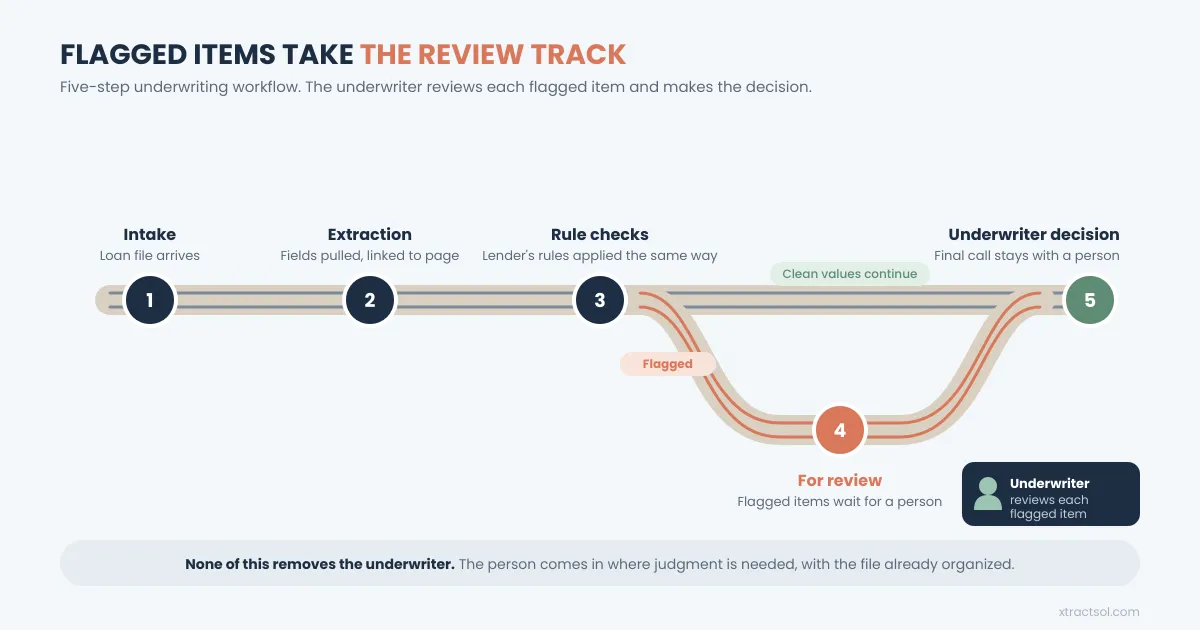
None of this removes the underwriter. The person comes in where judgment is needed, with the file already organized.
Implementation & Operational Considerations
Start with one document type, such as pay stubs. Your operations lead lists who reviews each flag. The list also says what sends a file to a senior underwriter. A small group of real files goes through first. The team compares the extracted values with the pages and adjusts the rules before adding more document types.
Check how the tool fits your current systems. Look for open connections to your LOS, a rules setup you can change, and vendor help during training. Keep a rule for unreadable pages: a person reads them, and the file says so.
XtractSol's OCR and intelligent data extraction service reads names, dates, and amounts. It links each value to its page and marks uncertain values for a person to confirm. For a look at models built for underwriting questions, read our case study on a fine-tuned small language model for underwriting knowledge. For a wider view of the workflow, see our guide to document process automation.
XtractSol Agents prepare the title search package, every finding linked to the recorded document. The examiner confirms the right documents came back. Examiners make every title decision.
Conclusion
OCR mortgage underwriting works best as a first reader: it extracts, sorts, and checks, and a person decides. Your next step is to pick one document type. Compare the extracted values with the source pages on a few real files.
See where AI fits in your title workflow.
Book a Free 30-Minute Workflow Review
Frequently Asked Questions
OCR turns scanned documents into text, so other systems can check, sort, and process loan information without someone typing it in.
No. Software handles routine reading and rule checks. Unusual files and final decisions stay with an experienced person.
Pay stubs, bank statements, tax returns, and title commitments are common starting points, because they have predictable fields.
Look for a fit with your current systems and a link from every value to its page. Also look for rules you can change and help with training.
About the Author
Usama Muneer, Founder & CEO, XtractSol. Usama writes about title search operations, public records, and practical automation for title and escrow teams.
XtractSol Agents prepare the search package from public records; examiners make every title decision.
See where AI fits in your title workflow.
Stay Updated
Get the latest insights on AI and automation delivered to your inbox.
See where AI fits in your title workflow.
Stay Updated
Get the latest insights on AI and automation delivered to your inbox.
More posts
Product notes, how we build, and what we are learning.
General
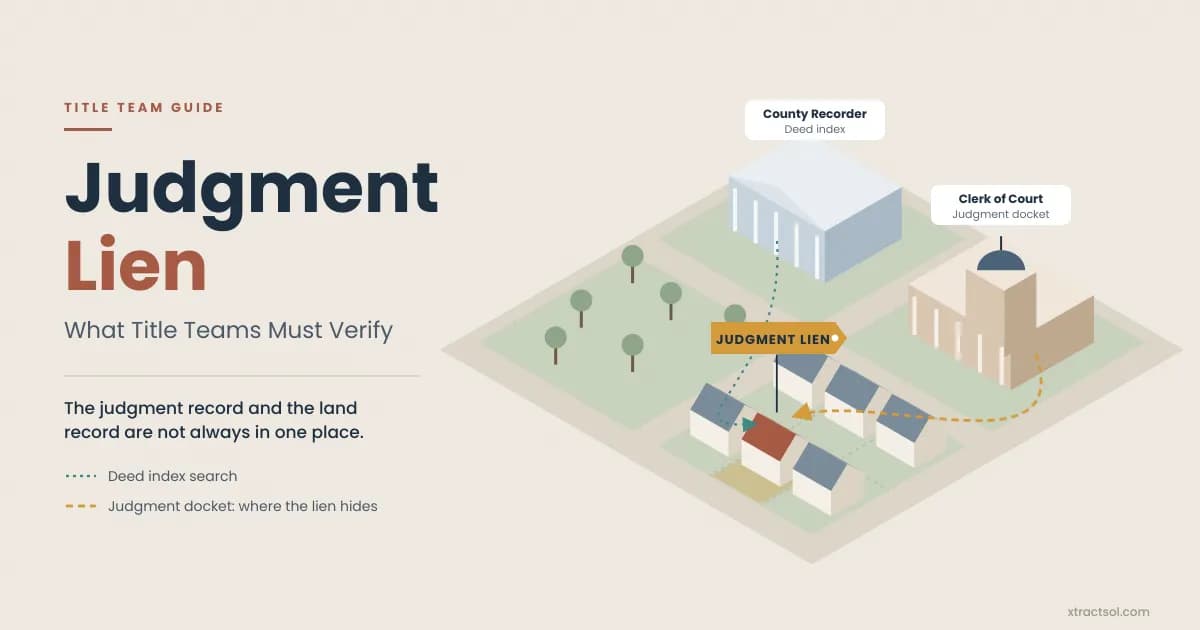
Judgment Lien on Real Property: A Title Team Guide
Learn how a judgment lien attaches to real property, how state recording rules and duration work, and how title teams find and resolve liens before closing.
Read more
Title Search
What Is an Auditor? A Guide for Title and Escrow Teams
Learn what an auditor is in real estate, how county auditor and recorder duties vary by state and county, and which records a deed needs before recording.
Read more
Title Search
Plat Maps Explained: A Guide for Title Teams (2026)
Learn how plat maps define lots, blocks, and easements, and how title teams use recorded plats to support more accurate property searches and commitments.
Read more
Ready to get started?
30 minutes. You walk us through how one file moves from order to closing, and we send a one-page note on the 2-3 steps worth automating first. Nothing to send us.