

What Does HOA Stand For? A Guide for Title Teams
By Usama Muneer, Founder & CEO
• 7 min read • Updated
What does HOA stand for? It stands for homeowners association, a group that manages a neighborhood, condo building, or planned community. The Foundation for Community Association Research estimates 373,000 community associations in the U.S., home to 78.1 million residents. For a title team, the problem shows up at closing, where ALTA's study of title production found HOA dues and transfer fees in nearly 57% of transactions. Someone has to find the association, get the balance, and confirm what is owed. An examiner records each figure with its source and decides what the commitment requires.
Key Takeaways
- HOA stands for homeowners association, a group that manages a neighborhood, condo building, or planned community.
- ALTA found HOA dues and transfer fees in nearly 57% of the transactions it studied.
- Unpaid HOA assessments can become a lien that clouds title, and the rules differ by state.
- An examiner confirms the HOA, the balance, and any lien before the commitment goes out.
What Does an HOA Do?
An HOA maintains shared spaces such as lawns, pools, and roofs. It sets and enforces rules on paint, parking, pets, and rentals. It also manages money, which means setting a budget and saving for repairs. An owner joins by buying a home in the community.
The rulebook is the CC&Rs, short for covenants, conditions, and restrictions. CC&Rs may be recorded against the property, so check the county's records for them. Index names vary by county.
Fees and rules differ widely from one association to the next, so a title team reads the documents for each community instead of assuming one pattern. Title teams meet four payment terms again and again.
| Term | What it means | Why it matters at closing |
|---|---|---|
| HOA dues | The regular payment set by the association | Shows whether the seller is current |
| Assessment | Often another word for dues | Confirm which charge a statement means |
| Special assessment | A one-time charge on top of dues | Can add to the payoff figure |
| Fine | A charge for breaking a rule | Ask whether it is part of the balance |
Why Do HOA Balances Matter at Closing?
An unpaid balance is a debt tied to the property. Nolo notes that an unpaid assessment lien can cloud the property's title and make it harder to sell or refinance. The same page says the HOA may still foreclose on a home that has a mortgage, because the lien is separate from the lender's claim. Whether and how it can foreclose depends on the state. ALTA's figure shows how common these items are in the transactions it studied. An HOA can add another payee to the payoff list, next to the lender.
Liens and super liens
In some states, part of an HOA lien ranks ahead of the first mortgage. Nolo reports that about 20 states give HOA or condominium association liens this super lien status in certain circumstances. Colorado covers six months of assessments and Nevada covers nine. Many states have no such rule, so an examiner reads the statute for the state of the property.
How Do You Find the HOA and Its Balance?
Three steps cover the search for an HOA.
Confirm there is an HOA
Look for it in the listing, the order, and the county's records. Recorded CC&Rs or a recorded association lien may appear in the recorder's indexes, and a parcel record may point to an association.
Find the manager
Many associations hire a management company, and a volunteer board runs the rest. Record the contact name, the phone number, and where you found it. If the listing names no manager, the association's recorded documents or the county's records may point to one. A missing contact is an open item, not a finished search.
Request the figures
Ask for the dues statement, the payoff figure, any special assessment, and any lien notice. Record each amount with its date and source. Ask whether a transfer fee applies, since ALTA found transfer fees in the same transactions.
How Do Examiners Handle HOA Items in the Commitment?
An examiner reads the CC&Rs and the figures together. An unpaid balance or a recorded assessment lien can become a requirement or an exception in the commitment, and which one depends on the state and the underwriter.
Our guide to HOA closing documents lists the papers a title team asks for. If a lien is recorded, how to find a lien on a property shows where to look. Open items follow the steps in our guide to title curative.
The examiner also checks that the amounts match the dates. A dues statement is a snapshot, so a figure from an old statement may not match the payoff at closing. Where a lien is recorded, the examiner also reads the lien notice to see which assessments it covers and when it was filed. The examiner decides what the commitment requires.
Implementation & Operational Considerations

Manual versus automated handling of HOA workflows.
Your operations lead keeps a list of the management companies you deal with most, with a named contact for each. An examiner sets the request list: dues statement, payoff figure, special assessments, lien notice, and CC&Rs. The team records each figure with its date and source and tracks every open request until it is answered. An examiner then checks a small first batch against the recorded documents and lists every gap.
For a worked example of pulling payment status into a structured view, see our case study on property tax and payment status extraction. Our curative and exception management service follows open items the same way.
XtractSol Agents prepare the title search package, every finding linked to the recorded document. The examiner confirms the right documents came back. Examiners make every title decision.
Conclusion
HOA stands for homeowners association, and its balance can follow the property to the closing table. The team that finds the association early, records each figure with its source, and tracks open requests keeps those items off the critical path. As a next step, write the HOA request list for your next file.
See where AI fits in your title workflow.
Book a Free 30-Minute Workflow Review
Frequently Asked Questions
In many communities, membership comes with the property, so an owner cannot opt out while holding title. Check the CC&Rs and the state's law for the specific community.
In many states it can, even when the home has a mortgage, because the assessment lien is separate from the lender's claim. State law sets the limits, so read the statute for the property's state.
A special assessment is a one-time charge on top of regular dues, such as a charge for a large repair. It can add to the payoff figure, so ask for it by name.
A super lien is the part of an HOA lien that state law ranks above the first mortgage. About 20 states have such laws in some form, and the amount covered varies by state.
Start with the listing and the order. Then check the recorded CC&Rs and the county's records for the association's name. Record the contact with its date and source, and mark it as an open item if no one answers.
About the Author
Usama Muneer, Founder & CEO, XtractSol. Usama writes about title search operations, public records, and practical automation for title and escrow teams.
XtractSol Agents prepare the search package from public records; examiners make every title decision.
See where AI fits in your title workflow.
Stay Updated
Get the latest insights on AI and automation delivered to your inbox.
See where AI fits in your title workflow.
Stay Updated
Get the latest insights on AI and automation delivered to your inbox.
More posts
Product notes, how we build, and what we are learning.
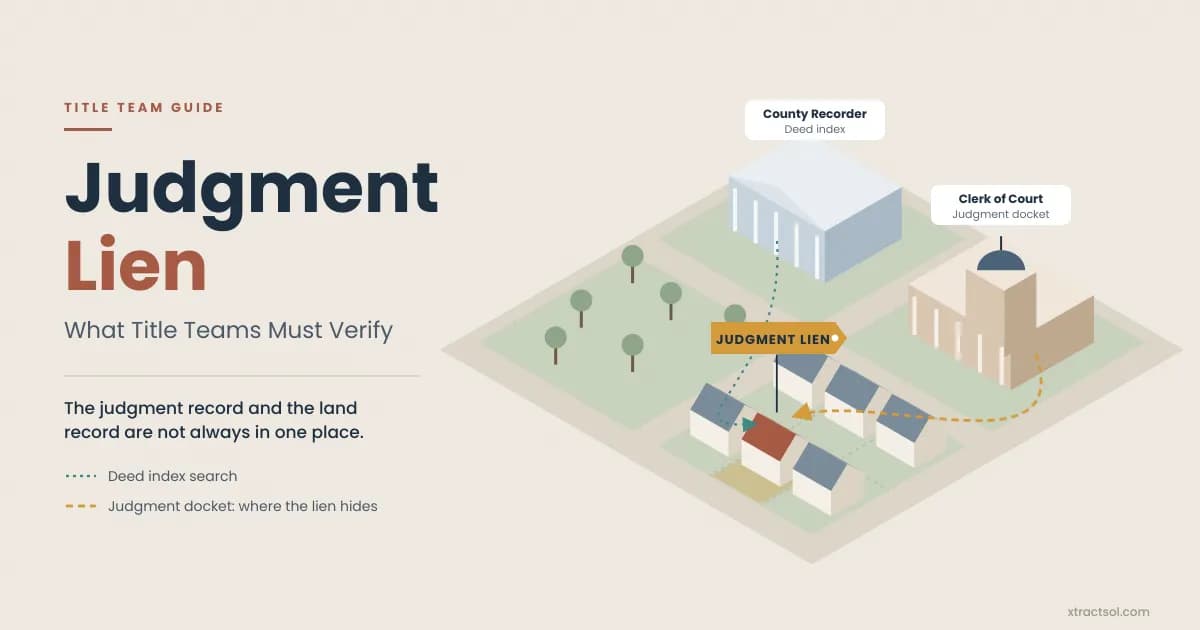
General
Judgment Lien on Real Property: A Title Team Guide
Learn how a judgment lien attaches to real property, how state recording rules and duration work, and how title teams find and resolve liens before closing.
Read more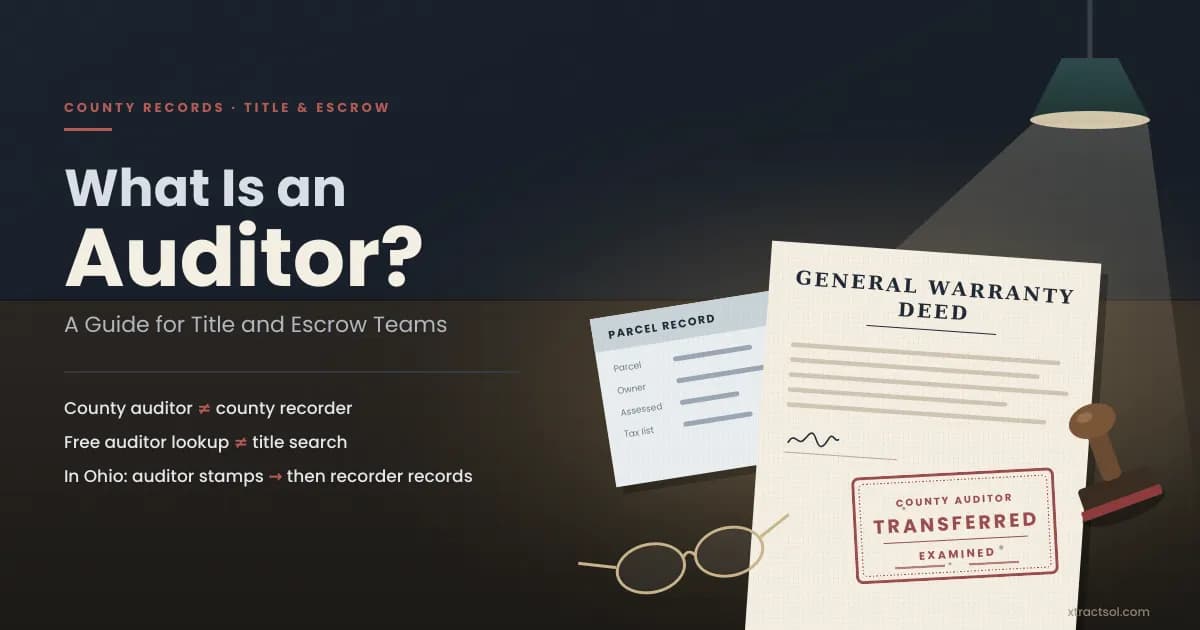
Title Search
What Is an Auditor? A Guide for Title and Escrow Teams
Learn what an auditor is in real estate, how county auditor and recorder duties vary by state and county, and which records a deed needs before recording.
Read more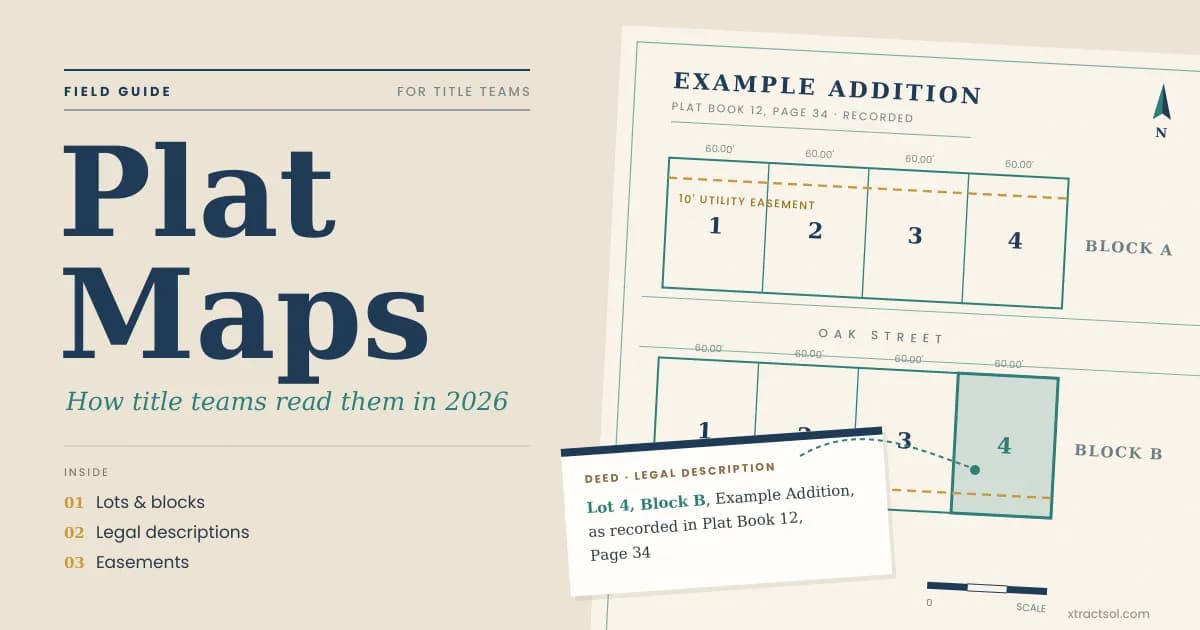
Title Search
Plat Maps Explained: A Guide for Title Teams (2026)
Learn how plat maps define lots, blocks, and easements, and how title teams use recorded plats to support more accurate property searches and commitments.
Read more
Ready to get started?
30 minutes. You walk us through how one file moves from order to closing, and we send a one-page note on the 2-3 steps worth automating first. Nothing to send us.