

What is a Judgment Lien? A Title Workflow Guide
By Usama Muneer, Founder & CEO
• 7 min read • Updated
A judgment lien is a claim that a court judgment places on a debtor's property when a debt goes unpaid, and Cornell's Legal Information Institute says it lasts until the debt is satisfied. For a title team the trouble is timing, since a judgment found late can hold up a closing and shift money at the table. ALTA's workflow analysis says settlement teams resolve liens far more quickly when they identify every lien early in the closing process. The fix is to search the debtor's name early, link each finding to the recorded document, and let the examiner decide what the commitment requires.
Key Takeaways
- A judgment lien is a claim a court judgment places on a debtor's property for an unpaid debt, and it lasts until the debt is satisfied.
- Recording an abstract of judgment in a county places a lien on the debtor's real estate in that county.
- A federal judgment lien runs 20 years and can be renewed once under 28 U.S.C. § 3201, and state judgment liens follow state law.
- The examiner decides what the commitment requires, whether the answer is a payoff and release, a holdback, or a name affidavit.
Table of Contents
- How Does a Judgment Lien Attach to Real Estate?
- Why Does a Judgment Lien Stall a Closing?
- How Do Title Teams Address a Judgment Lien Before Closing?
- How Does Lien Discovery Fit the Search Workflow?
- Implementation & Operational Considerations
- Conclusion
- Frequently Asked Questions
How Does a Judgment Lien Attach to Real Estate?
It starts with an unpaid debt and a lawsuit. The creditor wins, the court enters judgment, and the creditor records an abstract of judgment. Cornell explains that recording the abstract in a county places a lien on any real estate the debtor owns in that county.
The lien is indexed under the debtor's name, not under the label "judgment lien", and which index holds it varies by county. Cornell adds that it takes priority over liens perfected after it but ranks behind liens that existed before the judgment.
A title examiner reads the judgment, the abstract, and the property record together, because the lien binds only property the debtor owns in the county where the abstract is recorded. A lien that names a person with a common name needs extra care before anyone treats it as the seller's.
The table compares three liens a title team meets often.
| Lien | Where it comes from | What to check |
|---|---|---|
| Judgment lien | A court case against the owner | The docket, the abstract, and the amount |
| Property tax lien | A statute, for unpaid taxes | The treasurer or tax collector's records |
| Federal judgment lien | A federal court judgment | The filing date and any renewal |
Why Does a Judgment Lien Stall a Closing?
A recorded judgment can stall a sale because the lender and the title insurer need it addressed before closing. If the creditor recorded in more than one county, the same judgment can sit on several properties. The seller's proceeds may then have to cover a payoff, and the lender will want the requirement shown as satisfied before it funds.
Duration is a second trap. State law sets the period and the renewal rules, so the file's age tells you little. Under 28 U.S.C. § 3201, a federal judgment lien runs 20 years and can be renewed once, by court approval, for another 20. Check the docket rather than the date on the abstract, and note any renewal filed before the first period ended.
A third trap is a name match. Some judgments belong to another person with the seller's name. Our guide to how to find a lien on a property covers the search order and the name variations to try.
How Do Title Teams Address a Judgment Lien Before Closing?
The team addresses the lien by proving it is satisfied, getting a release, or setting money aside at closing. This is title curative work.

Timeline of a closing file: lien found, payoff demand ordered, escrow holdback set, release recorded, and requirement satisfied before policy issuance.
Confirm the lien
Pull the docket and the abstract to confirm the amount, the parties, and the county where the abstract was recorded. Compare the debtor's name and any identifying details with the seller's.
Order a payoff
Order a payoff letter from the creditor or its attorney that states the amount through a set date, so the closing statement shows the right figure.
Pay and record the release
Pay from net proceeds and record the release. Our guide to the release of a lien covers the steps.
Search again
Run a bring-down search and remove the requirement from the commitment once the release is of record.
If the judgment belongs to someone else, a name affidavit can document the mismatch. If a payoff is disputed, an escrow holdback can let the closing go forward.
How Does Lien Discovery Fit the Search Workflow?
Manual lien discovery goes name by name. The examiner searches the seller's name, tries the variations, and reads each record. A judgment found late becomes a curative exception near closing.
Software can gather the records first, so the examiner starts from a list rather than a blank search. It reads the recorded documents, links each finding to its source, and flags a page it cannot read. The examiner reviews every match, compares the debtor's details with the seller's, and decides whether it belongs to the seller. Our post on title defects workflow automation covers where that review sits.

Workflow diagram: record search, agent extraction, examiner review, and commitment preparation, with Found, Flagged, For review, and Reviewed labels.
Implementation & Operational Considerations
Your operations lead pulls recent files and counts how many needed a manual judgment search, then notes where the search stalled. An examiner sets the name variations to try and the counties to search. Each finding keeps a link to the recorded document. The team checks a small first batch against the recorded documents, lists every gap, and reviews gaps and rework on a regular schedule.
For a related workflow, see our case study on smart title commitment intelligence. Our curative and exception management service follows open items the same way.
XtractSol Agents prepare the title search package, every finding linked to the recorded document. The examiner confirms the right documents came back. Examiners make every title decision.
Conclusion
A judgment lien is easy to miss and hard to resolve when found late. A repeatable process searches the debtor's name, confirms the abstract, checks the match, and removes the requirement once a release is of record. As a next step, review your last five files that had a lien and note where it was first found.
See where AI fits in your title workflow.
Book a Free 30-Minute Workflow Review
Frequently Asked Questions
A judgment lien is a court-created claim on a debtor's property for an unpaid debt. Cornell says it lasts until the debt is satisfied or the creditor takes the property.
Recording an abstract places the lien on real estate the debtor owns in that county. A creditor may record in other counties, so the examiner searches each county where the seller owns property.
Not automatically. Under 11 U.S.C. § 522(f), a debtor may avoid a judicial lien to the extent it impairs an exemption, and the statute lists limits. A court order is required, so the examiner looks for it.
About the Author
Usama Muneer, Founder & CEO, XtractSol. Usama writes about title search operations, public records, and practical automation for title and escrow teams.
XtractSol Agents prepare the search package from public records; examiners make every title decision.
See where AI fits in your title workflow.
Stay Updated
Get the latest insights on AI and automation delivered to your inbox.
See where AI fits in your title workflow.
Stay Updated
Get the latest insights on AI and automation delivered to your inbox.
More posts
Product notes, how we build, and what we are learning.
General
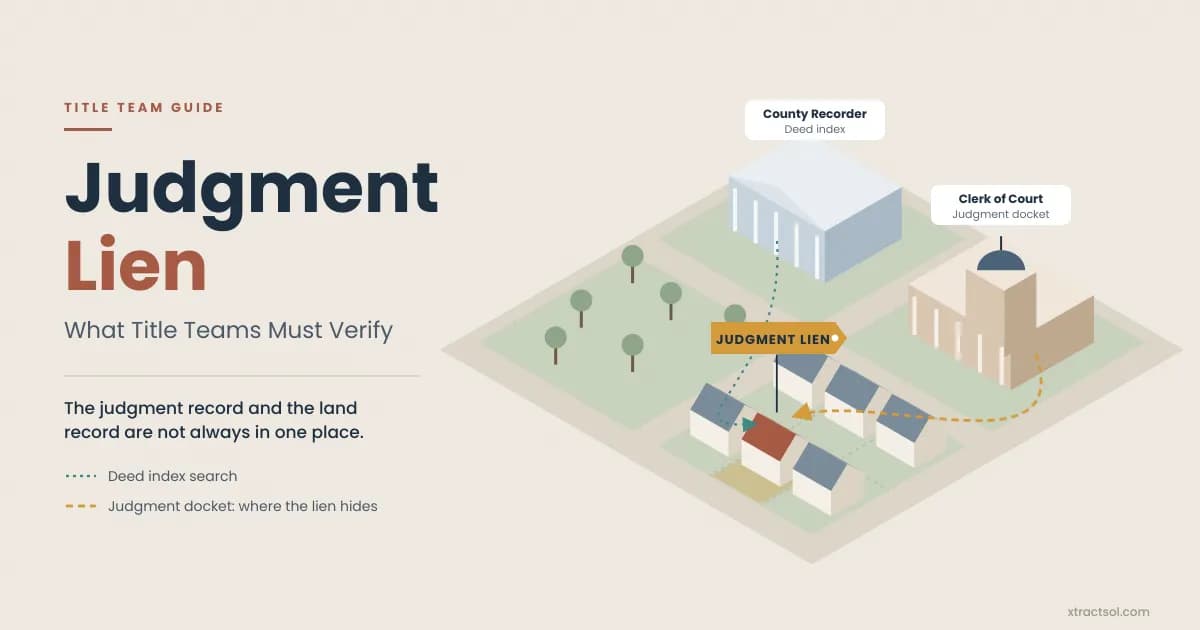
Judgment Lien on Real Property: A Title Team Guide
Learn how a judgment lien attaches to real property, how state recording rules and duration work, and how title teams find and resolve liens before closing.
Read more
Title Search
What Is an Auditor? A Guide for Title and Escrow Teams
Learn what an auditor is in real estate, how county auditor and recorder duties vary by state and county, and which records a deed needs before recording.
Read more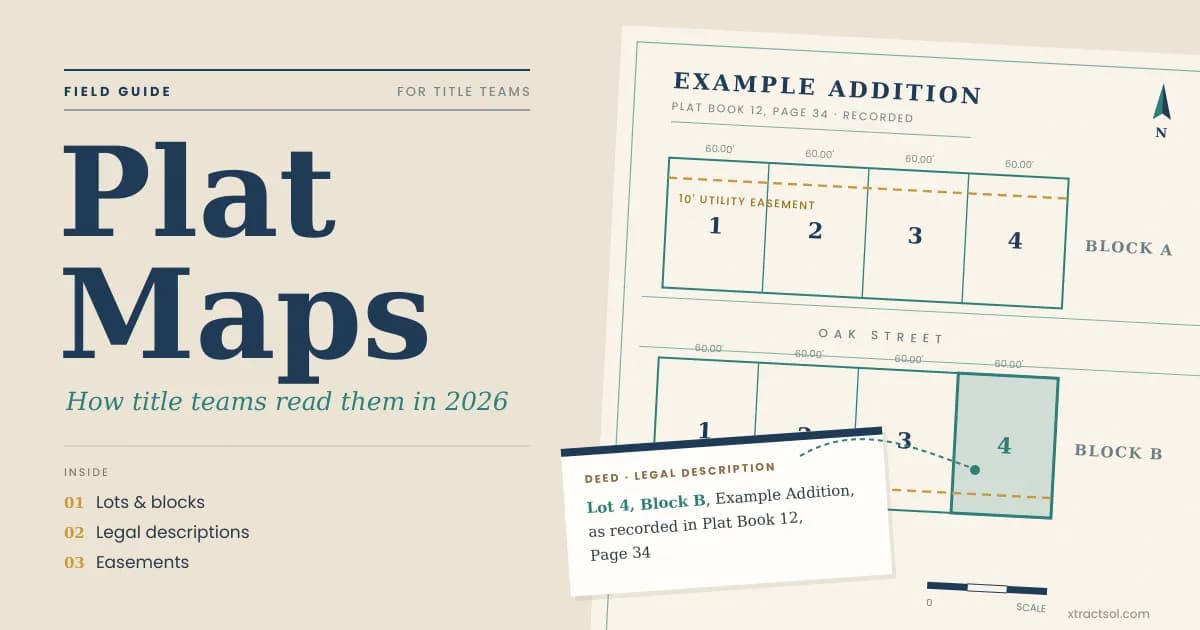
Title Search
Plat Maps Explained: A Guide for Title Teams (2026)
Learn how plat maps define lots, blocks, and easements, and how title teams use recorded plats to support more accurate property searches and commitments.
Read more
Ready to get started?
30 minutes. You walk us through how one file moves from order to closing, and we send a one-page note on the 2-3 steps worth automating first. Nothing to send us.