

Wire Fraud in Real Estate: How AI and Automation Help in 2026
By Usama Muneer, Founder & CEO
• 7 min read • Updated
Wire fraud in real estate happens when a criminal uses email, phone calls, or fake documents to trick someone into sending closing money to the wrong account. A buyer, seller, or lender can lose the funds in one transfer. The old defense was to call the other side and confirm. That still helps, but it fails when staff are busy or when a caller sounds real. ALTA's 2023 Best Practices revision calls for verifying outgoing wires, including multi-factor authentication. The strongest plan adds software that checks changes every time and a person who approves the wire. XtractSol Agents prepare the search package from public records, and the examiner reviews it.
Key Takeaways
- Criminals redirect closing funds by sending fake or changed wire instructions.
- Manual checks fail when they depend on memory, speed, and one person.
- Software can compare changes, raise flags, and keep a record of each check.
- A person must still verify and approve every wire.
How Does Real Estate Wire Fraud Happen?
One common pattern has four steps. First, the criminal gets into an email account that belongs to an agent, closer, buyer, or seller, often through a phishing message. Second, the criminal reads the messages and waits, learning the closing date, the amount, and the names. Third, near funding, the criminal sends new or changed wire instructions that look real. Fourth, once the money is sent, the criminal moves it fast through other accounts, which makes recovery hard. Each step is easy to miss because the messages look like the real thread.
Some attacks never touch the victim's email. In domain spoofing, the criminal creates a look-alike email address. In a man-in-the-middle attack, the criminal steps into a real email thread and changes it along the way.
Criminals may also pose as a seller to redirect the seller's proceeds, or change the account that should receive a mortgage payoff. They can also use AI to write convincing emails or copy a voice, so a message that sounds right is not proof.
The goal is always the same: get real closing money sent to the criminal's account.
Which Types of Wire Fraud Are Most Common?
CertifID's 2026 State of Wire Fraud report splits fraud cases into three main types. The figures below come from its 2025 recovery cases.
| Type | Share of cases | Median loss |
|---|---|---|
| Buyer cash-to-close fraud | 30% | $239,850 |
| Mortgage payoff fraud | 20% | $389,125 |
| Seller net proceeds fraud | 12% | $343,497 |
Buyer cash-to-close fraud is the most common. A criminal poses as the title company and sends the buyer fake instructions. Mortgage payoff fraud has the highest median loss. The money meant to pay off the seller's loan goes to the wrong account. Our guide to the release of a lien explains how examiners confirm a lien is satisfied, including the payoff demand step. Seller net proceeds fraud targets the money the seller should receive after closing.
The same report found that 60% of title professionals said fraud attempts are increasing.
Who bears a loss depends on the facts, state law, the contracts, and insurance. Treat it as a question for your attorney and insurer, not as a given.
Where Do Manual Checks Break Down?
Most title teams already have a rule: confirm wire instructions before money moves. The hard part is making sure the check happens every time. A rule that lives only in someone's memory will fail on the busiest day.
Checks get missed. New instructions often arrive near funding, when staff are busy. People compare account numbers by eye, and a small change is easy to miss. A new account number or payee name does not always raise a flag. Verification may happen late, which leaves little time to look into a strange change. Records can be thin, so it is hard to show who checked what and when. Fraud tools that sit outside the title system add extra steps, and extra steps get skipped. Our guide to title company requirements and compliance follows a closing file step by step and shows where these checks fit.
How Can AI and Automation Help, and Where Do They Fall Short?
The goal is not to automate the wire. It is to automate the checks around it, so every wire gets the same steps. Start with the check that fits your biggest gap.
A secure portal can replace email for collecting instructions. Software can compare new instructions with the details you already trust and flag a changed account number or payee. A change can start a new check automatically, so nobody has to remember. The system can also record who sent the instructions, what changed, which checks ran, and who approved the payment. Higher-risk files can go to a person for a second look. ALTA published Best Practices 5.0 on October 8, 2026, so check what applies to your company.
AI has limits. A voice, face, or document match is one signal, not proof. A criminal with real stolen details may pass some checks. AI cannot decide who is liable, and it cannot recover stolen money, since banks and law enforcement control that. Too many false alarms can also teach staff to ignore alerts, so track them and adjust the rules.
Implementation & Operational Considerations
Your operations lead lists every point where wire instructions enter the file. The team moves collection to a secure method and records the source of each set of instructions. Any new or changed instruction starts a check. A staff member then confirms it through a separate channel, using contact details from the file and not from the message. High-value wires need a second approver, and the person who enters the instructions is never the only approver. Each month the team reviews false alarms and misses, and adjusts the rules.
XtractSol's OCR and intelligent data extraction service reads fields such as names, dates, and amounts from scans and PDFs, links each value to its place on the page, and flags uncertain values for human review. It does not verify identity or approve a wire. Our case study on defensible AI extraction shows why keeping the source with the data matters. For document checks, see our post on document fraud detection.
XtractSol Agents prepare the title search package, every finding linked to the recorded document. The examiner confirms the right documents came back. Examiners make every title decision.
Conclusion
Wire fraud is a process problem that technology can help control. Software can compare changes, raise flags, and record each check, but a person must still verify and approve the wire. As a next step, map every place wire instructions enter your files and ask which ones rely on email alone.
See where AI fits in your title workflow.
Book a Free 30-Minute Workflow Review
Frequently Asked Questions
No. AI can compare details, flag changes, and support checks. It cannot prove a request is real, so high-risk wires still need a person to verify them.
Yes, but not alone. Use a phone number from your own file, not from the message, and add secure collection and automatic change checks.
Mortgage payoffs had the highest median loss in CertifID's 2026 data, and buyer cash-to-close fraud was the most common. Both need strong controls.
Automatic change detection. It compares new wire instructions with details you already trust and flags a changed account number or payee before funds go out.
About the Author
Usama Muneer, Founder & CEO, XtractSol. Usama writes about title search operations, public records, and practical automation for title and escrow teams.
XtractSol Agents prepare the search package from public records; examiners make every title decision.
See where AI fits in your title workflow.
Stay Updated
Get the latest insights on AI and automation delivered to your inbox.
See where AI fits in your title workflow.
Stay Updated
Get the latest insights on AI and automation delivered to your inbox.
More posts
Product notes, how we build, and what we are learning.
General
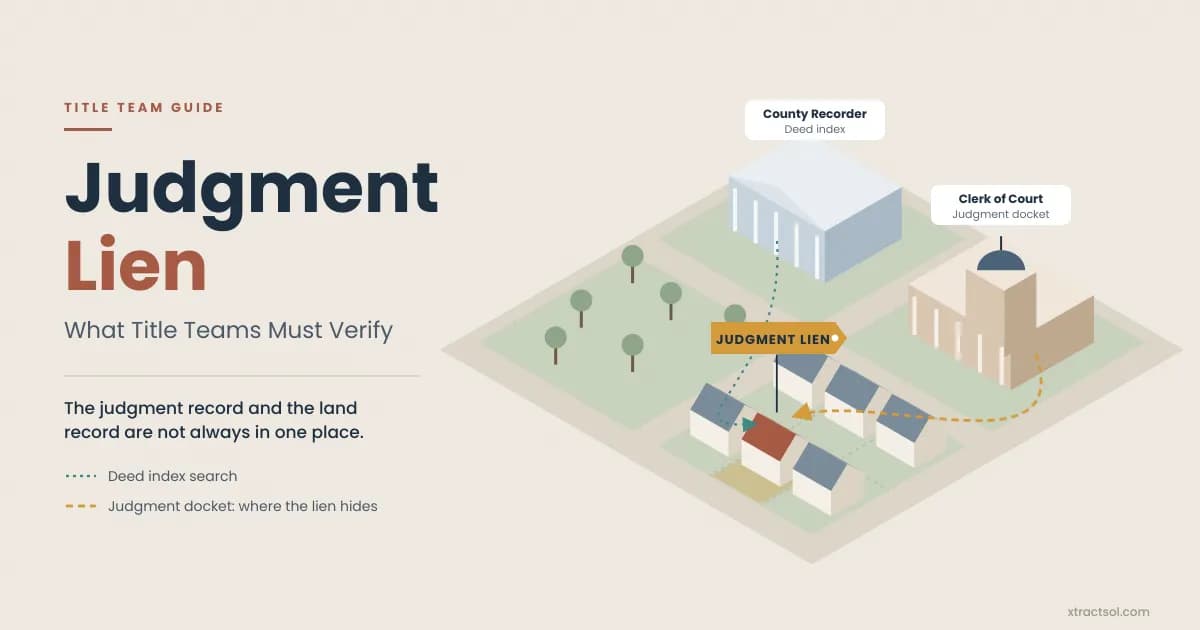
Judgment Lien on Real Property: A Title Team Guide
Learn how a judgment lien attaches to real property, how state recording rules and duration work, and how title teams find and resolve liens before closing.
Read more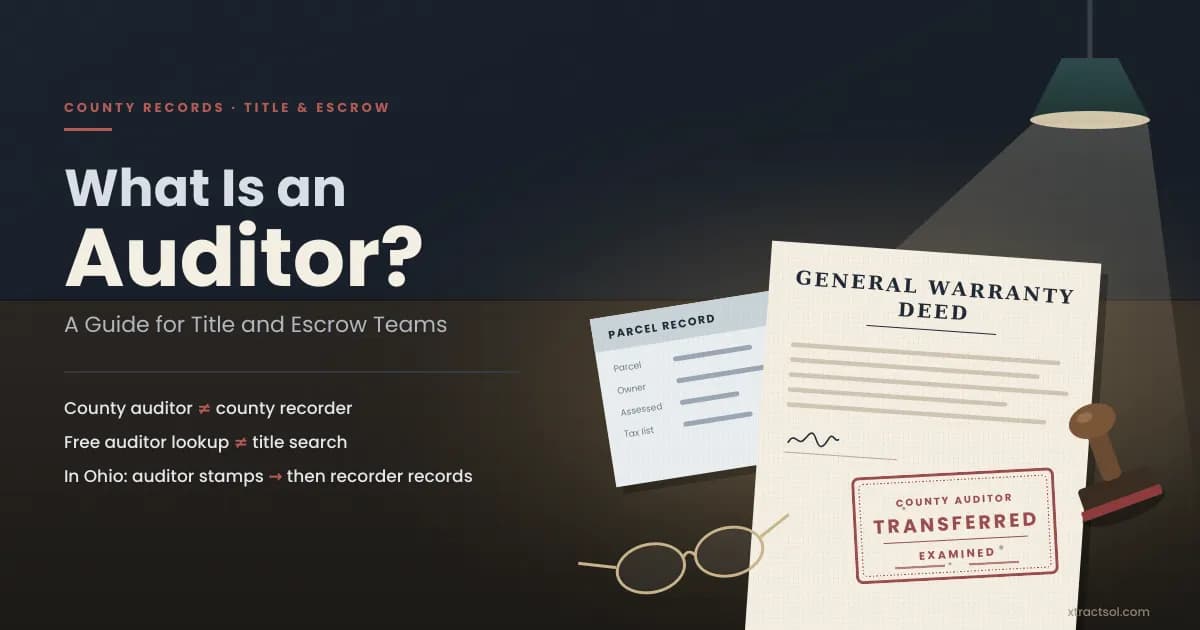
Title Search
What Is an Auditor? A Guide for Title and Escrow Teams
Learn what an auditor is in real estate, how county auditor and recorder duties vary by state and county, and which records a deed needs before recording.
Read more
Title Search
Plat Maps Explained: A Guide for Title Teams (2026)
Learn how plat maps define lots, blocks, and easements, and how title teams use recorded plats to support more accurate property searches and commitments.
Read more
Ready to get started?
30 minutes. You walk us through how one file moves from order to closing, and we send a one-page note on the 2-3 steps worth automating first. Nothing to send us.